
Thailand Business Leaders Urge Proactive Readiness for Environmental Laws
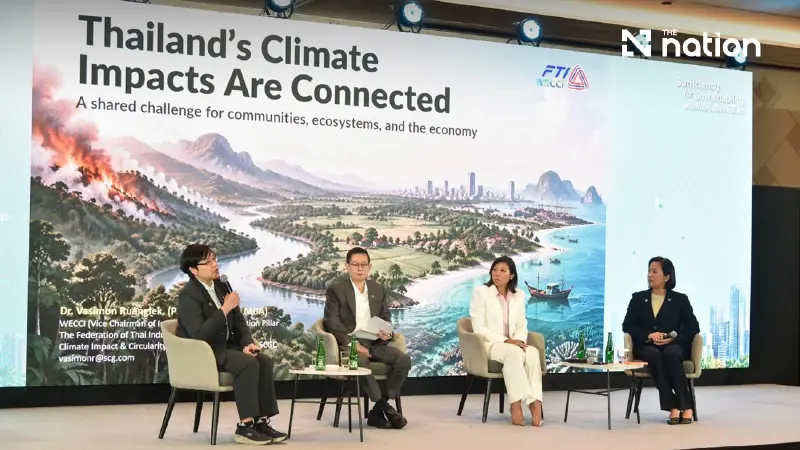


At the SX2026 CSO Forum, industry experts discuss how upcoming climate, clean air, and EPR laws will reshape corporate strategy and resilience
- Thai business leaders are urging companies to shift from reactive compliance to proactive preparation for major upcoming environmental laws, including the Climate Change Act, Clean Air Act, and Extended Producer Responsibility (EPR) framework.
- To prepare for the Climate Change Act, businesses are advised to measure their greenhouse gas inventories and map out carbon reduction plans, including emissions from their supply chains (Scope 3).
- In anticipation of the Clean Air Act, companies are already taking steps like upgrading to emission-reduction technologies and switching from coal to biomass fuel to stay ahead of statutory requirements.
- The upcoming Extended Producer Responsibility (EPR) law will make producers financially accountable for their packaging's lifecycle, requiring them to redesign products for better recyclability and use more recycled content.
At the SX2026 CSO Forum, industry experts discuss how upcoming climate, clean air, and EPR laws will reshape corporate strategy and resilience.
As Thailand prepares to roll out major environmental legislation, including the Climate Change Act, Clean Air Act, and Extended Producer Responsibility (EPR) framework, business leaders must shift from reactive compliance to proactive preparation.
That was the core message delivered during the second session of the Chief Sustainability Officers (CSO) Forum, held on Friday, 13 November 2026, as part of Sustainability Expo 2026 (SX2026) at the Queen Sirikit National Convention Center.
Moderated by Thai Beverage PLC Executive Vice President Tongjai Thanachanan, the panel brought together prominent industry voices to examine how upcoming regulations will affect corporate operations, supply chains, and long-term competitiveness.
Navigating the Climate Change and Clean Air Acts
Dr Vasimon Ruanglek, Climate Impact and Circularity Senior Alliance Manager at SCG Chemicals PLC and Vice Chairman of International and Innovation at the Federation of Thai Industries (FTI), noted that climate change introduces cascading pressures on ecosystems and supply chains, driving up operating costs across all sectors.
To prepare for the forthcoming Climate Change Act, Dr Vasimon advised companies to establish robust greenhouse gas inventories, calculate carbon footprints, and map out reduction trajectories that account for Scope 3 emissions across their supply chains.

While larger conglomerates have already initiated this work, smaller enterprises will require collaborative support to manage data collection and financial burdens. Complementing climate measures, the Clean Air Act aims to curb particulate matter and industrial emissions.
Danaidej Ketsuwan, Chief Financial Officer at SCG Packaging PLC, highlighted that companies are already taking internal steps—such as upgrading to advanced emission-reduction technologies, shifting industrial boilers from coal to agricultural biomass, and managing transport dust—to stay ahead of statutory requirements.
Initiatives such as the Saraburi Sandbox purchase agricultural waste for biomass energy, simultaneously tackling regional burning and reducing corporate reliance on fossil fuels.
Elaborating on this community model, Danaidej explained that his company buys agricultural residues, such as rice husks and straw, from neighbouring farmers to prevent open-field burning.
The biomass is then utilised as fuel in place of fossil fuels, creating a win-win model that delivers cleaner air and economic benefits across three areas near the company’s major complexes.
Addressing broader air quality concerns, Dr Vasimon noted that while the law’s intentions are sound, PM2.5 pollution is also driven by transport and cross-border haze.
She emphasised that any environmental fund must be tied to a clear implementation plan, directing financial resources toward prevention at the source rather than clean-up afterwards.
Puntarika Susuntitapong echoed this sentiment, noting that businesses have actively advocated for the legislation to achieve its aims and want assurance that their financial contributions will tangibly improve air quality.

Embracing Extended Producer Responsibility (EPR)
Turning to waste management, the upcoming EPR framework will introduce mandatory responsibilities for producers regarding packaging life cycles.
Puntarika, who also serves as Vice Chairman of the Thailand Institute of Packaging and Recycling Management for Sustainable Environment (TIPMSE) under the FTI, stressed that businesses must adapt packaging designs to be more recyclable and contain higher recycled content.
While EPR will impose compliance fees based on packaging footprints to support collection and recycling infrastructure, panellists emphasised that early adaptation offers distinct strategic advantages.
Thailand benefits from an existing informal recycling network of junk shops and waste collectors, providing a solid foundation for a more robust circular economy ecosystem.
The EPR framework, which makes producers accountable for the packaging they place on the market, is expected to have a wide-ranging impact.
Puntarika noted it will affect the food and beverage, consumer goods, and retail sectors, as well as the broader recycling industry, signalling a fundamental shift from passive waiting to proactive preparation.
She added that Thai Beverage has prepared for EPR for years, having been a founding member in 2019 of a producer responsibility organisation that served as a sandbox for managing packaging collection and recycling.
Furthermore, TIPMSE announced the establishment of a Thailand Voluntary Producer Responsibility Organisation at SX2026 on Wednesday, providing small and medium-sized enterprises (SMEs)—which are directly affected by international packaging rules—with a platform to learn and test systems.
Although penalties and finer details remain under discussion, the core mechanism will involve EPR fees paid by producers according to the weight and type of packaging, which will fund enhanced collection and recycling infrastructure.
Highlighting international experience, Danaidej cited the UK, where a group company selling packaged goods faces EPR fees but can offset them by collecting used cardboard locally and selling it as raw material for paper-based packaging.
Without such systems, that material would otherwise go to waste.
Attaching financial accountability to producers drives responsible behaviour, encouraging recyclable design, higher recycled content, and simpler mono-material packaging.
Dr Vasimon added that EPR offers the clearest use of funds among the three laws, noting that registration can be vital for trade compliance with the European Union.
While direct penalties are limited, firms that fail to register risk losing market benefits. However, Puntarika cautioned that the greater challenge lies in ensuring packaging is actually recycled, rather than merely recyclable.
While Thailand starts from a stronger position than some neighbours thanks to its informal collection sector, robust data and traceability are essential to connect these players effectively.

Policy Risk and Collaboration
Asked whether Thailand might follow the United States in rolling back environmental regulations, Dr Vasimon argued that such shifts reflect pressures on economic resilience and operational costs.
Nevertheless, she maintained that escalating climate disasters and mounting EU trade pressures will keep the global trajectory unchanged.
She noted that Thailand’s climate law benefits domestic firms by keeping carbon-related funds within the country and boosting competitiveness, provided it is fine-tuned in consultation with the private sector.
Echoing this view, Danaidej stated that preparing for current rules is not merely a defensive shield but vital risk mitigation against future regulation, advising companies to follow customer trends.

Puntarika concluded that if every stakeholder in the value chain recognises the value of their role—from producers redesigning packaging to consumers sorting waste—the legislation will succeed.
When asked for closing advice, the panellists united in calling for deeper cooperation. Dr Vasimon urged the creation of a dedicated platform for joint action, emphasising that change always presents opportunities for those who are prepared.
Puntarika noted that while all industries will be affected differently, leading firms are already moving forward, and businesses should support one another along the journey.
