
Green Finance Shifts from Labels to Evidence and Resilience
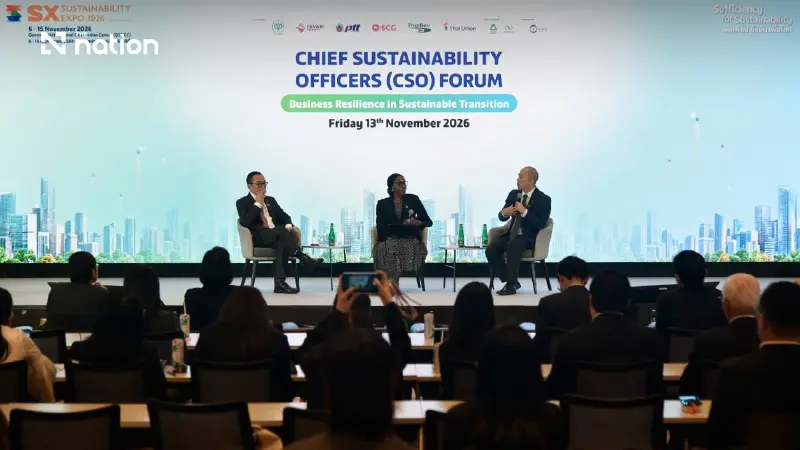


At the SX2026 CSO Forum, financial leaders from MUFG, the IFC and World Bank explore how green finance is adapting to tighter global regulations
- The focus in green finance is shifting from simple "green" labels to a demand for credible data, robust transition plans, and performance-based accountability.
- Financial institutions now require corporate borrowers to provide verifiable data, science-aligned transition plans, and meaningful Key Performance Indicators (KPIs) that are often externally verified.
- This evolution is marked by the rise of financial instruments like sustainability-linked bonds (SLBs) and transition loans, which tie financing terms directly to a company's performance on specific sustainability targets.
- The goal is to ensure companies commit to long-term, resilient structural changes for sustainability, rather than simply seeking competitively priced "green" loans for short-term gains.
At the SX2026 CSO Forum, financial leaders from MUFG, the IFC and World Bank explore how green finance is adapting to tighter global regulations.
As global environmental regulations tighten and economic uncertainties shift capital markets, the green finance landscape is maturing. Rather than relying on simple, standalone green labels, financial institutions are increasingly demanding credible data, robust transition plans, and performance-based accountability.
That was the core consensus during the third panel discussion at the Chief Sustainability Officers (CSO) Forum, held on Friday, 13 November 2026, as part of Sustainability Expo 2026 (SX2026) at the Queen Sirikit National Convention Center.
Moderated by World Bank Senior Country Officer Kwanpadh Suddhi-Dhamakit, the session featured Colin Chen, MUFG Managing Director and Head of Sustainable Finance, and Christina Ongoma, International Finance Corporation (IFC) Country Manager for Thailand.
From Niche Labels to Core Business
Opening the discussion, Colin Chen noted that sustainable finance has evolved significantly over the past five years. While the market initially focused on distinct, labelled green or social transactions, sustainability has now become business as usual.
This evolution is reflected in the rise of alternative financial instruments, such as sustainability-linked bonds (SLBs) and transition loans.
Highlighting a recent milestone, Chen pointed to the Kingdom of Thailand’s groundbreaking 25-billion-baht sustainability-linked bond issued in September 2026—oversubscribed by 2.8 times—which tied its financing terms to greenhouse gas reduction and nature-based Key Performance Indicators (KPIs).

Christina Ongoma echoed this view, emphasising that the International Finance Corporation (IFC) has continually integrated sustainable investing into its core DNA.
While high interest rates since 2022 have made commercial banks more selective, green finance has concentrated heavily on areas banks understand well, such as renewables, green buildings, efficient transport, and blue finance initiatives like water supply security in Thailand’s Eastern Economic Corridor.
The Reality of "Cheap Loans" and Risk Sharing
Addressing a common question from corporate borrowers about whether sustainable finance offers cheaper loans, Chen and Ongoma offered a pragmatic reality check.
"The first thing I learned in business school was that there’s no free lunch," Chen remarked.
While sustainable bonds and loans often experience strong market demand and competitive pricing, commercial banks price facilities based on fair risk, ensuring companies commit to long-term structural changes rather than short-term gains.
From a development finance perspective, Ongoma explained that the IFC maintains strict credit discipline to protect its AAA rating but uses its balance sheet innovatively to "crowd in" private capital.
Through blended finance, structured credit funds, and first-loss or mezzanine tranches, the IFC helps de-risk sustainable investments and mobilise institutional capital into emerging markets.

Requirements for Accessing Sustainable Finance
Providing a roadmap for corporate issuers seeking green or sustainable financing, the panellists outlined key criteria required by modern financial institutions:
• Credible Transition Plans: Net-zero pledges must be backed by science-aligned, actionable strategies.
• Verifiable Data: Leveraging digital and AI tools to measure carbon footprints and track loan-book progress in real time is vital.
• Second-Party Opinions: Independent external verification ensures frameworks meet international standards and Thailand's national taxonomy.
• Meaningful KPIs: Targets must have a legitimate, material impact on the company's operations and sustainability journey.
• Active Engagement: Continuous dialogue between corporate boards, chief sustainability officers, and lenders is essential to maintain transparency.

Bringing MSMEs Along the Supply Chain
A major theme of the forum was ensuring that small and medium-sized enterprises (MSMEs) are not left behind as global supply chains face stricter disclosure rules.
Because Scope 3 emissions tie large corporations directly to their suppliers, financial institutions and multilateral agencies are investing in technological platforms—such as AI-driven disclosure tools and digital supply chain financing—to help smaller businesses report emissions and access preferential rates.
Concluding the session, the panellists urged business leaders not to despair over complex regulations or economic headwinds. By combining public policy foundations, private sector innovation, and long-term strategic vision, Thai companies can successfully navigate the transition toward a low-carbon economy.
