
Eco-cars could be new champion product for Thailand


Play
Manufacturers are seeing great scope for export
Thailand has long relied on its pickup truck industry, which over the years has made the country the world’s second-largest producer.
Thailand is also the largest exporter of 1-ton pickup trucks, with major auto-makers setting up production and export bases in the country.
However, the Thai government, through the Ministry of Industry and the Thai Automotive Institute, has initiated a new programme that would give Thailand another champion product.
The eco-car project would see Thailand becoming a producer and exporter of small and fuel-efficient passenger cars, and today we have seen many of these cars being launched.
Auto companies in Thailand agree that total auto sales in the country will reach 1.1 million units in 2012. This is due to several factors such as the recovery of auto-makers from the flood crisis, the unanswered demand from last year, the Thai government’s First Car Buyer programme as well as the large number of new vehicle launches since late last year, including all-new pickup trucks from Chevrolet, Isuzu, Ford and Mazda, as well as eco-cars from Suzuki and Mitsubishi.
Nissan was the first company to launch the March eco-car in 2010, followed by Honda with the Brio. However, last year’s tsunami in Japan and flooding in Thailand led to Honda producing only 3,000 units of the new model in 2011. Nevertheless Honda is expected to restart its production line later this month, although it will take several months before it could achieve maximum production capacity.
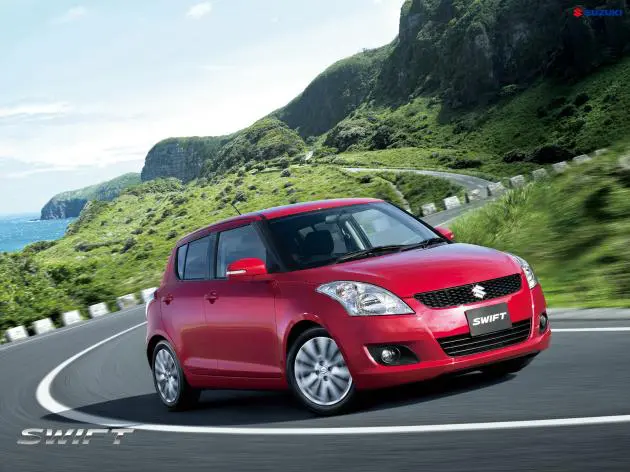
Suzuki Swift coming on strong
Japanese small-car expert Suzuki has invested Bt10 billion in its eco-car programme, with production of the Swift taking place at its new plant in Rayong. Production capacity is claimed at 100,000 units per year, and approximately 50 per cent of production will be exported.
The Swift will be officially launched on March 21, and cars will be ready in showrooms the following day.
The Swift comes with a 1.2-litre engine capable of producing 91 horsepower, and the price is expected to be in the same level as other cars in its segment.
Takayuki Sugiyama, president of Suzuki Motor (Thailand), said that Suzuki believes that demand for eco-cars in Thailand would definitely reach 100,000 units per year.
“Users of 1.5-litre passenger cars will change their behaviour and switch over to eco-cars because they see the higher value and benefits,” he said.
Sugiyama said Suzuki will produce 10,000 units of the Swift this year, which would cater mainly to the domestic market.
“Exports are expected to commence in July to Asean markets. And the reason that we have no plans to export the Swift back to Japan is because we want to do our best in the Thai market first,” he added.
Last year, Suzuki sold 9,600 vehicles in Thailand, up 165 per cent from 2010. This year, sales are expected to reach 15,000 units, with the Swift representing 66 per cent.
Mitsubishi to introduce Mirage
Nobuyuki Murahashi, president of Mitsubishi Motors (Thailand), said the company will launch its eco-car, the Mirage, later this month. Sales are expected to reach 2,000-2,500 units per month, he said.
“Mitsubishi plans to sell about 90,000 vehicles in Thailand this year, and if there are no more negative factors, sales could exceed the target,” he said, adding that eco-car deliveries will commence in May.
The Mirage, made under Mitsubishi’s Global Small Car programme, was first unveiled at the Tokyo Motor Show in December last year.
Retail price in Thailand starts at Bt380,000 and ends at Bt550,000 for the top model.
Nissan still Number 1
Praphat Choeychom, senior vice president for sales and marketing at Nissan Motor (Thailand), said that the increasing number of eco-cars will help push the market to further growth.
“Nissan was the first company to launch the eco-car and had very high market share. However after the launch of other eco-cars, Nissan still expects to dominate the market with 50-per-cent share,” he said.
Combined sales of Nissan eco-cars, consisting of the March and Almera, are 70,000 units, with the March taking up more than 50,000 units.
The Almera was launched in October last year, and although the flood crisis prevented Nissan from delivering vehicles to customers in many areas, more than 12,000 orders have been placed within three months, which is 9,000 more than the company had expected.
“We are trying to rev up production and delivery in order to speed
up the delivery time – we don’t
want the customer to wait more than 2-3 months. The March is still enjoying continued popularity, with average sales of 3,000 units per month and 5,000-6,000 back orders. Customers must also wait 2-3 months,” he said.
