
A refreshing new approach to science


Play
The annual Intel Foundation pre-college research competition aims to inspire students all over the world
Changing the way of learning and teaching science to children is one of the major goals of the Intel Foundation-supported Intel International Science and Engineering Fair (ISEF), the largest pre-college science research competition.
“We believe strongly that one of the problems happening around the world is the way of science is being taught. We teach science as something that is strict, with unrelated facts, and needs to be memorised,” Wendy Hawkins, executive director of the Intel Foundation, Intel Corporation, told international media during the Intel ISEF 2012 held in Pittsburgh, Pennsylvania last month.
But the ISEF is the opposite of all that, she said.
The fair gave students the opportunity to decide what they choose to be interested in, not what the teachers tell them to be interested in, she said.
“These kids are not learning about science. They are practising science and they are scientists,” Hawkins said.
The ability to convert science into real world problems is meaningful. They are making real, concrete contributions to science,” said Hawkins.
“We want to inspire millions of students to participate in this science fair and meet science in a new way,” she said.
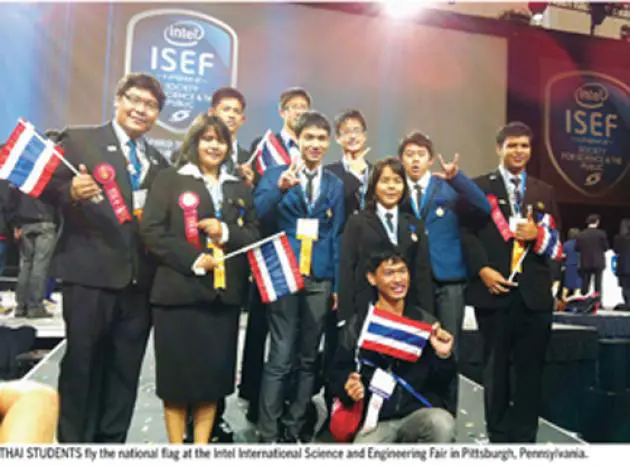
More than 1,600 of the world’s most promising young scientists and innovators from 68 countries took part in the fair this year, including young Thai scientists.
Nine Thai students who submitted five research projects reached the final round of the ISEF. Two of the five projects won second place Grand Awards in the animal sciences category.
Although they failed to win a big prize, they gained a lot in terms of experience from the fair as well as their thinking about studying science has also changed.
“What I learnt from the ISEF is that science is very important. They pay more attention to science because science students are people who are going to change and develop the world. It will also drive us to help develop our country and the world,” Jatuporn Chaweekpak, one of the winners of a team from Suratpittaya School in Surat Thani that won a second place for its project entitled “effects of Siamese snail on natural rubber coagulation”, said.
At the ISEF, they did not teach us to memorise what was written in the textbook but to think and see things in another way, he said.
“Science is not right or wrong. It’s about how you look at the things and whether you have reasons to support your thought or not. It makes us have a more reasonable point of view,” Jatuporn said.
He said he gained many experiences from the fair as well as friends from all over the world. It was a good opportunity to observe many projects by students all over the world.
“I’m very impressed. They did a good job. Some of the projects inspired me for my researches in the future,” he said.
Kitthanaet Thanaroungrochthawee from Kanthararom School in Si Sa Ket, the second-place winner for the project entitled “effect of food types on quantity and nutritional quality of weaver ant larvae”, said the fair changed his views on learning science. He thought science projects in Thailand were not developed as much as other projects in the world.
At the fair, there were many big and potential projects that would benefit the world, said the Si Sa Ket born, who is going to study pharmaceutical sciences at Ubon Ratchathani University in the upcoming semester.
“I think we don’t have new technologies enough to equal the international projects. The projects of high-school students I saw at the fair are like the thesis of teachers in our country. I’m curious why they can do that and why we cannot,” he said.
Varot Pakavatsoontorn, who attended the fair with a research project entitled “Untangling Theta Graphs with Modified Gauss Codes”, said it was exciting to see a lot of projects selected from the best researches from all over the world.
“They [students] started studying their researches without knowing about the topic before. I thought international students are determined when it comes to study and they play when they are not working,” he said.
The Mattayom 6 student from Trium Udom Suksa said what he had learnt from the ISEF was that if you are determined and continue with your goals you will accomplish it one day.
“Moreover, we should clearly understand what we are doing because we are the only person to know best about what we study,” he said.
Karn Imwattana, who will study at Chulalongkorn University’s Faculty of Science in the upcoming semester and Varot’s team partner, was impressed with the ISEF.
“I met many new friends. Several of their ideas are amazing that I could never have imagined before. They are very wonderful. I see many new things here and they inspire me so much to develop my projects in the future,” he said.
Accharas Ouysinprasert, country manager, Intel Thailand, said Intel supported the ISEF because they knew that maths and science were imperative to future global growth.
“This competition encourages millions of students to engage their skills for innovation and develop promising solutions for global challenges,” Accharas said.
SIDEBAR
Award winners at the ISEF
Jack Andraka, 15, of Crownsville, US, was awarded first place for his new method to detect pancreatic cancer at this year’s Intel International Science and Engineering Fair (ISEF), a programme of the Society for Science & the Public.
Based on a diabetic test paper, Jack created a simple dip-stick sensor to test blood or urine to determine whether or not a patient has early-stage pancreatic cancer. His study resulted in over 90 per cent accuracy and showed his patent-pending sensor to be 28 times faster, 28 times less expensive and over 100 times more sensitive than current tests. Jack received the Gordon E Moore Award, named in honour of Intel co-founder and retired chairman and CEO, of US$75,000 (Bt2.25 million).
Two students, Nicholas Schiefer, 17, of Pickering, Ontario, Canada and Ari Dyckovsky, 18, of Leesburg, Virginia, US, each received the Intel Foundation Young Scientist Award of $50,000.
Nicholas studied what he calls “microsearch”, or the ability to search the fastest-growing information medium: small amounts of content, such as tweets and Facebook status updates. Through his research, Nicholas hopes to improve search engines’ capabilities, which will in turn improve access to information.
Ari investigated the science of quantum teleportation. He found that once atoms are linked through a process called “entanglement”, information from one atom will just appear in another atom when the quantum state of the first atom is destroyed. Using this method, organisations requiring high levels of data security, such as the National Security Administration, can send an encrypted message without running the risk of interception because the information will not travel to its new location; it would simply appear there.
From Thailand, the team of Jatuporn Chaweepak, Nattapong Chinnara and Nantakan Longlod from Suratpittaya School in Surat Thani were awarded second place in the animal sciences category and awarded $1,500 for their project entitled “effects of Siamese snail on natural rubber coagulation”.
Kitthanaet Thanaroungrochthawee from Kanthararom School, Si Sa Ket, also won a second place grand award in the animal sciences category and was awarded $1,500 for his project entitled “effect of food types on quantity and nutritional quality of weaver ant larvae”.
