
New Camry - fun and highly sporty
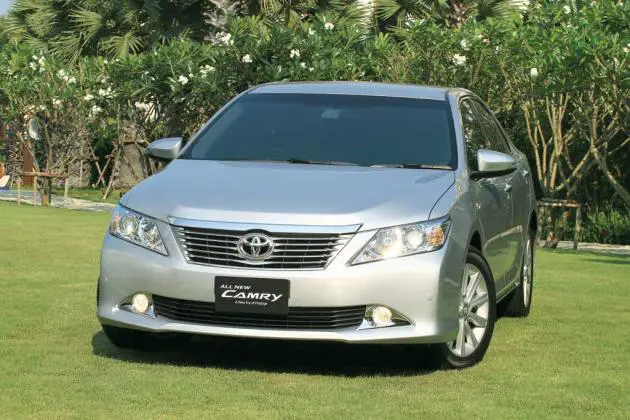


Play
Toyota's midsized sedan, which boasts comfort, safety and great road manners, is bound to leave many a customer smiling
The Toyota Camry has been the best-selling Japanese midsized sedan for a considerable period of time.
Previous models boasted a large, comfortable interior, a good level of safety and lots of comfort features.
But they weren’t fun to drive.
Well, this time around, Toyota has made sure that the new Camry surprises many with its character change. This is the seventh-generation Camry globally (5th for the Thai market).
Apart from the sharper exterior styling, the new Camry comes with a highly sporty performance that’s going to put a smile on the faces of many Toyota customers.
There are five variants to choose from – 3 are 2.5-litre hybrid models, while the other two are the 2.5G (featured this week) and the 2.0G.
The overall design of the new Camry is tidier than its predecessor both in front and at the rear. Toyota says that the aerodynamic fin helps lower drag and wind noise during high-speed driving, as well as road dynamics. In addition, the low wind resistance also results in improved fuel economy.
The interior is spacious and comfortable, featuring eight-way adjustable powered front seats (with lumbar support) in front, a multi-function steering wheel, automatic climate control, a DVD entertainment system, and more.
The new Camry gets an all-new 2.5-litre engine that replaces the old 2.4-litre block.
The 4-cylinder DOHC 16-valve Dual VVT-i engine is capable of pumping out as much as 181hp (up from 167 in the previous model) at 6,000rpm and 231Nm of torque at 4,100rpm.
A new 6-speed automatic transmission replaces the old 5-speed box, and features a manual shift function. Besides the smoother and more accurate shifting, the new gearbox comes with its own electronic control unit (ECU) that is linked to the car’s main ECU for extra precision.
The engine and gearbox team up to offer the new Camry a dramatically improved performance over its predecessor. Apart from the 10-per-cent increase in engine output, Toyota also claims a 24-per-cent improvement in fuel economy.
The 2.5G (as well as the hybrid models) gets 17-inch alloy wheels with 215/55 R17 tyres offering lots of grip, although those who want more comfort would be better off with the 215/60 tyres offered in the 2.0G model.
Acceleration is swift while handling is much tidier. In fact, the front strut and rear dual-link suspension has been tuned for sporty driving. There is plenty of grip and little body roll, but there’s a trade-off as the suspension is also less forgiving when the car is travelling over poorly maintained roads.
The brakes – discs all around with ABS, EBD and Brake Assist – have also been improved, offering a crisper bite and shorter stopping distance.
Safety features include dual front SRS airbags, side airbags and WIL (Whiplash Injury Lessening) system.
Cruise control and Bluetooth come as standard in the 2.5G with as many as five mobile phones with a 1,000-number storing capacity.
I got to admit that despite the rather straightforward design, the new Camry comes as a surprise with its highly entertaining performance.
A clear problem that would emerge is which powertrain to choose – 2.0, 2.5 or the 2.5 hybrid.
TOYOTA CAMRY 2.5G SPECIFICATIONS
Engine: 4-cylinder DOHC
16-valve VVT-i
Displacement: 2,494cc
Bore and stroke: 90x98
Compression ratio: 10.4:1
Max power: 181ps/6,000rpm
Max torque: 231Nm/4,100rpm
Transmission: 6-speed automatic
Ratios: 3.300/1.900/1.420/1.000/0.713/0.608
Suspension (f/r): McPherson strut, stabiliser/dual-link
Steering: powered rack and pinion
Turning circle: 11.0 metres
Brakes (f/r): vented discs/discs
Dimensions (mm)
Length: 4,825
Width: 1,825
Height: 1,470
Wheelbase: 2,775
Track (f/r): 1,575/1,560
Weight (kgs): 1,470
Wheels: 17-in alloy
Tyres: 215/55 R17
Fuel tank capacity: 70 litres
Price: Bt1.499 million
Distributor: Toyota Motor Thailand
