
Kaspersky offers new generation solution for corporates


Play
Company aims to be the leader in IT security marketing in the corporate sector
Kaspersky Lab unveiled its new generation of business security solutions at the Kaspersky Cyber-Security Summit 2013 held last week in New York.
Kaspersky Endpoint Security for Business is the company’s new flagship security platform for businesses, and was built to provide industry protection from advanced malware and cyber-crime. The solution is designed to help businesses overcome the latest challenges in managing a secure, efficient network.
Kaspersky Lab’s chief executive officer and co-founder Eugene Kaspersky said that the new-generation solution is the first security platform offering a critical combination of protection, efficiency and seamless manageability for businesses.
He added that cyber-espionage is becoming the most serious threat for businesses, and just about any enterprise could be attacked, regardless of its size or market share. All organisations have data that are valuable to cyber-criminals, which in turn can be used as “back stairs” to reach other companies. An intrusion may come either from a cyber-criminal seeking personal enrichment, or a nation state looking to steal proprietary or classified information. Every decision-maker should keep all this in mind when building a company’s IT security infrastructure.”
“We’ve entered the age of high-profile targeted attacks, with espionage tools becoming more and more widespread,” said Eugene.
According to a study conducted by B2B International, 50 per cent of IT managers consider cyber-crime one of the three most pressing problems for their companies. Cyber-threats are No 2 on the list of key business risks, behind economic uncertainty.
The current trend is for cyber-criminals to target both the corporate and personal devices of company employees. Hence protecting PCs, laptops and also mobile devices used for company business is becoming a high-priority task for corporate IT services.
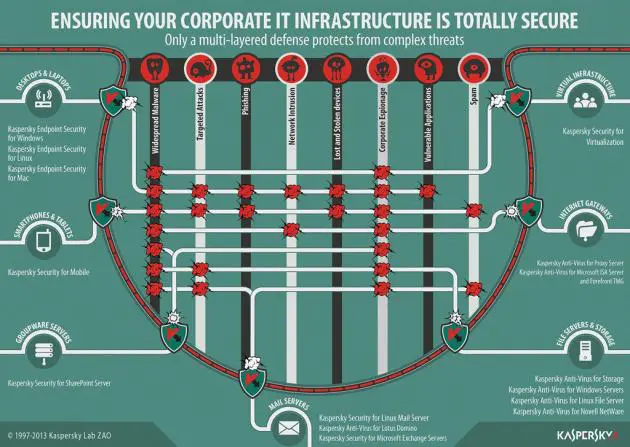
The protection of endpoints, then, becomes the cornerstone of corporate IT security. Kaspersky Endpoint Security for Business, the latest Kaspersky Lab offering, is designed to protect the corporate IT infrastructure.
The new challenges of organised cyber-crime and a boom in employee-owned devices have made protecting business data tougher than ever. To simplify and secure business of all sizes, the Kaspersky solution comes with a number of new and improved technologies that allow IT administrators to see, control, and protect their network, said Petr Merkulov, chief product officer at Kaspersky Lab.
“The three approaches – see-control-protect – are offered in the Kaspersky Endpoint Security for business,” said Merkulov.
For example, mobile endpoint protection can be deployed remotely through centralised Mobile Device Management (MDM). It lets administrators secure and protect data, even on employees’ own smart phones and tablets. And, its new encryption technology can also be enforced on peripheral devices, removable drives, files, and folders, and is transparent to users and applications while rendering data unreadable to cyber-criminals.
Moreover, the security solution is designed to control application usage through policies and dynamic white-listing. Administrators can also create custom policies around removable storage devices, USB storage devices and printers, and creating on-device Web policies ensure users browse the Internet safely whether on the corporate network or at home. And, its new systems configuration, deployment and management tools included makes time-consuming IT tasks both faster and less complex.
All managed from Kaspersky Lab’s Security Centre, the powerful administrative console unifies every aspect of Kaspersky Lab’s endpoint, file server and virtual infrastructure protection under one “pane of glass”.
Kaspersky Lab’s chief marketing officer Alexander Erofeev said the company aims to be the leader in IT security marketing in the corporate sector. The corporate market contributes about 35 to 40 per cent of the company’s total revenue.
“IT security has now become a critical issue and of concern for all organizations, small and medium enterprises to large corporates. The critical sectors are financial, banking, transportation, and public sectors,” said Erofeev.
He added that three big problems for IT security include mobile devices and big data and together with cloud and social network.
Kaspersky Lab’s senior director for product marketing, Peter Beardmore, said that Kaspersky Endpoint Security for Business is the flagship product in the corporate market, which is the focus of Kaspersky. The company plans to debut the online campaigns to promote this product around the world over the next 12 months.
“The online campaign will be localised and customised according to the regions. This includes online advertisements. We have allocated about 50 per cent of the total marketing budget for marketing this flagship product,” said Beardmore.
He added that Kaspersky always spends more than 50 per cent of total operating budget on research and development, compared to most companies in IT sector who spend about 25 to 30 per cent on R&D.
“We have more than 25,000 employees; over 50 per cent are engineers and researchers,” said Beardmore.
He said the overall market for IT security in the corporate side is growing more than 5-10 per cent every year, but the workload of the IT security department in corporates is more than that. The corporates are looking for ways to be more efficient and cost effective.
Kaspersky’s security forecast for 2013
1 Targeted attacks and cyber-espionage:
Targeted attacks have become an established feature in the last two years. The growth of cyber-espionage will continue in 2013 and beyond. Any organisation can become a victim. All organisations hold data that is of value to cyber-criminals; and they may also be used as “stepping stones” to reach other companies.
2 The onward march of “hacktivism”:
The purpose of an attack is to make a political or social point. There was a steady stream of such attacks this year. Society’s increasing reliance on the Internet makes organisations of all kinds potentially vulnerable to attacks of this sort, so ‘hacktivism’ looks set to continue into 2013 and beyond.
3 State-sponsored cyber-attacks:
The world is now entering an era of cold “cyber-war”, where nations have the ability to fight each other, unconstrained by the limitations of conventional real-world warfare. It is expected that more countries will develop cyber-weapons designed to steal information or sabotage systems. The targets for such cyber-attacks could include energy supply and transportation control facilities, financial and telecommunications systems and other “critical infrastructure” facilities.
4 The use of legal surveillance tools:
In recent years, cyber-crime has become more and more sophisticated. This has not only created new challenges for anti-malware researchers, but also for law enforcement agencies around the world. The use of legal surveillance tools has wider implications for privacy and civil liberties. And as law enforcement agencies, and governments, try to get one step ahead of the criminals, it’s likely that the use of such tools and the debate surrounding their use will continue.
5 Cloudy with a chance of malware
It is clear that the use of cloud services will grow in the coming years. As the use of the cloud grows, so will the number of security threats that target it. The wide use of mobile devices also increases the risk that cloud data can be accessed from devices that may not be as secure as traditional endpoint devices. When the same device is used for both personal and business tasks, the risk increases even more.
6 Dude, where’s my privacy?
Many people routinely bank, shop and socialise online. Every time they sign up for an online account, they are required to disclose information about themselves and companies around the world actively gather information about their customers. The threat to privacy takes two forms. The value of personal data to cyber-criminals and legitimate businesses will only grow in the future, and with it the potential threat to our privacy increases.
7 Who do you trust?
The use of fake, and stolen certificates is set to continue in the future. The malware might be signed, using a stolen certificate: if the white-list application automatically trusts software signed by that organisation, the infected program might also be trusted. Or cyber-criminals (or someone inside a company) may gain access to the directory, or database, holding the white-list and add their malware to the list. A trusted insider whether in the real world or the digital world is always well placed to undermine security.
8 Cyber extortion:
This year will see growing numbers of ransomware Trojans designed to extort money from their victims, either by encrypting data on the disk or by blocking access to the system.
9 Mac OS malware:
The threat to Macs is real and is likely keep growing. It has been growing steadily over the last two years. It’s not only generalised attacks – such as the 700,000-strong Flashfake botnet that pose a threat. It has seen targeted attacks on specific groups, or individuals, known to use Macs.
10 Mobile malware:
Mobile malware has exploded in the last 18 months. To date, most malware has been designed to get access to the device. In the future, it is likely to see the use of vulnerabilities that target the operating system and, based on this, the development of “drive-by downloads”.
11 Vulnerabilities and exploits:
One of the key methods used by cyber-criminals to install malware on victims’ computers is to exploit unpatched vulnerabilities in applications. This relies on the existence of vulnerabilities and the failure of individuals or businesses to patch their applications.
