
Lexus in Texas: test-driving the new model


Play
The latest IS 250 luxury compact car comes with bold design, quality materials and improved handling
Lexus, Toyota’s luxury division, has launched its new IS 250 luxury compact car, which is making its public debut today at the Bangkok International Motor Show.
Having just driven the new IS here in Austin at a global test-drive event staged by Lexus, I came away with a positive feeling that it would be a successful model in the Thai luxury compact car market as it locks horns with such major players as the BMW 3 Series and Mercedes-Benz C-Class.
Well, the strongest attraction of the new IS would have to be its bold design and improved handling, along with the usual Lexus package that includes excellent quality and materials. The car also comes with 12 Lexus firsts and innovations, although some major components have been carried over from the previous model.
In developing the new IS, Lexus engineers strived to raise the level of driving enjoyment further, with major improvements in the suspension as well as body rigidity, the latter being improved by 20 per cent thanks to laser-screw welding and body-adhesive technology, along with additional spot welding in critical areas. The body shell is 10kgs lighter, due to the use of hot stamped and high-tensile steel sheets, as well as aluminium.
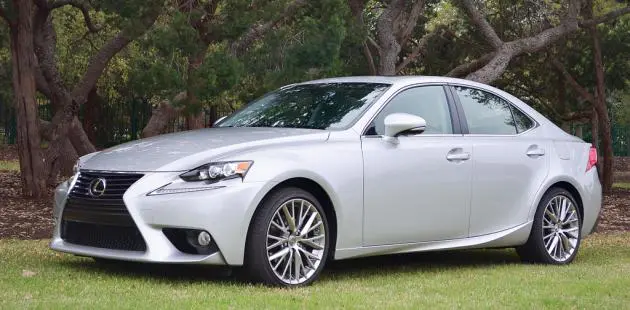
In terms of design, the new IS is a killer: there’s the aggressive spindle-grille design at the front and the rising crease line flowing from the lower body through the rear wheel arch and into the rear lamp clusters that gives the car a highly dynamic appearance.
The new model is 75mm longer and 10mm wider than its predecessor, while the wheelbase has been increased by as much as 70mm to improve high-speed stability and interior space.
While the front suspension geometry has been revised resulting in 20-per-cent increase in stiffness and reduction in cornering roll, the rear multi-link suspension has been adopted from the GS model. In this case the shocks and springs have been separated, aiming to improve shock-absorber efficiency and enhancing ride comfort.
The steering has also undergone major improvements: it delivers a more direct feel with increased road feedback than the previous model. However, there is considerable assistance and you won’t get as much beefiness as in a BMW 3 Series, the segment’s benchmark in terms of driving enjoyment.
Brakes have also been improved, with 296mm and 290mm discs front and rear, plus new lightweight aluminium alloy brake calipers at the rear.
The engine of the new IS 250 has been carried over from the previous model, something that has become a pattern with Toyota and Lexus vehicles these days. The LS460, which went through a major change last year, didn’t get a new engine despite being in the market for a considerable period of time, and even the new Toyota Vios, which is being shown at the Bangkok Motor Show, comes with an old engine.
The 2.5-litre V6 in the IS 250 has gone through several weight reductions, yet a small amount of power and torque has been lost as well. It now produces 207hp and 252Nm (compared to 212hp and 260Nm), and is mated to a close-ratio 6-speed automatic with quicker shifts, earlier torque converter lock-up and downshift throttle blips. Nevertheless, acceleration from 0-100km/h is quicker at 8.1 seconds (compared to 8.4 seconds in the previous model), and top speed is up by a click to 225km/h.
Lexus says the new IS was not developed to produce better performance figures but instead to offer increased driving enjoyment – handling, response and feedback. After driving both on the circuit and on public roads, I agree.
For example, in the F SPORT version, there’s an intake sound generator that produces a nice throaty sound that adds to the enjoyment.
But the biggest question anyone would ask is whether the IS can challenge its German rivals in terms of driving characteristics. On the circuit it suffered from a good amount of understeer compared with a 3 Series, while high-rev downshifts weren’t as willing as in the Beemer.
But if you’re not madly driving pedal-to-the-floor at full speed all the time, the gap starts to narrow. The steering of the IS feels great in your hands (compared to the thick 3 Series steering), and ride comfort is excellent.
Personally, I wouldn’t buy an IS if I was looking for a car with the best handling in this segment, which still goes to the 3 Series. But as far as the design and the overall package are concerned, the IS certainly has what it takes to win a slice of the market.
Lexus IS 250
Engine: 24-valve V6 direct-injection
Displacement: 2,499cc
Bore and stroke: 83x77mm
Compression ratio: 12.0:1
Max power: 207hp/6,400rpm
Max torque: 252Nm/4,800rpm
Transmission: 6-speed automatic
Ratios: 3.538/2.060/1.404/1.000/0.713/0.582
Suspension (f/r): double wishbone, coil spring, stabiliser/multi-link, coil spring, stabiliser
Steering: powered rack-and-pinion
Min turn: 10.4 metres
Brakes (f/r): vented discs/solid discs with ABS, EBD, BA
Fuel economy (litres/100km):
City: 12.4
Highway: 7.3
Combined: 9.2
Performance:
0-100km/h: 8.1 secs
Top speed: 225km/h
Dimensions (mm)
Length: 4,665
Width: 1,810
Height: 1,430
Wheelbase: 2,800
Track (f/r): 1,535/1,550
Wheels: 17-inch alloys
Tyres: 225/45R17
Min clearance: 135mm
Weight: 1,555-1,645kgs
Fuel tank capacity: 66 litres
Distributor: Toyota Motor Thailand
Local model features F SPORT
In Thailand, Lexus is offering the IS 250 that comes with the awesome-looking F SPORT package (dynamic front styling, LED fog lamps, 18-inch wheels, sports suspension, an LFA-style driver’s meter and sports seats) priced at Bt3.99 million, and the IS 300h in two trim levels priced at Bt2.99 million and Bt3.49 million, respectively. The IS 250 F SPORT is targeted at previous IS owners, while Lexus hopes that the 300h will help draw in new customers looking for excellent fuel economy and eco-friendliness in the IS range.
