
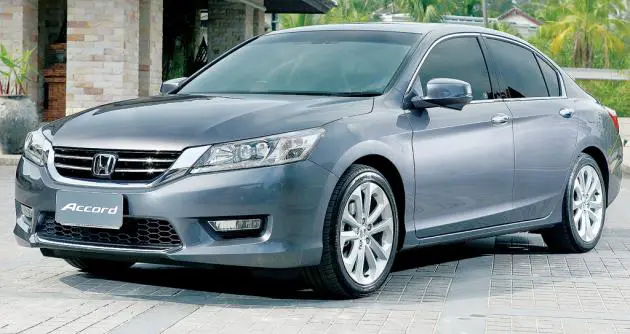
New Accord: Quiet with improved handling


Play
This Honda is stuffed with innovative features, but a new, more powerful engine would have been appreciated
After the massive flood in late 2011 badly damaged both Honda assembly plants in Ayutthaya, everyone felt sorry for the Japanese auto-maker as production came to an abrupt halt for several months.
But the plants were up and running again in April, and Honda did what industry experts did not expect. The company launched 10 new models (three imported) last year and registered its highest sales ever in Thailand, claiming higher monthly passenger car sales figures than even arch rival Toyota, the all-time leader.
Well, it’s 2013 and the flow of new models from Honda hasn’t ceased, with the Civic Hybrid and the new Accord being introduced in the first quarter.
I got behind the wheel of the Accord last week when distributor Honda Automobile Thailand staged a test-drive event down in scenic Phang Nga. The route wasn’t too long (approximately 200 km and shared by two test drivers), but it did include a good portion of long straights as well as curvy mountain roads that made my job easier in checking out the dynamic improvements in the new model.
Compared with the previous version, handling in the new Accord is significantly improved even at low speeds – the steering (now electrically powered) is sharper and beefier thanks to the improved steering ratio as well as the thicker rack.
The front double wishbone suspension has been replaced with McPherson struts, while the rear suspension is multi-link and provides a more refined ride quality than the previous generation Accord. Cornering performance has also been improved thanks to the stabilisers both at the front and the rear, and a much more rigid bodyshell.
But what you will notice more easily in the new Accord is the quietness in the cabin. Thanks to various sound-absorption measures as well as electronics such as the ANC (Active Noise Control) system, the interior sound level of this Accord is dramatically lower.
The front seats (both are electrically powered) are supportive (lots of lateral support on the abdomen), and the rear passengers get plenty of space (after all it’s an executive car). The rear trunk is large enough to fit four golf bags.
At the rear, passengers also get air vents and window/windshield sunblinds, along with trunk access and control buttons for the front passenger seat in order to increase or decrease available rear legroom.
In developing the new Accord, one of the benchmarks used by Honda engineers was the BMW 5 Series. So it isn’t surprising to see several similarities between the two, such as the “Hofmeister kink” on the rear C-pillar, the general shape of the vehicle, and even the veneer design.
And in order to become a true “Japanese Beemer”, the Accord also had to come with a large number of innovative features.
The top 2.4 TECH model features the CMBA (Collision Mitigation Brake System) that alerts the driver of an imminent front-end collision, and the Honda LaneWatch Blind Spot Display for an enhanced view of the passenger-side roadway. Strangely though, it is not offered on the driver’s side as in other car brands.
Personally, I wouldn’t mind ditching these two systems. Of course, they have their benefits, but if you are careful enough behind the wheel, they start to become annoying. It’s like driving with a front passenger who repeatedly tries to tell you what you already know.
For example: “Watch out for the big truck on the left!” Whoa! “There’s a motorcycle on the right!” and “Be careful of the pedestrians”!
I would of course respond: “Calm down buddy. I can see everything that you see because I am sitting right next to you.”
There are also Active Cornering Lights and Daytime Running Lights, dual front airbags, i-Side airbags, side curtain airbags, Hill Start Assist (HSA), ACC (Adaptive Cruise Control), and more.
Innovative onboard electronics include a bright, full-colour 20cm (diagonal) intelligent Multi-Information Display (i-MID) and navigation system. With the Smart Interface, drivers can control the audio system and the Bluetooth Hands-Free Telephone interface using the On-demand Touch Panel. There’s also 16GB of storage available for songs and pictures, so you can even save your own wallpaper, perhaps a family portrait, on the screen.
The engine and 5-speed transmission of the new Accord has been relayed from the previous model, although the 2.4-litre power plant gets numerous “Earth Dream” improvements. However, there isn’t any improvement in performance here, with similar output of 174hp and 225Nm. But the engine is now E85 compatible and average fuel consumption has been lowered to 8.5l/100km. Carbon dioxide emissions are also lowered, falling under 200g/km, enabling the this Accord to be taxed reasonably.
The new Accord offers an improved driving experience along with an elegant design as well as a healthy number of innovative features. But a new engine with more power and transmission with more ratios would be appreciated.
2-litre version
There’s also a 2.0-litre version that is priced at Bt1.299 million for the entry level and Bt1.419 million for the NAVI model. The 2.0-litre motor develops 155hp and 190Nm, and is mated to a 5-speed automatic transmission. Despite being approximately 30kg lighter and having less power torque than the 2.4-litre version, the 2.0 gets similar suspension and brakes, and feels more balanced than its more powerful sibling.
With the Jazz and Civic models being available in hybrid versions, it is worthy to note that the Accord could also later come in hybrid form in order to compete more aggressively against its arch rival, the Toyota Camry.
Honda Accord 2.4 TECH specs
Engine: 4-cylinder DOHC 16 valve i-VTEC
Displacement: 2,356cc
Bore and stroke: 87.0x99.1mm
Compression ratio: 10.1:1
Max power: 174hp/6,200rpm
Max torque: 225Nm/4,000rpm
Transmission: 5-speed automatic
Ratios: 2,651/1.516/1.037/0.738/0.537
0-100km/h: 10.3 secs
Top speed: 200km/h
Average fuel economy: 8.5 litres/100km
Suspension (f/r): McPherson strut, stabiliser/multi-link, stabiliser
Steering: Electrically powered rack-and-pinion
Turning circle: 11.8 metres
Brakes (f/r): vented discs/discs
Dimensions (mm)
Length: 4,870
Width: 1,850
Height: 1,465
Wheelbase: 2,775
Track (f/r): 1,584/1,586
Weight (kg): 1,575
Wheels: 18-in alloys
Tyres: 235/45R18
Fuel tank capacity (litres): 65
Price: Bt1.799 million
Distributor: Honda Automobile (Thailand)
