
Princess' IT Project benefits the disabled, kids, juveniles


Play
Teaches them and prisoners to use ICT to improve their lives
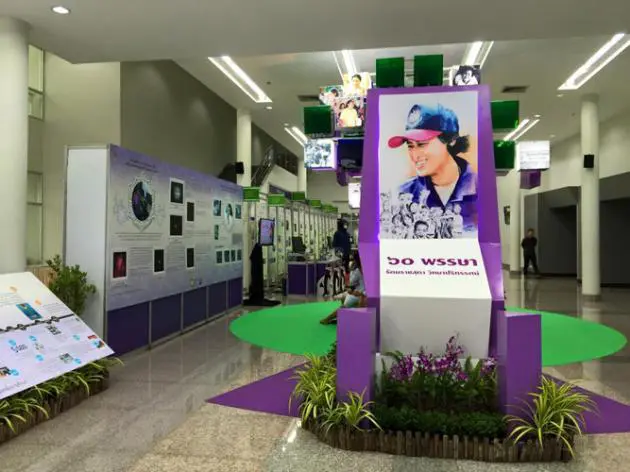
The Information Technology Project under a royal initiative is helping hospitalised children, detained juvenile delinquents, disabled people and prisoners learn to use information and communication technology to improve their lives.
The project is an initiative under Her Royal Highness Princess Maha Chakri Sirindhorn.
Computer training for prisoners
Pornthip Choksamai, director of the Rehabilitation Bureau, Department of Corrections, said the IT Project had got started in four prisons, and the plan was to expand it to 25 prisons within a couple of years.
“In the prisons, we provide education for the inmates, including vocational and university education, as well as informal training. ICT is one of the main subjects,” she said.
She added that under the ICT umbrella, there were many courses such as in multimedia, animation, computer assembly, computer repair and maintenance, and graphic design. So far, more than 20,000 inmates have received such training.
Prisoners who are trained on ICT also get jobs while they are still in custody. Companies outsource some work to the prisons, such as telesales and call centres. Currently, 78 prisoners work as call-centre staff. They can earn Bt11,000 per month while still behind bars, and once they get out of prison they can continue with their call-centre jobs.
Meanwhile, a group of female inmates have produced a multimedia book call “DAISY”, short for Digital Accessible Information SYstem, which is an open format for people with disabilities including the blind. The Association of the Blind has set aside some money to hire these inmates to convert books into multimedia in the DAISY format.
The Rehabilitation Bureau also uses electronic distant learning TV (eDLTV) to access educational and training material for the prisoners.
Juveniles get ICT training
Besides adult prisoners, juvenile delinquents are also receiving ICT training. Veerayuth Sukcharoen, director of the Juvenile Observation and Protection Department, said youngsters in juvenile detention homes could receive training in order to help improve their skills.
Currently, around 8,000 to 9,000 people aged between 10 and 18, mostly males, are in 77 juvenile detention homes and 18 training centres.
Since 2004, the Juvenile Observation and Protection Department’s training centres have been receiving sets of computers from the IT Project under the initiative of HRH Maha Chakri Sirindhorn. So far, five training centres have set up computer rooms to provide ICT training for detained juveniles. Training courses include multimedia, graphic design, and stop-motion animation.
Veerayuth said the purpose of the training was to provide young offenders with skills that can help them pursue productive lives after their release. “We have been contacted by four juveniles who have got jobs in ICT fields because of the skills they learned while they were imprisoned.”
The department has partnered with organisations such as King Mongkut’s University of Technology Thonburi to provide ICT training, but also utilises the eDLTV system. There are 295 satellite sets in the country’s juvenile detention homes and training centres.
This year, the department plans to add 11 training centres, with 10 computer sets each.
Children continue learning in hospital
Dr Adidsuda Fuengfoo, assistant professor of paediatrics at Queen Sirikit National Institute of Child Health, said a pilot programme to provide ICT training to young patients was launched in 1995 in four hospitals. Since then, the project has expanded to 29 hospitals throughout the country. About 50,000 children a year now benefit from this training thanks to the Princess’ IT Project.
The objective is to maintain children’s education if they have to take leave from school for lengthy hospital treatment.
In the early days of the programme, she said, ICT such as computer learning aids were used. Nowadays, multimedia courseware as well as the eDLTV system are playing important roles to help young patients keep learning.
Adidsuda said it was not
only children who benefited
from this project but hospital staff as well.
“Next, we plan to expand [this programme] to exceptional children who have to stay in hospital.
“Initiated and supported by the Princess’ IT Project for years, hospitals now are also getting support from private companies through their corporate social responsibility schemes,” she said.
