
RoboDoctors to give specialists remote access to stroke patients


Play
Chulalongkorn Hospital lauds new technology
Stroke patients at Chulalongkorn Hospital have a chance of getting instant treatment from specialists thanks to RoboDoctor.
Nijasri Charnnarong Suwanwela, chief of the hospital’s neurology and stroke unit, said a female stroke patient arrived one night. Once staff got her to the emergency room, the doctors put her on the hospital’s stroke fast track.
The patient was X-rayed and then got to meet a stroke specialist through the RoboDoctor.
The stroke specialist diagnosed the patient instantly, even though he was at home. The doctors and nurses at the hospital were able to assist the specialist, who diagnosed the patient via the RoboDoctor, until she was safely out of critical status. This is one example of a real case where Chulalongkorn Hospital benefited from the RoboDoctor.
The RoboDoctor helps the hospital quickly provide treatment for stroke patients while at the same time training other doctors with real cases.
Sompongse Suwanwalaikorn, deputy director of Chulalongkorn Hospital, said the stroke unit currently had two RoboDoctors, RP-Lite models, one in the emergency room and the other in the ward.
The hospital has been using RoboDoctors for seven months to help stroke specialists easily reach patients, from wherever the doctors are. Patients and their families can also get reach the specialists even at night.
The hospital plans to have more RoboDoctors at its new stroke units, which will double the number of inpatient beds to 20. The hospital also plans to provide tele-medicine for its networked hospitals nationwide, and plans to use RoboDoctor in ambulances as well.
About 500 stroke patients are treated at Chulalongkorn Hospital every year. Nationwide, there are about 150,000 new stroke cases annually.
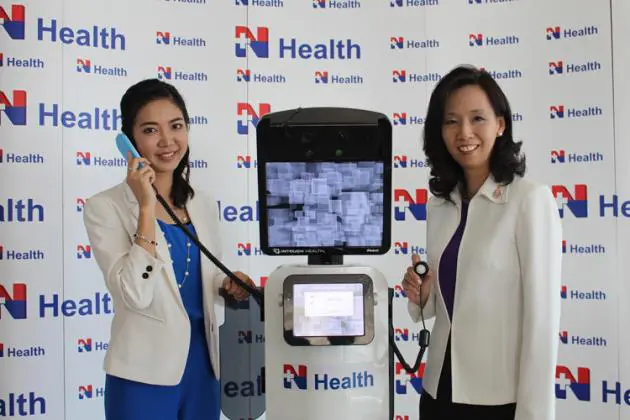
Kanjaree Phrasing, commercial manager for tele-medicine at N-Health, a medical-service provider, said RoboDoctor was designed and developed to be an assistant to doctors, especially stroke specialists, to provide diagnosis and treatment to patients instantly from anywhere the doctors are.
RoboDoctor combines data, voice, video, and Web-based technologies to help hospitals provide tele-medicine, also known as distance medicine.
There are only a few stroke specialists in Thailand, so with the RoboDoctors, hospitals can optimise their ability to help more patients via online connections. The doctors can provide consultation and diagnosis via their smartphones, tablets or computers easily.
The doctors log in remotely use the RoboDoctor from anywhere they are at the time. Meanwhile, at the hospital, RoboDoctors along with doctors and nurses staying with the patient can provide treatment according the specialist’s instructions.
Doctors can control the RoboDoctor remotely from their access devices. They can initiate a 120-times zoom-in to look at the patient very closely or examine the patient’s health information, such as blood pressure or X-ray films, and can listen to the patient’s heart rate via a stethoscope attached to the RoboDoctor.
“It supports multiple doctors, up to four, to consult with the same patient at the same time,” Kanjaree said.
There are four RoboDoctor models: RP-VITA, RP-Lite, RP-Vantage, and RP-Xpress. The first three are suitable for hospitals, while RP-Xpress is suitable for use in an ambulance or mobile intensive-care unit.
All content accumulated while doing tele-medicine via RoboDoctor will be saved on to the hospital’s private cloud, provided as a part of total solution by the company.
The total solution includes RoboDoctor with modules of software and applications as well as private cloud and maintenance services. Therefore, the cost of having RoboDoctor ranges from Bt2 million to Bt10 million.
“Our RoboDoctor and TeleHealth Network are under the Hospital Information Accountability Act,” Kanjaree said.
