
Messing about on the river


Play
Bangkok Tree House offers a great break for the environmentally conscious
The hotel industry has long been aware of its carbon footprint and over the past few years has been going all out to be more environmental friendly.
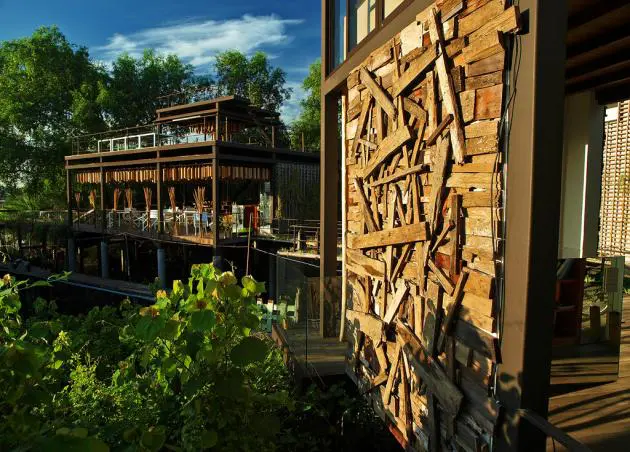
Among the Thai hotels making an effort is Bangkok Tree House in Phra Padaeng, which relies heavily on natural resources. Among its innovative ideas are to collect wood floating in the river to use for the external décor and putting plastic water bottles to good use as containers to grow flowering plants.
Opened last year, the 11-room hotel is gaining in popularity, usually enjoying capacity bookings over weekends. Some 70 per cent of the guests are foreign, with most of them coming from eco-conscious Europe.
“We built the hotel with a nod to environmental care rather than large profits. Our budget constraints mean that creativity and innovation are playing a leading role in shaping the way we do business,” says owner Jirayu Tulyanond.
Located on more than one rai of land on the banks of the Chao Phraya River bank and surrounded by trees, the hotel cost Bt20 million to build and is expected to recoup its investment within six years. Room prices are not cheap, starting at Bt3,900 and going up to Bt6,500 per night for a bed under the stars in a room that has no roof – just a mosquito net and a corner for dinner.
The four solar cells on the roof produce to 1,000 watts of electricity per hour. Rather than install fridges in every room, the hotel boasts a central refrigerator and guests are invited to help themselves with cold water and free home-made ice-cream. And only refillable glass bottles are used.
Jirayu is still experimenting with the walls and rooftop greenery. He plans to grow vegetables on the roof and the walls will eventually play host to climbing plants, though he admits he has yet to find the kind of climbers that can sustain the blazing sun.
Guestrooms feature a bathroom exposed to the elements and a glass-covered floor, allowing guests to look below and watch the aquatic life. The rooftop has an open area for sunbathing and stargazing once night falls.
There are close links with the community too, with the chefs and most of the staff resident in the neighbourhood. Local people are encouraged to earn extra income by produce chemical-free soap for the hotel. Pineapple peel is snapped up to make liquid for cleaning.
Hotel guests are also asked to collect one kilogram of garbage before checking out. To reduce garbage, the community map used on these trips is not distributed in paper format, but available instead by looking at the wall. Many use their smart phone to ensure they don’t get lost.
Jirayu, an international relations graduate, acknowledges his talents don’t lie in business management but says he is excellent at encouraging his staff to come up with good and hygienic services. The result is a unique hotel with sincere service, differentiating his small venue from the large hotels in other parts of town.
The guests arrive through word of mouth and social media and while they bask in the natural surroundings, they can also keep in touch with the world through free Wi-Fi.
Jirayu is pleased with the hotel’s success to date and says he has no plans to extend. He does however hope to open a small restaurant where solar power will be used for cooking and his own vegetables will form part of the menu.
At a Glance
High points: It’s an ideal spot for being at home with nature and offers easy access to town by ferry then a short taxi ride to BTS Udom Suk.
Low points: The hotel doesn’t use any insecticide so the mosquitoes can be fierce.
Pay for it: Prices start at Bt3,900
Find it: 60 Moo 1, Petch Cha Hueng Road, Bang Namphueng, Phra Padaeng, Samut Prakan, Greater Bangkok 10130
Call it: (082) 995-1150
Browse it: www.BangkokTreeHouse.com.
