
Location, location, location


Play
Zhangjiajie cashes in on the visitors who flock to see the floating mountains made famous in "Avatar"
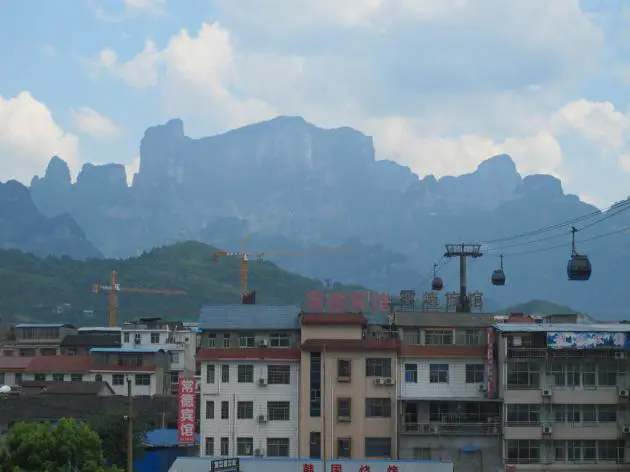
A city whose history can be traced back more than 2,000 years, Zhangjiajie, in the northwest of Hunan province, is permanently awash with local and foreign tourists, most of them in town to marvel at the nearby sandstone peak forest that inspired “Avatar”.
While tour buses often clog the roads and infrastructure can be a little strained during peak holidays, the municipality is delighted at the revenue the tourists bring to the town.
“From the statistics of Zhangjiajie’s immigration department, tourist numbers in the first half of this year are equivalent to the whole year of last year, that is 2 million visitors. They include 300,000 Koreans, 150,000 Taiwanese, and 50,000 Thais. Since April 15, flights between Taipeii and Zhangjiajie have increased to seven a week,” says Chen Danfeng, vice mayor of Zhangjiajie Municipal People’s Government and member of Zhangjiajie Municipal Standing Committee of the Party, during a welcome meeting for the Thai media at Samantha Resort & Spa Hotel.
The airport, which formerly supported just 700,000 tourists, now has a capacity for 1.2 million, the expansion taking place after the Hallelujah Mountain was chosen as a location for the American science fiction action film. Danfeng says that further work is underway, which will bring the capacity up to 5 million tourists.
The increasing tourist numbers have also led to greater investment in five-star luxury hotels.
“We are looking at ways to boost tourism from Thailand. We had planned to officially promote Zhangjiajie in Thailand and also to formulate a relationship between Pattaya and Zhangjiajie in April but postponed the campaign to December because of the change in China’s government in March.
“The number of Thai tourists to Zhangjiajie is the highest in Southeast Asia and the third in the world. That’s why we are placing so much importance on tourists from Thailand,” says the vice mayor.
Formerly known as Dayong, Zhangjiajie City was inaugurated in 1988 and given its new name in 1994, two years after the Wulingyuan Scenic Area was designated a UNESCO World Heritage Site. The three characters of Zhangjiajie, derived from “Zhang”, a Chinese common surname, “jia” meaning "family", and “jie” meaning “homeland”, read “Zhang family homeland” conveying the idea of opening the door to welcome the world.
Zhangjiajie is on its way to becoming a world-class tourist destination. Covering 951.6 square kilometres, it boasts not just the sandstone peaks, valleys and caves but also hot springs, lakes, creeks, forests and a wealth of cultural heritage.
“Zhangjiajie has four factors going for it,” says Danfeng. “The first factor is the beauty of Zhangjiajie’s valley and the rock column forest at Wulingyuan.
“The second factor is the greenness of Zhangjiajie. Zhangjiajie’s slogan this year is ‘fresh air, clean water, green food for good health’. A survey by the Ministry of Science and Technology it found that one cubic metre of pure and fresh air in Zhangjiajie is equal to 100,000-120,000 units of oxygen. Clean water comes from the Xiangjiang, Zishui River, Yungjiang and the Lishui rivers. Vegetables are grown 2,000 metres above sea level and the salamander fish, which date back some 380 million years, reflect the great environment in Zhangjiajie.
“The third factor is a variety of people in Zhangjiajie. There are more than 150 ethnic groups in China and 33 out of them in Zhangjiajie.
“The fourth factor is opportunity. Zhangjiajie has been just only 25 years but has the spots to draw the tourists. In addition to the ‘Avatar’ movie, we’ve had wingsuiters flying over and passing through Heaven Gate in Tienmen Mountain and in June, a French spiderman climbed up the glass elevator. Next month, we will be the venue for a country music festival and next year, we plan to make Zhangjiajie as a heaven for outdoor lovers from Asia and Europe.”
