
Riding in a walnut


Play
Why Cuba is a paradise for US classic cars
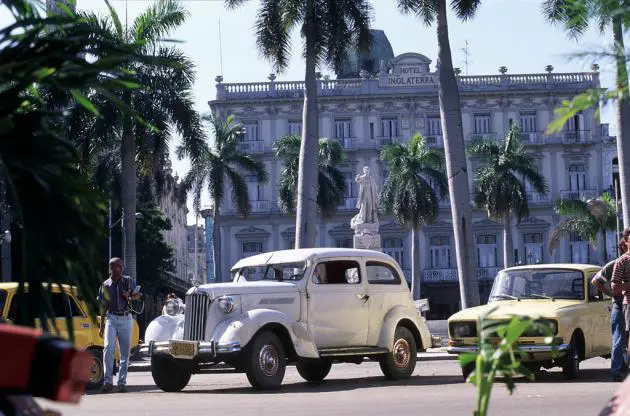
“American car! American car!” shouts a taxi driver in heavily accented English near the Cathedral Plaza in Old Havana.
The taxi driver is trying to capture the attention of a group of foreign tourists and he is offering one of the classic attractions of the Cuban capital, a ride in an old US automobile from the 1940s or 1950s.
The term coined by locals is “almendrones” and refers to the cars’ oval walnut shape. These classic cars, worshipped by fans in other countries, earned their Spanish nickname because of their rounded and solid shape when cars were like ships, sliding slowly through the streets.
Havana is full of them because time stopped still in the early 1960s after the Cuban revolution led by Fidel Castro.
Cuba became isolated from the rest of the world, imports stopped and the old cars had to remain in use.
There are Plymouths, Chevrolets, Oldsmobiles, Dodges, Cadillacs; the streets of Havana are a veritable museum of objects from the golden age of the US automobile industry, a time when cars were finally a product for the masses.
These veterans are today, as they have been for decades, part of daily life in Cuba. The models have been out of production for many years, but here they continue to be driven as they have for more than half a century.
“They are good for business,” says Pedro, a 50-year-old Havana resident. The Cuban government allows small freelance entrepreneurs like Pedro.
He owns a Chevrolet Deluxe from 1952, the last year General Motors produced the portly model. The car is somewhat ramshackle, but at least it runs. Last year it cost Pedro the not-to-be scoffed-at sum of US$6,000 to buy. He put it to use as a taxi.
Classic cars are the main form of transportation in Havana. The city does have public-transportation buses but they are very scarce, so people often get around using the informal way, in private taxis.
A regular ride within the city costs a little bit more than half a dollar.
In the early 1990s, when the Cuban economy was on the verge of collapse after the Soviet Union was dismantled and the Socialist island lost the steady economic support it had enjoyed for decades, Cuba discovered anew the value of its old cars for tourism.
Visitors loved the vintage touch, the romantic and anachronistic look offered by the old automobiles in a world that everywhere else was recklessly speeding ahead.
“We drive through the city, on a tour, for 30 ‘convertible’ pesos (equivalent to dollars, so 30 dollars) an hour,” says Arturo, a 23-year-old taxi driver outside the famous National Hotel.
Arturo drives a 1952 Ford Victoria.
His car, like many others, no longer has its original engine.
Arturo’s car belongs to the state-run Gran Car company and has for years used a four-cylinder Mitsubishi motor that runs on diesel. This way it uses less fuel and it is easier to obtain spare parts and fix it when it breaks down.
“We use parts from other cars, we invent ways to repair it,” Arturo says.
“You know that Cubans always have a trick up their sleeve,” adds another taxi driver in front of the National hotel who drives a ’49 Oldsmobile. This driver had a Toyota motor put in his car two years ago for $3,000.
This is surprising, because there is no official Toyota outlet in Cuba.
“People travel, they bring pack spare parts, they appear, they are out there,” Arturo says.
At the informal online classified ads listing site called “Revolico.com”, locals can find, for example a 1955 Chevrolet with a Mercedes motor, or a 1951 Chevrolet that has an adapted Volga motor from the former Soviet Union. Cars from the Soviet Union and other Eastern bloc countries were also popular in Cuba in the 1960s, 1970s and 1980s.
Today, the most common cars on Cuban streets are the US veterans and the Ladas and Moskovich cars from the Soviet era. It is only slowly that Chinese Geelys and South Korean Kias are beginning to be seen.
“American car! American car!” shout the taxi drivers, if they don’t already have a European visitor happily sitting inside their convertible Cadillac and being driven under the tropical sun along the Havana Malecon or ocean driveway.
