
Walks on the wild side


Play
South Africa offers so much more than exotic animals
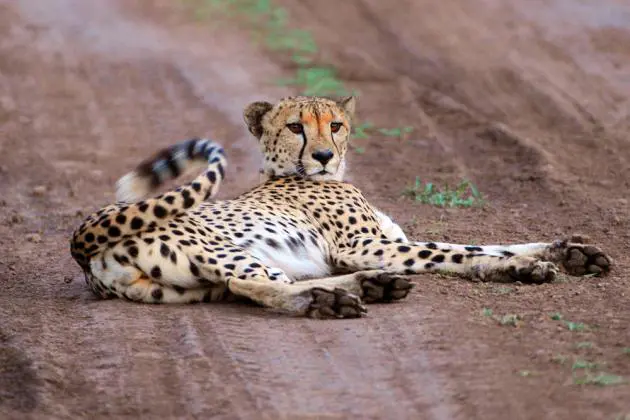
The adrenaline is pumping, and your pulse is racing. Barely 20 metres away, a spotted animal is dozing under an umbrella thorn tree. It’s a real-life cheetah. Spread out on the ground as he lies on his side slumbering.
“He has obviously just had a substantial meal,” says the experienced South African ranger and indicates the rounded stomach of the animal. Then suddenly the animal raises its head.
An icy cold stare scrutinises the small group of tourists whose cameras are directed at the magnificent big cat.
A short hiss from the cheetah is enough of a message: “That is a clear warning – not a step closer,” says the ranger, who knows how to interpret feline signals. Even when a cheetah is on siesta, it remains dangerous.
In the landscape of South Africa’s wonderfully situated Samara Private Game Reserve, coming face-to-face with nature takes on a whole new meaning. Wildlife tourism in South Africa has progressed far past the well-trodden path through Kruger National Park.
Small but capable is the motto of the many private and public wildlife parks that have been established in South Africa’s Cape region.
Because currencies in many developing countries are dropping, South Africa has become a paradise, offering holidays at a bargain price.
Those holidaymakers enjoying stronger home currencies can afford first-class service at low prices. Couple that with inexpensive flights due to falling oil prices, and South Africa becomes the real deal.
Not that all has been well for South African tourism.
“We had a very difficult year in 2014,” says Theresa Bay-Mueller of the government’s tourism promotion agency.
The reason: ebola. Although the virus was rampaging nearly 6,000 kilometres away in West Africa, the entire continent’s tourist industry suffered. The French capital Paris is closer to the outbreak area than South Africa is, but most intending tourists don’t know that simple fact.
“People are lumping the entire continent together – the lack of knowledge about Africa influences travel behaviour enormously,” says Torsten Schaefer, spokesman for the German Travel Association DRV.
A caricature making the rounds on the Internet makes the point crystal clear, with the small epicentre of the now fading epidemic set off in colour against the gigantic landmass. It’s as if the island of Taiwan had left its mark all over Asia.
Yet, travellers in the know – such as the Germans who make up the third largest contingent of visitors to South Africa – can take advantage of a whole range of offerings, not limited to wildlife.
Diversity is the name of the game in the new South Africa including tourism.
Beside the wildlife in the national parks, there’s diving and beaches on the Indian Ocean in the country’s east, wine and fine dining on the Cape, balloon flying over the savannah lands or rafting on the Orange River.
For those who want a little bit extra, some packages offer picnics on the veldt prepared by master chefs.
In addition, more remote regions are increasingly finding their niche.
In Eastern Cape province for example, more and more guesthouses have established themselves with a targeted focus on families with children.
The Lowlands Country House, run by a retired couple from Johannesburg in the dry Karoo region is an example of such an establishment.
The small resort consists of former farmhouses near the city of Graaf-Reinet and offers inexpensive accommodation with excursions and activities that are doable with smaller children.
“We purposely wanted to keep our services affordable and thereby provide an atmosphere of staying on a little farm,” says owner Anne Bowker.
Whether it is riding, fishing, hiking or stargazing at the side of a competent professional, South Africa has more to offer than just big cats.
IF YOU GO
<Singapore Airlines operates flights from/to Singapore and Johannesburg in South Africa.
<Samara Private Game Reserve (www.samara.co.za), in the Eastern Cape, has a luxury lodge where wild animal roam around an amphitheatre of mountains on 70,000 acres.
<Lowlands Country House (www.lowlandscountryhouse.co.za) is a beautiful sheep, cattle and pecan nut farm on the Fish River, North of Cradock. Guests can enjoy canoeing, river rafting, bird watching, mountain climbing or just relaxing in tranquil and comfortable surroundings.
