
EU diplomat highlights Europe’s commitment to global energy transformation in bid for net-zero emissions
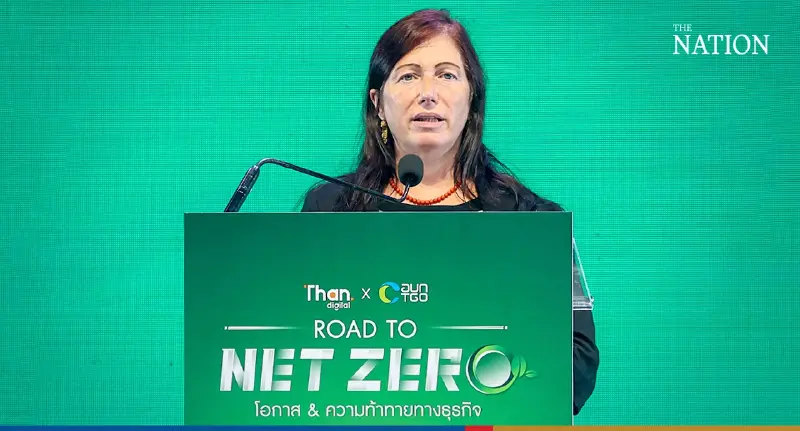


A European Union (EU) diplomat in Thailand has released a report indicating that the world is facing the highest-ever recorded levels of heat this summer.
Sara Rezoagli, charge d’affaires of the EU delegation to Thailand, said at the “Road to Net Zero: Business Opportunities and Challenges” seminar hosted by Thansettakij.com on Tuesday, that the report warns of temperatures rising by 1.1 degrees Celsius from pre-industrial levels.
The report was written by the Intergovernmental Panel on Climate Change.
Experts stress that this is the last, limited opportunity to limit global warming to 1.5 degrees Celsius as set by the Paris Agreement. If this target is exceeded, it will result in irreversible damages and cascading consequences including more heatwaves, wildfires and rising sea levels.
“This summer, regions around the world are experiencing extreme weather conditions,” Rezoagli said, citing data from the World Meteorological Organisation.
The European Copernicus Climate Change Service has also noted that July was the hottest month ever recorded.
With rising global temperatures, natural disasters like wildfires in Greece and Italy have devastated nearly 1.25 million acres, marking a 40% increase over the previous decade.
In Asia, meanwhile, prolonged droughts and high temperatures have pushed up the use of water and electricity, and are threatening economic stability, especially for vulnerable groups like the elderly and children.
Global warming has already had an adverse impact on Thailand, particularly in the agricultural sector, as well as vital industries and supply chains.
Hence, Rezoagli said, the EU will strengthen its push to address the problem of global warming through the United Nations Framework Convention on Climate Change. The 28th session of the Conference of Parties (COP28), to be hosted by the United Arab Emirates from November 30 to December 12, will provide the EU an opportunity to advocate for the Paris Agreement and push for increased global energy transformation.
She said the EU will strongly support commitments to global energy transformation in line with three interconnected goals:
1. Increasing renewable energy use threefold on average annually from now to 2030
2. Improving energy efficiency two-fold per year during this decade
3. Phasing out the use of fossil fuels by 2050, with a strong focus on achieving net-zero emissions
The diplomat said these goals align with the European Union’s commitment to achieving net-zero emissions by 2050 under the Paris Agreement and the European Green Deal.
