
Pheu Thai urges Chiang Mai voters to deliver another home run
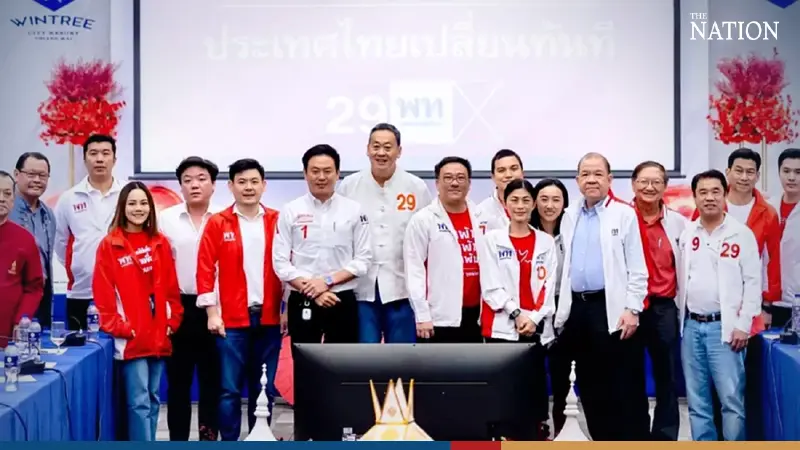


Pheu Thai Party showed its determination to dominate the May 14 election in its home base of Chiang Mai, as one of its leading figures – Srettha Thavisin – on Wednesday urged voters in the northern province to deliver his party an overwhelming victory on May 14.
The province’s potential has been held back by the national government, but with an elected governor instead of one appointed from Bangkok would unleash its potential, Srettha told a campaign rally.
An elected governor would support every initiative that would benefit the province, with key performance indicators used to evaluate his or her performance, said Srettha, a property-tycoon-turned politician and one of Pheu Thai’s candidates to be Thailand’s next prime minister.
Chiang Mai will be a city of opportunity under a Pheu Thai, Srettha said, saying its status rose when the Thai Rak Thai Party was in power. Thai Rak Thai is Pheu Thai’s predecessor. It swept every seat in Chiang Mai in the 2005 election.
A Pheu Thai government would stop the flow of young people leaving the province to find work, Srettha told the crowd.
It will accomplish this by honouring its pledge to raise the daily minimum wage to 600 baht, and setting a minimum salary of 25,000 baht a month for university graduates, he said, adding that households earning less than 20,000 baht per month will receive financial assistance.
A Pheu Thai government will push for solar power so people can generate their own electricity, he said.
Chiang Mai is the hometown of former prime minister Thaksin Shinawatra, the founder of Thai Rak Thai.

