
HCM City races to find urgent solutions to worsening air pollution
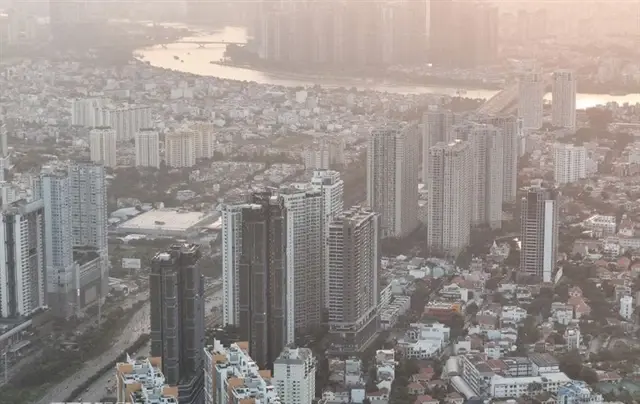


HCM City is urgently seeking effective solutions to address worsening air pollution as emissions from traffic, construction, industry and waste treatment continue to push air quality to unhealthy levels, officials said on Wednesday (December 3).
HCM City is urgently seeking effective solutions to address worsening air pollution as emissions from traffic, construction, industry and waste treatment continue to push air quality to unhealthy levels, officials said on Wednesday.
Recent monitoring showed days with poor air quality have increased significantly, especially in the early morning when dust and pollutants accumulate before dispersing later in the day.
According to the city’s Department of Agriculture and Environment, fine particulate matter (PM2.5) remains the most worrying pollutant, often exceeding national and World Health Organisation (WHO) guidelines.
The problem has been aggravated by high traffic density.
Millions of vehicles travel in and out of the city daily, including a large volume from neighbouring provinces, putting enormous pressure on the environment and worsening emissions levels.
The transport sector now accounts for more than 50 % of total air pollutants.
The department’s deputy director, Dang Nguyen Phuong Trinh, said the city has implemented various measures, including monitoring pollution sources, improving forecasting systems, and working with districts to control emissions from traffic and industrial operations.
“However, she admitted current solutions are still fragmented and not strict enough.”
To tackle vehicle emissions, the city aims for 100 % of its bus fleet to run on electricity or green energy by 2030, while gradually eliminating old, high-emission vehicles.
Several electric bus routes operated by Vinbus have already been launched, and more are expected to open next year.
Transport experts said shifting to electric vehicles must go hand in hand with expanding public transport.
The city currently has only one metro line in trial operation and a bus system that meets less than 10 % of total travel demand.
Without a strong public transport network, private vehicle use will continue to grow, adding pressure on the city's environment.

In addition to traffic emissions, construction dust remains a major source of pollution.
Many projects do not fully comply with environmental regulations, such as covering materials, cleaning vehicles or preventing dust dispersion.
The city has ordered stricter inspections and imposed higher fines to ensure contractors follow environmental standards.
Industrial zones on the outskirts also contribute to rising pollution.
While most factories have installed emission treatment systems, violations persist, especially among small and medium-sized enterprises.
Local authorities have been asked to enhance supervision, particularly at night when illegal emissions often occur.
Experts warned that air pollution poses increasing health risks to the city’s nearly 10 million residents.
Prolonged exposure to PM2.5 is linked to respiratory and cardiovascular diseases, especially in children and the elderly.
Doctors at major hospitals said the number of patients with respiratory illnesses typically rises on days with poor air quality.
The city plans to expand its air quality monitoring network to 100 stations by 2030, allowing for more accurate forecasting and public warnings.
Officials also encouraged residents to check air quality indices regularly and take preventive measures such as wearing masks and reducing outdoor activities during peak pollution hours.
Environmental experts emphasised that reducing emissions requires coordinated efforts across sectors.
They recommended speeding up public transport development, expanding green spaces, imposing emission fees for vehicles entering the city centre, and applying stricter control on construction and industrial activities.
The city is also studying measures implemented in other Asian megacities, such as Singapore’s congestion pricing and Seoul’s restrictions on old diesel vehicles.
However, experts noted that any policy must be tailored to the city’s specific characteristics and socio-economic conditions.
Efforts to raise public awareness are being stepped up.
Several districts have launched campaigns to limit the burning of waste, encourage waste sorting, and promote energy-saving practices.
Schools are also incorporating environmental education into their curricula.
The Department of Agriculture and Environment said it will soon submit a comprehensive air quality management plan to the People’s Committee, outlining priority actions to cut emissions, enhance monitoring and strengthen enforcement.
Officials stressed that restoring clean air requires long-term commitment and participation from both authorities and citizens.
As the city continues to grow, balancing development with environmental protection will be crucial to ensuring a livable and healthy urban environment.
Viet Nam News
Asia News Network
