
Indonesia clears hurdles, US trade deal due in January
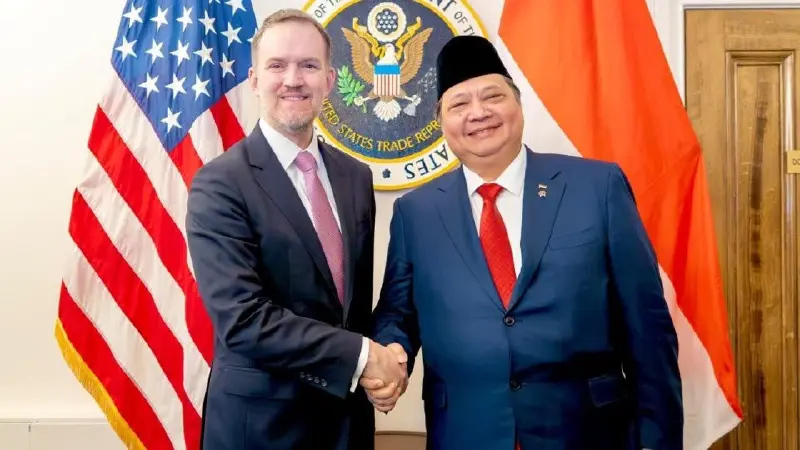


The agreement, which is expected to be signed by President Prabowo Subianto and US counterpart Donald Trump, will not constrain Jakarta’s domestic policy space and will deliver “balanced economic benefits” for both countries, according to Office of the Coordinating Economy Minister Airlangga Hartarto.
Indonesia is preparing to seal a trade agreement with the United States by the end of January after the two sides reportedly resolved all substantial issues in negotiations earlier seen at risk of stalling.
The Agreement on Reciprocal Trade, which is expected to be signed by President Prabowo Subianto and his United States counterpart Donald Trump, will not constrain Jakarta’s domestic policy space and is designed to deliver “balanced economic benefits” for both countries, according to Office of the Coordinating Economy Minister Airlangga Hartarto.
“No Indonesian policies are restricted by this agreement […], which is purely commercial and strategic in nature,” Airlangga told an online press briefing on Tuesday, emphasising the pact would contain no provision limiting Jakarta’s ability to pursue trade deals with other countries.
Airlangga, who leads Indonesia’s negotiating team, was speaking after a meeting with US Trade Representative Jamieson Greer in Washington, DC, on Monday (December 22) local time.
Airlangga said he and Greer welcomed progress in resolving “crucial issues” in the latest round of talks, with negotiations centred on safeguarding mutual interests while ensuring Indonesia’s key concerns “were clearly conveyed”.
The US wanted access to Indonesia’s critical minerals and had agreed to grant import tariff exemptions for key Indonesian export commodities like palm oil, tea and coffee, he added.
Indonesia is the world’s largest producer and exporter of palm oil and a major global supplier of Robusta coffee.
“Ambassador Greer welcomed the meeting’s outcome and praised both sides for pushing to accelerate the completion of the tariff agreement, despite the talks taking place at the start of the US Christmas holiday,” the Office of the Coordinating Economy Minister said in a statement published on Tuesday.
The US imposed a 19 % tariff on most goods from Indonesia in a preliminary “framework” agreement in July, down from a previously threatened 32 %, following an earlier understanding under which Indonesia agreed to remove tariff and nontariff barriers for US companies and to buy some US$19 billion worth of US goods to close the trade gap.
Indonesia also presented a plan by manufacturing firm Indorama to invest $2 billion in a blue ammonia project in the US state of Louisiana as part of the deal.
However, the US had reportedly grown frustrated with slow progress in the negotiations, according to unnamed US officials who saw the deal at risk of collapsing due to Jakarta supposedly backsliding on earlier commitments, particularly those related to US agricultural exports, cross-border data flows and industry regulations the US deems nontariff barriers.
At the same time, rumours of a so-called “poison pill” clause similar to one in Malaysia’s trade deal with Washington fueled concerns in Jakarta.
Malaysia’s pact included a provision requiring consultations with Washington before entering digital trade deals with third countries, and allows the US to terminate the agreement if the country signed pacts deemed to jeopardise US interests.
Airlangga sought to dispel those concerns, stressing that discussions were strictly on a reciprocal trade agreement under the framework agreed in July and did not extend to broader commitments.
There were “dynamics” in the negotiations, but recent talks had focused largely on legal drafting and harmonising language in the text, the minister reiterated, adding that such dynamics were normal at this stage and did not affect the substance of the deal.
“All issues have been discussed and agreed upon by both sides. There is no factor that can hinder the signing of this ART,” he emphasised.
Technical teams from both countries are scheduled to resume meetings in mid-January to finalise the text, with discussions expected to run between Jan. 12 and 19, Airlangga said.
US officials are currently arranging a schedule for Prabowo and Trump to sign the agreement, with the Indonesian leader expected to travel to the US, said Dwisuryo Indroyono Soesilo, Indonesian ambassador to the US, at the same press briefing.
The US Embassy in Jakarta declined to comment. The USTR did not immediately respond to The Jakarta Post’s request for comment.
Donna Priadi, managing director of the American Chamber of Commerce in Indonesia (Amcham), said the priority for US businesses was not only reaching an agreement but ensuring it would deliver greater regulatory clarity and predictability.
Longstanding concerns remained over the country’s nontariff barriers, including regulatory uncertainty, overlapping authorities, local content requirements and licensing processes, she told the Post on Tuesday.
Addressing these issues would send a strong signal to investors and reinforce Indonesia’s competitiveness as an investment destination.
“While reported progress is encouraging, the business community will be looking closely at how commitments are translated into clear regulations and effective implementation,” Donna emphasised.
Local experts previously noted that Indonesia “was right” to prioritise “prudence, presence and patience” in negotiations with Washington and not to rush for the sake of optics.
Ruth Dea Juwita
The Jakarta Post
Asia News Network
