
Trump, Carney, or Xi Jinping: Decoding the New Economic Game through “Sustainomy”


A Global-level Framework, Engineered by a Thai thought Leader
The world is entering a major structural turning point—economically, socially, and environmentally. This time, the shift is not driven only by technology or trade wars. It is also shaped by “global leaders,” each designing a different vision for future growth and ushering the world in different ways.
At the most recent World Economic Forum (WEF) Annual Meetings in Davos, Donald Trump of the United States, Mark Carney of Canada, and Xi Jinping of China (despite not attending in person) appeared to represent very different worlds. But if we look deeper, they are in fact all trying to answer the same question:
How can the economy continue to grow in a world with limited resources, compounding risks, and widening inequality?
The answers become clearer when we stop viewing economic growth and sustainable development as two separate agendas. The next global economic framework may not emerge solely from the West, as it once did, nor be driven by Eastern powers. Instead, it may arise from the convergence of both—through a model engineered by a Thai thought leader called Sustainomy, which decodes the dynamics of the Next Economy.
Growth the Trump Way: Economy through Sovereignty
Trump’s economic approach is not complex in theory—and theory itself does not seem to be his priority. While his actions may seem unpredictable, a practical analysis reveals a clear focus: 1. Power 2. Recognition and leadership.
This includes:
- Maximizing benefits from America’s role as a (former) global leader;
- Pulling manufacturing back into the country;
- Leveraging mechanisms of taxes, trade, and technology as unilateral political tools; and
- Creating international institutions led by the US, such as the proposed “Board of Peace.”
From Sustainomy’s perspective, this represents “Survival-driven Growth”—growth that relies on past power to protect national strength rather than improving the quality of the whole global system. Although this model may work in the short term, it inevitably leads to a crossroads…
Either the US leads the world in its own way, or the world moves forward together without the US as part of a new “Unity-1” system.
Growth the Xi Jinping Way: Economy through New Value Chains
China under Xi Jinping has taken an almost opposite approach to the US. Rather than rejecting globalization (which originated from the US), China has positioned itself to lead its next phase. As competition in basic commodities becomes increasingly constrained, China has leveraged its long-standing strength: market size.
This includes:
- Driving new technologies using domestic market scale and strong state support;
- Expanding its existing manufacturing strength from local to global markets;
- Building new value chains by positioning itself at the center of production, logistics, and branding; and
- Supporting free trade while benefiting from low costs and economies of scale.
In Sustainomy terms, this is “Systems-led Growth,” where the state acts as a conductor—designing balance between the economy, security, and social stability. This model has strong scaling power, much like the US once had, and positions China as a leader of Globalization 2.0.
However, because of its vast scale across the upstream, midstream, and downstream sectors, China itself faces significant challenges—including flexibility, internal management, and building trust from the outside world, across industries, businesses, and the people connected to Chinese brands.
Growth the Carney Way: An Economy for Today and the Future
Among these leaders, Mark Carney may seem the quietest. But his speech at WEF Davos brought renewed attention to the former central bank governor of the UK and Canada. Carney has long been one of the most influential thought leaders in global finance, particularly known for his belief that markets fail because they cannot “price in the long-term risks to humanity.”
This includes:
- What seems like short-term crises are actually structural ones;
- Countries must be able to protect themselves while staying connected to the world;
- Middle-power countries must choose their position carefully—sit at the table or be on the menu; and
- The world must accept that things have changed and a new system is urgently needed.
As a technocrat, Carney emphasized that we cannot afford to ignore the future. This is “Future-accountable Growth”—growth where today’s decisions are made with responsibility toward future generations, long-term economic stability, social cohesion, and environmental sustainability. In the face of polycrises—climate risk, inequality, and financial systemic risks—require structural solutions. This perspective aligns closely with the core principles of Sustainomy.
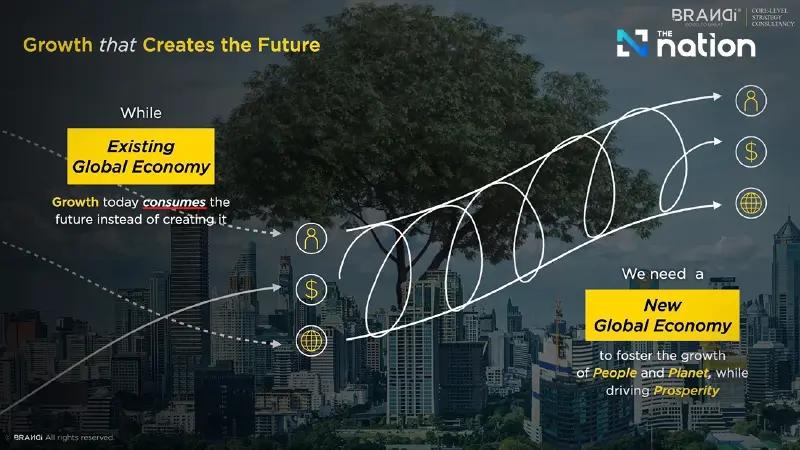
In short, growth must “create the future,” not consume it. Notably, it must also strengthen the “middle”—countries, businesses, and workers—because if the middle is weak, pressure comes from all sides, just as the world is experiencing now.
Sustainomy: A Framework that Connects All Three Growth Models
We should not judge Trump, Xi Jinping, or Carney through a “right or wrong” lens. Instead, we should understand cause and effect—why each leader acts as they do, based on their country’s unique context. Thus, Sustainomy does not take sides. It asks as new question:
What should the operating system of the global economy look like? What are the hidden costs of growth?
Sustainomy is a framework for solving structural economic problems while advancing sustainable development—by treating them as one agenda, not two separate ones. It focuses on designing strategies that:
- Drive economic growth while distributing wealth more fairly
- Expand growth opportunities while ensuring social well-being
- Use resources for growth while regenerating the environment

It is clear that Sustainomy does not focus on transitioning to any specific industry. Instead, it emphasizes the mechanisms required for growth—integrating the economy, society, and the environment into one unified agenda. This represents a shift in the “way” we grow: one that requires understanding the future while delivering results today. Although this is a difficult equation, we must accept the reality that the easy questions are gone. What remains are the imperatives.
And real, lasting growth, will depend on who can solve the hardest problems best.
A Global Model, Shared through a Book Written by a Thai thought Leader

Because these challenges demand a holistic perspective, the book Sustainomy serves as a blueprint for leaders—governments, businesses, and citizens—to understand change at the level of rules, roles, and relationships. Ultimately, this reflects a deeper shift in mindset.
At a time when the world is confused about its new path forward, Sustainomy is a book bold enough to tell the world this:
The problem with the global economy is not a lack of innovation, but a lack of a “new mindset”—one that understands system limits.
This is not a ready-made solution, but a new language for working toward the answers of the next era of the global economy. Trump, Xi Jinping, and Carney may be playing different games—but the answers they reach may not be so different. It depends on who is willing to accept the conditions that come with them.
For those interested, related articles on Sustainomy can be found on the WEF and TIME platforms.
The English edition of Sustainomy will be available worldwide on March 17, 2026.
