
Thailand Launches First Halal Regenerative Medicine Ecosystem
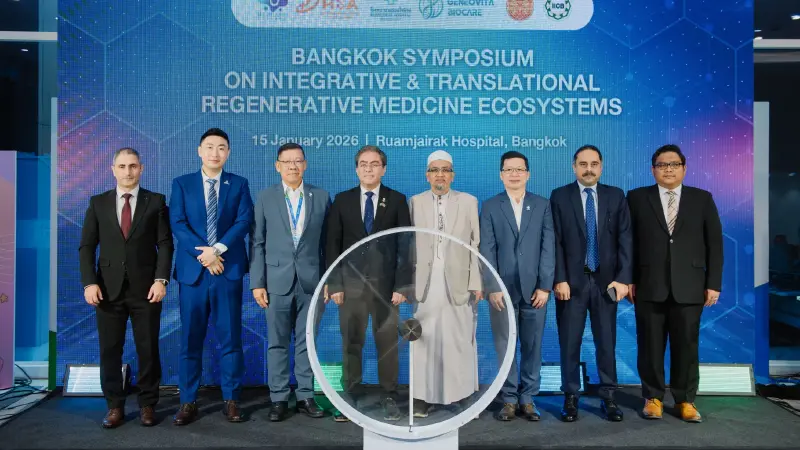


Thailand unveils the first Halal Regenerative Medicine Ecosystem, merging advanced science with Islamic ethics to become a global Medical Ethics Hub.
In a move set to redefine the global healthcare landscape, Thailand has officially launched the "Halal Regenerative Medicine Ecosystem."
This first-of-its-kind initiative integrates cutting-edge biotechnology with strict Islamic ethical governance, signaling a strategic transition for the nation from a general medical hub to a specialized "Medical Ethics Hub."

The initiative was unveiled on January 15, 2026, at the Bangkok Symposium on Integrative & Translational Regenerative Medicine Ecosystems. Led by Ruamjairak Hospital and Geneovita Biocare International, the project unites partners from Thammasat University’s Center of Excellence in Stem Cell Research and Innovation (ESRI), Bangkok Islamic International College, and international stakeholders from Saudi Arabia, Malaysia, Vietnam, and Australia.
Building a Platform, Not Just a Hospital Central to this ecosystem is the new Halal Wellness Medical Center, designed to serve the global Muslim population with healthcare that respects religious principles.

“We are building more than a hospital,” said Mr. Apirak Apisarnthanarak, Managing Director of Ruamjairak Hospital. “We are creating an international medical collaboration platform where advanced technology progresses alongside ethics, safety, and patient-centered care.”
Reinforcing Thailand’s capability to host such a platform, Dr. Sunthorn Srita, Director of Ruamjairak Hospital, highlighted the country's existing infrastructure. “Thailand was the first country in Asia accredited by the Joint Commission International (JCI) and currently hosts more than 60 JCI-accredited hospitals nationwide,” Dr. Srita noted. “This forms a strong foundation for regional and global medical leadership.”
Merging Science with Shariah A historic development announced at the symposium is the formation of Thailand’s first Medical Shariah Board. This body will oversee medical practices to ensure they align with Islamic ethics while meeting national professional standards.

Mr. Santi (Ali) Sue-Saming, Chairman of the Subcommittee of Experts at the Office of the Sheikhul Islam of Thailand, explained the significance of this governance: “The Medical Shariah Board strengthens confidence within Muslim communities while reflecting the integration of Islamic ethical values with modern medical science—reaffirming the importance of human dignity and ethical responsibility in advanced medical care.”
On the regulatory side, Associate Professor Dr. Precha Vanichayasethakul, Medical Director at Ruamjairak Hospital and Academic Committee Member of the Medical Association of Thailand, outlined how this fits into the national framework. He emphasized that governance would remain under the Medical Council of Thailand and the FDA, prioritizing “ethical compliance, legal accountability, and approved pathways for clinical implementation.”
Advancing Cell Therapy and Innovation The ecosystem relies heavily on Advanced Therapy Medicinal Products (ATMPs). Dr. Sun Jin James, CEO of Geneovita Biocare International, pointed to the government’s support. “The launch of the Thailand ATMP Fast Track Roadmap 2025 is a clear signal of the country’s commitment to accelerating the responsible translation of cell and gene research into safe, regulated clinical applications,” he stated.
Providing the academic perspective on these therapies, Professor Dr. Pakpoom Kheolamai from ESRI, Faculty of Medicine, Thammasat University, discussed the application of Human Mesenchymal Stem Cells (MSCs). He emphasized the necessity of “clinical research, standardized manufacturing processes, and translational pathways to ensure safety, efficacy, and sustainability in stem cell–based therapies.”
Supporting these advanced treatments is crucial laboratory infrastructure. Dr. Kanin Teerawatthanapong, Executive in Clinical Laboratory at N Health, highlighted that “precision diagnostics enable personalized medicine, preventive care, and long-term health planning through genomic and laboratory innovation.”
International Cooperation and Holistic Care The initiative has drawn significant international attention, particularly from the Middle East. Mr. Osama Kokandy, President of the Thai–Saudi Business Council, remarked that the launch of the Halal Wellness Medical Center “represents a tangible outcome of this growing international partnership in healthcare innovation,” facilitating knowledge exchange between Thailand and Saudi Arabia.
Complementing the high-tech approach, the ecosystem also values holistic care. Dr. Huynh Thanh Tuan (M.D., Ph.D.), Founder of Huang Healthcare, discussed the integration of natural products. He focused on “improving patients’ quality of life and managing treatment-related side effects under physician supervision and evidence-based practice.”
The launch marks a new chapter for Thailand, positioning the nation not just as a destination for treatment, but as a global leader in ethical, transparent, and scientifically advanced regenerative medicine.
