
Legal war targets Paetongtarn as Bhumjaithai seeks revenge
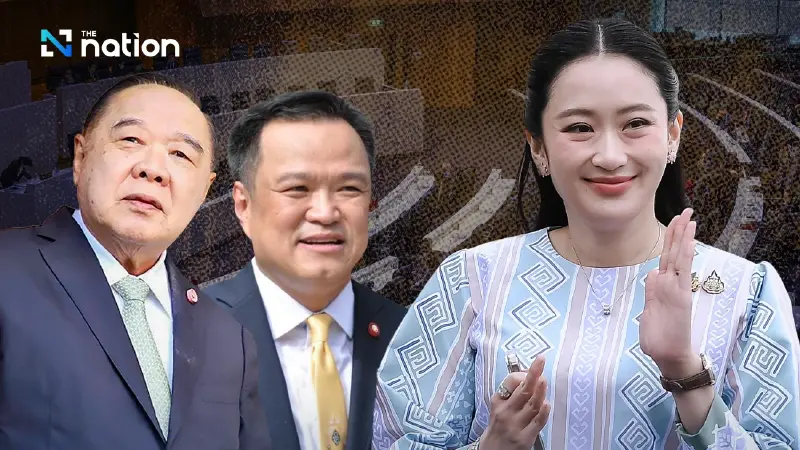


With a host of risks now encircling the government — including Prime Minister Paetongtarn Shinawatra herself — the situation mirrors the internal dynamics of the ruling coalition, where political manoeuvring and strategic one-upmanship are increasingly apparent. This raises a critical question: How far can this fragile alliance truly go before it begins to unravel?
The ruling Pheu Thai Party is set to push forward with its agenda, as the Cabinet line-up under Prime Minister Paetongtarn Shinawatra — dubbed “Paetongtarn 1/2” — appears to have been finalised.
The latest signal suggests that all major decisions have now been centralised under the authority of former prime minister Thaksin Shinawatra, effectively quelling speculation, internal jostling, and last-minute lobbying within the party.
With the withdrawal of the 69-MP Bhumjaithai Party from the coalition, the government’s House majority now stands at an estimated 260–270 MPs — still above the 248-seat threshold needed to maintain power, though with far slimmer margins.
Despite the reduced numbers, Pheu Thai, as the leading party in the coalition, remains confident it can steer the government through turbulent political waters. The party is particularly focused on passing the 2026 fiscal budget bill, which enters its second and third readings when Parliament reconvenes on July 3.
However, mounting risks continue to surround both the government and Prime Minister Paetongtarn herself. Uncertainty also looms over the stability of other coalition members, as intra-party rivalries and power plays threaten to undermine unity.
One notable case is the United Thai Nation Party (UTN), which, despite reaffirming its commitment to the coalition with its 36 MPs, remains visibly fractured.
The party is still reeling from an internal rift that has split it into two rival factions with little sign of reconciliation.
Tensions within the UTN flared up after Deputy Commerce Minister and party deputy leader Suchart Chomklin publicly questioned the prime minister over the Cabinet quota. He criticised the fact that the "Leader P' group" — led by a rival within the party — secured two full ministerial posts, while his own faction received only one minister and one deputy minister position, despite both groups commanding 18 MPs.
Ironically, it was the "Leader P' group" that had earlier threatened to pull out of the coalition if the prime minister was not replaced — a move that now appears to have been rewarded rather than punished.
The United Thai Nation (UTN) Party’s decision to retain its 18 MPs—led by party leader, Deputy Prime Minister and Energy Minister Pirapan Salirathavibhaga (Leader P)—within the coalition has drawn criticism, with allegations that it constitutes a policy reversal and undermines a previous resolution passed by the party’s executive board.
Amid the criticism, Pirapan’s close adviser, Himalai Piewpan, stepped forward to defend the decision, citing three major reasons. Chief among them is the urgent need for the government to pass the 2026 fiscal budget. “The prime minister must act decisively. The government cannot afford to stall at a time when it must push forward the 2026 budget bill, essential for national administration,” Himalai said.
He added that a House dissolution at this juncture would derail the budget process entirely, forcing a restart that could delay funding by at least nine months — a setback the country can ill afford.
Political insiders say the real driving force behind the move stems from a behind-the-scenes agreement between key power brokers on both sides — the conservative establishment and Thaksin Shinawatra, the so-called “big boss”, who are believed to have enlisted Pirapan as a proxy to advance a shared strategic agenda.
At the heart of this informal agreement is a shared interest in pushing forward three major pieces of legislation, all with long-term implications for Thailand’s energy sector. These include:
- The Petroleum Business Regulatory Act, aimed at tightening government control over fuel distribution.
- A law promoting solar energy adoption, expected to fast-track nationwide solar cell installation.
- A strategic oil reserve framework, designed to strengthen national energy security.
Should these bills pass, it would amount to a sweeping reconfiguration of Thailand’s energy architecture. Power and regulatory oversight, currently fragmented across multiple agencies and interests, would be consolidated, enabling greater central control and potentially sidelining entrenched actors in the energy business.
As Parliament prepares to reconvene on July 3, the new political equation is quickly taking shape — and with it, a more aggressive posture from the opposition bloc. Leading the charge is the Bhumjaithai Party, now fully embracing its role outside the government.
In a swift and decisive move, Bhumjaithai is set to submit a motion of no-confidence under Article 151 of the Constitution immediately after the new legislative session begins. This marks the party’s first major action since exiting the coalition and signals its intent to confront the government head-on.

Under Article 151 of the 2017 Constitution, a censure motion must be backed by at least one-fifth of the House of Representatives’ total membership. With the current House comprising 495 MPs, a minimum of 99 MPs must sign in support.
At present, the opposition commands 239 seats in total, divided among the following parties:
- People’s Party: 143 seats (1 aligned with government)
- Bhumjaithai Party: 69 seats
- Palang Pracharath Party: 20 seats
- Thai Sang Thai Party: 6 seats (5 pro-government)
- Fair Party: 1 seat
Although Bhumjaithai alone holds 69 MPs, it still falls 30 short of the 99 required to submit the motion. The party will therefore need support from fellow opposition parties, particularly the People’s Party and Palang Pracharath.
Crucially, the latter is led by Gen Prawit Wongsuwan, who is said to harbour deep grievances over the political realignments that excluded his faction from key positions. Whether this shared frustration will translate into a formal alliance for the no-confidence vote remains to be seen.
While the ruling coalition — now without Bhumjaithai — retains enough MPs (roughly 260–270) to maintain a parliamentary majority above the 248-seat threshold, the political calculus is becoming increasingly complex. Prime Minister Paetongtarn may have the numbers, but her greatest vulnerability could lie not in parliamentary arithmetic, but in what some are calling a “legal battlefield” that is beginning to take shape.
All eyes are now on the Constitutional Court’s meeting scheduled for July 1, where judges are expected to decide whether to accept a high-profile petition seeking the removal of the Prime Minister. The petition, submitted by Senate President Mongkol Surasajja on behalf of 36 senators, alleges serious ethical misconduct linked to a leaked audio clip involving Cambodian Senate President Hun Sen.
The petition cites Section 170, paragraph three, in conjunction with Section 82 of the Thai Constitution, and accuses the prime minister of “severe violations of ethical standards.” Specifically, the case centres on a purported audio recording of Paetongtarn speaking with Hun Sen about the ongoing Thai-Cambodian border tensions — a matter which, the petitioners claim, may have breached Section 170(1)(4), in conjunction with Sections 160(4) and (5) relating to ethical integrity and national loyalty.
In addition to seeking her removal, the petition also urges the court to order the prime minister to temporarily step aside from her duties should the court accept the case for review.
Adding to the legal pressure, a parallel ethics-related complaint has been filed with the National Anti-Corruption Commission (NACC), which convened on June 23 and unanimously agreed to begin a preliminary investigation.
This legal offensive — widely viewed as a coordinated response by conservative forces following their exclusion from the ruling coalition — is now being interpreted as a calculated effort to target the figurehead of the Shinawatra political dynasty. For many in the opposition, Paetongtarn represents not just the current administration, but the political legacy of her father, Thaksin Shinawatra.
Analysts note that this may mark the beginning of a broader strategy to unseat the prime minister through judicial and quasi-judicial mechanisms, with political rivals leveraging independent institutions to apply pressure. These developments have been described by observers as a “high-speed counterattack” orchestrated by factions once aligned with the Shinawatras — now bitter adversaries.
The Senate, still dominated by conservative appointees, and the NACC, where legacy networks of former military-aligned administrations reportedly remain, are now central players in what some are calling a "coordinated institutional offensive."
Former Constitutional Court judge Charan Pakdithanakul has weighed in on the mounting legal challenge against Prime Minister , warning that the court may follow precedent and order her temporary suspension from duty if it accepts the petition filed by Senate President and 35 other senators.
Charan drew a parallel to a 2022 case involving former Prime Minister Gen Prayut Chan-o-cha, who was suspended from his duties after the Constitutional Court accepted a petition to rule on his term limit under Article 158 of the Constitution. Charan suggested that in cases where facts are clear and rooted in constitutional provisions, the court typically proceeds without requesting further clarification from other agencies.
In contrast, he pointed to a recent petition filed against the Senate's selection process, which lacked clarity and required the court to seek input from the Office of the Attorney General before determining its course of action.
While some legal theorists argue that even if the court accepts the petition, it is under no obligation to order the prime minister's suspension, Charan noted that such a decision — whether to suspend or not — carries no bearing on the final ruling. The legal proceedings could still take months.
He cited the example of Prayut’s case, in which the court suspended him but ultimately ruled that his term had not yet ended. By contrast, in the case of former Prime Minister Srettha Thavisin, who was accused of serious ethical violations over the appointment of Pichit Chuenban as Minister to the Prime Minister’s Office, the court did not suspend him, but later ruled that his premiership must end.
The key difference, Charan warned, lies in the current political context. The Paetongtarn government does not enjoy the same strength or stability as previous administrations. The political environment is far more fragile, making any court decision particularly volatile.
Should the court order her suspension, the law dictates that Deputy Prime Minister and Defence Minister Phumtham Wechayachai would become acting prime minister. However, in such a politically sensitive climate, this transition could risk plunging the government into a leadership vacuum, potentially opening the door for political opponents to mount an offensive.
This scenario coincides with an emerging protest movement outside Parliament, driven by anti-Shinawatra sentiment and calls to dismantle the family's political influence. Activists are reportedly preparing a new round of mobilisation in the event of Paetongtarn’s suspension.
While the ruling coalition remains confident in its parliamentary majority, the current political landscape is anything but secure. Observers say the unfolding “legal warfare” — marked by judicial petitions, ethics probes, and coordinated moves through independent institutions — could ultimately pose the greatest threat to Paetongtarn’s premiership.
