
Boonsin prepares to retire, aiming to step down without backlash
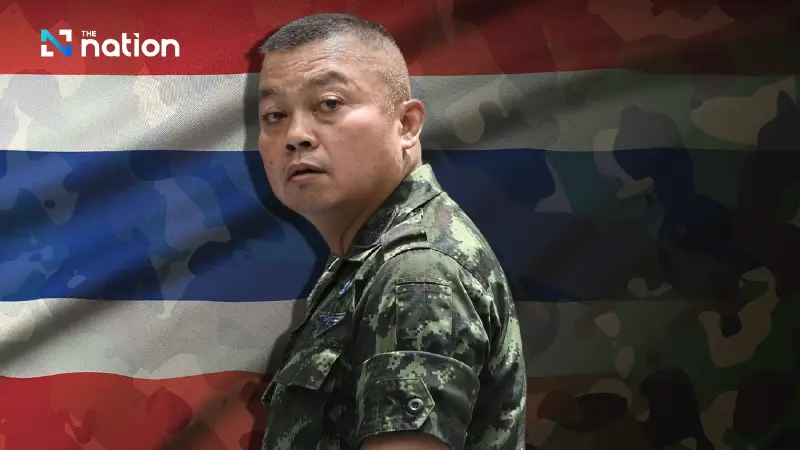


Lt Gen Boonsin Padklang has been receiving intensive guidance from former top generals who once commanded him in joint operations, amid concerns he could face retrospective scrutiny after stepping down from power.
Lt Gen Boonsin Padklang, commander of the Second Army Area, is set to retire on September 30, 2025, at a time when the Thai-Cambodian border situation remains highly unpredictable.
His departure coincides with political turmoil in Bangkok, where Paetongtarn Shinawatra has been removed as prime minister over the Hun Sen audio clip scandal. The country now faces uncertainty over whether a new government will be formed by Pheu Thai or Bhumjaithai, or if Parliament will be dissolved.
Military caution and scrutiny
While the political game unfolds, security circles remain focused on “Mae Thap Kung,” as Lt. Gen. Boonsin is known, with reports that former senior generals have been advising him closely. Their concern is that he could face retrospective scrutiny after leaving office, particularly regarding donations and supplies. He has reportedly been urged to ensure meticulous records, receipts, and accountability to prevent any gaps that critics could exploit.
The risks were highlighted by the resurfacing of a 2015 video showing a senior officer striking a sergeant at Phu Makua, Panom Dong Rak district, Surin. The Army had to clarify that the incident was old and that disciplinary action had already been taken.
Adding to the pressure, a recent public opinion poll found that more than 60% of respondents opposed the idea of a soldier becoming prime minister, underscoring the sensitivities around military influence in politics.
Cambodian pressure and drone intimidation
Although the Thai-Cambodian border dispute is officially a matter of bilateral sovereignty, Hun Sen has repeatedly singled out Lt Gen Boonsin, regarding him as a personal adversary. His decision to shut border checkpoints caused significant losses to Cambodian interests, while also disrupting grey-zone networks of foreign and Thai operators involved in cross-border crime, from call-centre scams to human trafficking.
The fallout has extended to heightened security threats, with swarms of drones spotted over four Thai provinces bordering Cambodia. These flights, believed to be linked to groups hurt by the crackdown, were reportedly used to map Thai military units, weapons depots, and transport hubs, intended as a show of intimidation.
‘If a man has no morality, the nation will collapse’
Boonsin has often framed Thailand’s security challenges through the lens of morality and integrity. “If human beings have no morality in their hearts, they have no value. The nation will collapse from selfishness, favouritism, and the worship of money,” he once remarked.
He added that those who live by principle need not fear legal cases or criticism. “I have never feared anyone in this world. If we act with good intentions for the nation, the land, and the people, and never exploit fame or influence for personal gain, then that is the dignity of being human,” Boonsin said.
With less than a month before his retirement on September 30, Boonsin remains at the centre of both domestic and cross-border tensions. Aware of speculation that he may become a target of legal or political attacks after stepping down, especially from groups affected by his crackdown on cross-border crime, he responded firmly.
“People worry I’ll be targeted after retirement by groups that lost from call-centre scams. I insist I have done nothing wrong. I am ready to fight in every form. As for the Cambodian side marking me as their enemy, I also mark them as mine,” he declared.
Fragile ceasefire and ongoing threats
Although Thailand and Cambodia are officially observing a ceasefire, border conditions remain volatile. Cambodian forces have continued incursions, reportedly laying landmines that have maimed Thai soldiers, causing several severe injuries, including lost limbs.
Army spokesman Maj Gen Winthai Suvaree, in his briefing marking one month since the latest clashes, confirmed that the Second Army Area must remain on high alert. “Cambodian troops continue to threaten Thai soldiers with incursions and landmine planting,” he said.
While Thai forces have been authorised to return fire immediately in self-defence under engagement rules, this raises the risk of further escalation. Any Cambodian gunfire in response could spark renewed clashes at short notice.
The First Army Area has declared martial law in Ban Nong Chan, Sa Kaeo province, after assessing that unrest could escalate into riots and potentially spread into areas under the Second Army’s responsibility.
Winthai admitted the situation remains unpredictable. “It is difficult to say when the conflict will end. There is uncertainty, as conditions change constantly during periods of heightened tension. But the Army is fully prepared, and both the First and Second Army Areas are ready to face any scenario,” he said.
Boonsin tipped for advisory role after retirement
Amid speculation about his retirement on September 30, 2025, reports suggest that Boonsin will be appointed adviser to Army Commander-in-Chief Gen Pana Klaewplodthuk. The role would allow him to continue contributing to efforts to resolve the Thai-Cambodian border crisis. There are also reports that he may be granted a special royal promotion in recognition of his service.
At the same time, Boonsin is said to be considering entering the monkhood to dedicate merit to those who lost their lives in the conflict.
Although his official duties will end with retirement, supporters believe “Mae Thap Kung” will continue to play an active role in national security. Boonsin himself has pledged to see the border issue through, suggesting that his involvement will extend beyond his formal military career until peace is restored along the Thai-Cambodian frontier.
