
Pheu Thai vs People’s Party Battle After Anutin becomes PM
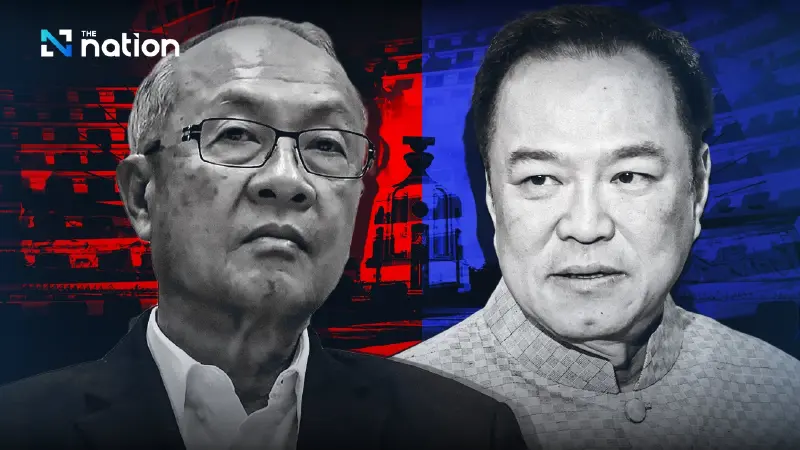


After losing out to Bhumjaithai in the PM race, Pheu Thai is set to target Anutin by drawing the People’s Party into the fight.
The power struggle between three political parties is far from over, even though the "People's Party" has closed a deal to support "Anutin Charnvirakul," leader of the Bhumjaithai Party, as the new Prime Minister.
This support comes with five key conditions, including the dissolution of the parliament within four months.
However, Pheu Thai is still in the game, even though the dissolution of parliament is no longer viable due to the caretaker government's lack of authority. The red camp has played its final card by nominating "Chaikasem Nitisiri," their PM candidate, in a bid to challenge the blue camp. Pheu Thai has proposed an option that the People's Party finds hard to refuse: an immediate dissolution of the House after the policy statement, rather than waiting for four months, as stipulated in the agreement with the Bhumjaithai Party.
Bhumjaithai has managed to gather support from 146 coalition members, with 143 votes from the People's Party, bringing the total to 289 votes in favour of Anutin as Prime Minister.
With Pheu Thai’s House dissolution plan blocked, the political momentum shifts to the People’s Party, which now faces questions about its position as a democratic force opposing the “off-system” games.
Meanwhile, the voices within the People’s Party are divided. One faction wants to vote for Anutin as agreed, while another seeks to reconsider the party's stance and vote for Chaikasem to push for an immediate dissolution of the House.
From Pheu Thai's perspective, the “secret deal” between the People’s Party and Bhumjaithai has long been in place, and it will be difficult to break it. The key issue remains the assistance in legal matters for the People's Party’s inner circle, especially the 44 members facing charges related to lèse-majesté. This is something the party’s leadership need to resolve.
This deal forces Pheu Thai’s power brokers to think through every move carefully to try and win back the support of the People’s Party as an ally.
It must be acknowledged that the People's Party's strength lies in its firm stance on democracy. However, the decision to vote in support of Anutin in forming a minority government has been heavily criticized as a violation of democratic principles. This has raised questions among the People's Party's supporters, who are now scrutinising the party's leadership.
The potential consequence of this move could be political retaliation from Pheu Thai. If Anutin becomes Thailand’s 32nd Prime Minister, the target of criticism may not be the Prime Minister himself, but the leadership of the People's Party.
Pheu Thai has already started preparing a strategy to file a motion for a no-confidence debate immediately after Anutin's policy statement in Parliament.
The main objective is to challenge the People’s Party and scrutinise their involvement in key issues, particularly the controversial "Senate election collusion" and the "Khao Kradong land issue."
If the People's Party refrains from signing the motion alongside Pheu Thai, it will trigger an immediate wave of criticism aimed at them.
During the no-confidence debate, Pheu Thai’s key figures will press on the issues of the "Senate election collusion" and "Khao Kradong land." They will repeatedly question the People’s Party about their position on these matters, putting the party in a difficult spot.
Finally, Pheu Thai will put the People's Party to the test by asking whether they will vote to support Anutin. Pheu Thai expects the People's Party to abstain, and they are prepared to counter this move by arguing that abstaining equals supporting Anutin.
If the game unfolds as planned, the People's Party will find itself in a precarious position.
The People’s Party will face a challenging decision in the upcoming no-confidence vote against Anutin Charnvirakul. If they vote to oppose Anutin, it could cause the deal to collapse, resulting in a significant political loss. However, if they vote in favour of him or abstain, the deal remains intact, but the People’s Party risks losing significant public support.
As a key "swing party" in the ongoing battle between Pheu Thai and Bhumjaithai, the People's Party's decision will inevitably impact their popularity, regardless of which option they choose.
While Pheu Thai's strategy against Bhumjaithai may be a short-term game, their approach towards the People's Party is part of a longer-term play, extending all the way to the next general election.
