
Bhumjaithai’s 4 roadmaps: reviving economy, steering political crisis
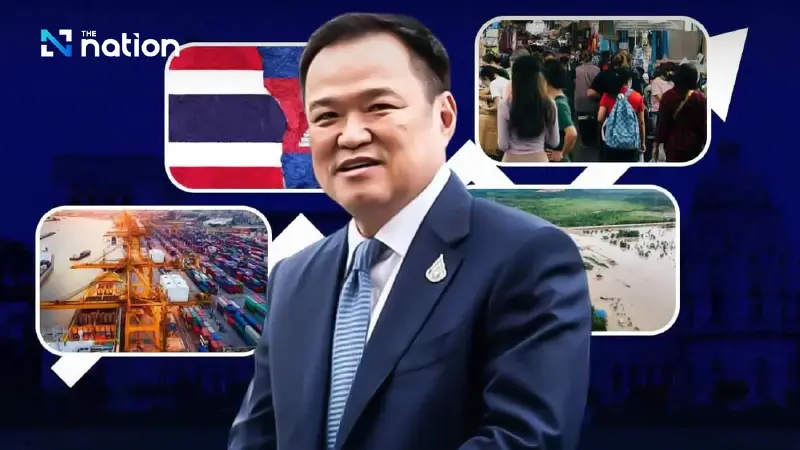


If the Bhumjaithai-led government can turn crisis into opportunity, it could gain a political edge in the upcoming election, emerging as a conservative alternative to Pheu Thai, now weakened by repeated setbacks.
On September 5, 2025, the House of Representatives voted 311 to endorse Anutin Charnvirakul, leader of the Bhumjaithai Party, as Thailand’s 32nd prime minister. Two days later, on September 7, Anutin formally received the royal command appointing him to the post.
The next step will be the finalisation of cabinet positions. Once the line-up of the inaugural “Anutin 1” cabinet is complete, the prime minister will submit the list for royal approval. The cabinet will then take an oath of allegiance before commencing its duties. Government operations will officially begin after the policy statement is delivered to Parliament.
At present, the cabinet’s composition is nearly final, with several incoming ministers already submitting their profiles for qualification checks.
According to the latest arrangement, the Bhumjaithai Party will secure 12 ministerial portfolios. Anutin himself will concurrently serve as Prime Minister and Interior Minister.
Other key appointments include:
Songsak Thongsri as Deputy Interior Minister
Sabida Thaiset as Culture Minister
Phiphat Ratchakitprakarn as Transport Minister
Napinthorn Srisanpang as Deputy Transport Minister
Chaichanok Chidchob as Minister of Digital Economy and Society
Surasak Phancharoenworakul as Minister of Higher Education, Science, Research and Innovation
Supamas Isarabhakdi and Paradorn Prisanananthakul as Ministers attached to the Prime Minister’s Office
Four challenging months ahead for three key economic ministries
Attention is now shifting to the leadership of the three core economic ministries, which will be headed by figures from outside the political parties.
Finance Ministry:
Ekniti Nitithanprapas, Director-General of the Treasury Department, to serve as Finance Minister.
Vorapak Tanyawong, former President of Krungthai Bank, as Deputy Finance Minister.
Pichai Chunhavajira, former finance minister under Paetongtarn Shinawatra’s government, is chief adviser.
Energy Ministry:
Auttapol Rerkpiboon, former CEO and President of PTT Plc, to serve as Energy Minister.
Commerce Ministry:
Jatuporn Buruspat, former commerce minister in the Paetongtarn administration, is to return to the same post.
Beyond the economic portfolios, close attention is also paid to other “outsider” appointments. At the Foreign Ministry, the position is firmly expected to go to Sihasak Phuangketkeow, a seasoned diplomat.
Meanwhile, the Justice Ministry remains under watch due to ongoing high-profile legal cases, particularly the Senate vote-rigging scandal, which includes charges of organised crime and money laundering under investigation by the Department of Special Investigation (DSI). Reports suggest the justice portfolio will be given to an outsider from the police force.
Thamanat unlikely to secure defence portfolio
Under the coalition quota formula, the Kla Tham Party is expected to secure seven cabinet seats. However, the position of the defence minister remains uncertain.
Capt Thamanat Prompow, a party adviser, had expressed his interest in the defence portfolio. Yet signals from Prime Minister Anutin suggest otherwise. Speaking earlier, Anutin stressed the need for “someone with professional expertise,” a remark widely interpreted as narrowing Thamanat’s chances.
According to the latest lineup, Thamanat may be shifted to the tourism and sports portfolio, which previously belonged to the Bhumjaithai Party.
Meanwhile, in the Agriculture Ministry, Attakorn Sirilatthayakorn, who held the same post in Paetongtarn Shinawatra’s government, is slated to return as minister. He will be joined by deputy ministers Phai Lik and Sampan Mayuso.
At the Education Ministry, Narumon Pinyosinwat is tipped to take the top post, with Ongart Wongprayoon, MP for Saraburi, serving as deputy minister.
The Social Development and Human Security Ministry is set to go to Akara Prompow.
Four seats for Palang Pracharath
The Palang Pracharath Party (PPRP) is set to receive four cabinet seats under the new coalition formula.
Earlier speculation suggested party leader Gen Prawit Wongsuwon might take the defence portfolio himself, or serve concurrently as deputy prime minister. However, the latest signals indicate that he will instead nominate Gen Nat Intharacharoen for the post.
This move is seen as a gesture of goodwill towards Santi Promphat, the party secretary-general and leader of the “Sweet Tamarind” faction. By stepping back from the cabinet, Prawit appears to be strengthening Santi’s role and influence.
The Labour Ministry is also expected to fall under PPRP’s quota, with contenders including Trinuch Thienthong and Chaiwut Thanakamanusorn.
Meanwhile, the United Thai Nation Party’s 16-MP bloc, led by Suchart Chomklin, has secured three seats:
Deputy Prime Minister and natural resources and environment minister (Suchart himself)
Industry minister (Yotsingh Liamlert, Suchart’s close ally)
Deputy interior minister (Thanakorn Wangboonkongchana)
For the Sakda Wichiansilp group, comprising eight Pheu Thai MPs and one Democrat MP (Naris Khamnurak), the quota is one minister and one deputy minister.
The Niphon Bunyamanee faction, with three Democrat MPs, will also receive one deputy ministerial post. Due to Nipon’s legal disqualification, his daughter Nithiya Bunyamanee is expected to take the role in his place.
Four months, four roadmaps: Bhumjaithai government sets short-term agenda
The Bhumjaithai-led government has only four months to govern before dissolving the House, under its agreement with the People’s Party. Excluding the caretaker period after dissolution, the administration will effectively remain in charge for six to eight months, possibly longer if unforeseen political complications arise.
Facing challenges on political, economic, and social fronts, Prime Minister Anutin has outlined four roadmaps as the government’s priority framework.
1. Economic relief and stimulus
The immediate focus is on tackling the cost of living. Measures include reducing household expenses, energy and transport costs, restructuring debt for farmers and low-income earners, and boosting community and SME income.
A revival of the “Khon La Khrueng” (Let’s Go Halves) scheme, first introduced under former PM Prayut Chan-o-cha, is being prepared in an updated form, promoted by Bhumjaithai as a new version with added features to rival Pheu Thai’s shelved digital wallet plan.
2. Border security and foreign affairs
The government has pledged to resolve the Thai–Cambodian border dispute peacefully, to prevent further casualties. The military will receive full backing, with Anutin leveraging his close ties to senior generals.
3. Disaster preparedness
Plans include upgrading early-warning and disaster management systems, accelerating compensation for victims, and strengthening recovery mechanisms to deal with increasingly severe natural disasters.
4. Social issues and crime
The administration vows to intensify crackdowns on drug trafficking, human trafficking, scams, and online gambling, while working with neighbouring countries to tackle cross-border syndicates.
Political implications
Though the timeline is limited, success in turning crises into opportunities could give Bhumjaithai a decisive advantage in the next election. The party, once seen as a secondary player, is now positioning itself as a conservative alternative to Pheu Thai, whose reputation has been weakened by political setbacks.
