
Crossroads or separation: UTN faces key decision
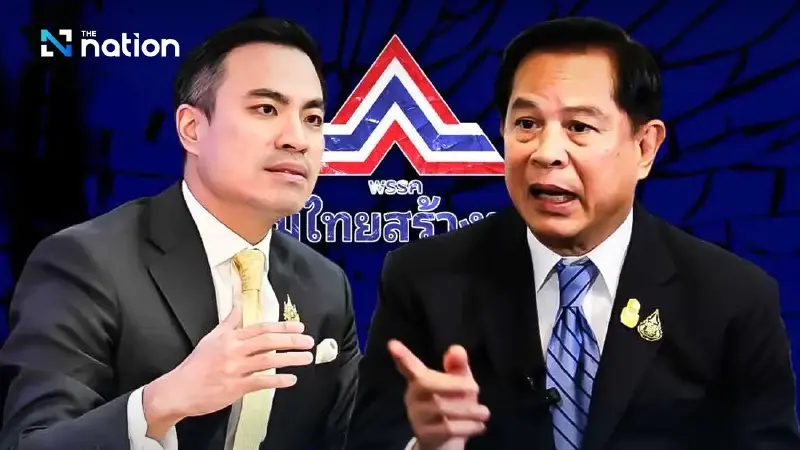


Watch for the UTN's next move: If Pirapan Salirathavibhaga and Akanat Promphan can reconcile, they may unite the party to strengthen its position and challenge for the top spot in the conservative camp."
The vote that saw Anutin Charnvirakul take the position of Thailand's 32nd Prime Minister has shifted the political landscape, pushing parties to reconsider their strategies and quickly reorganise in preparation for upcoming elections.
One such example is the case of the United Thai Nation Party (UTN), which had split into two factions. The first faction, led by party leader Pirapan Salirathavibhaga, teamed up with the party's secretary-general, Akanat Promphan, controlling 16 to 20 MPs.
The second faction, led by Suchart Chomklin, a party-list MP, along with a network of business tycoons, commanded 14 to 16 MPs, aiming to reshape the power dynamics within the party.
With the shift of power to "Suchart's" faction, a list of 16 UTN MPs was submitted, guaranteeing their vote for Anutin. However, when it came time for the vote, 33 out of 36 UTN MPs voted in favour of Anutin, with only 3 abstentions.
The added support for Anutin came from Akanat's team, while the abstentions came from Pirapan's faction. This sparked rumours that Pirapan was dissatisfied with Akanat's voting strategy, as Pirapan had preferred that UTN MPs abstain from voting.
On the other hand, sources indicate that Pirapan sought to build a closer relationship with the Pheu Thai Party, potentially strategising for future political manoeuvring. Pirapan has become well-connected with Thaksin Shinawatra, enhancing these ties.
Meanwhile, Akanat is focused on keeping UTN aligned with the conservative camp. He believes that failing to vote for Anutin would raise questions about UTN’s stance, especially considering the Constitutional Court ruling on the Paetongtarn Shinawatra case, which directly impacted the party's base of support.
All eyes are now on the relationship between Pirapan and Akanat, as their ability to reconcile will determine whether UTN can continue to progress in the upcoming election, especially without the backing of Prime Minister Prayuth Chan-o-cha's influence.
Meanwhile, the group of 16 MPs led by Suchart and Thanakorn Wangboonkongchana, after securing ministerial posts, felt the need to resign from the party's list of MPs to avoid the implications of the party’s decision to send candidates for ministerial roles. As the election nears, it’s expected that these MPs will gradually leave UTN and join a new political party.
Similarly, Himalai Phiwphan has joined forces with his old ally, Thammanat Promphao, the advisor to the Kla Tham Party, and has left behind his former party. He criticised UTN’s key figures, particularly those designated as potential party leaders, and claimed conflicts within the party over leadership.
UTN’s executive board consists of 8 members, with 5 representing Pirapan’s faction, 2 from Akanat’s team, and 1 from the business faction. Therefore, changing the party leader is unlikely unless Pirapan approves, making it challenging to shift the leadership dynamics.
However, Himalai’s move to side with Thammanat is also seen as an attempt to fuel internal divisions within UTN, potentially destabilising the party from within.
Looking ahead, the key question is how Pirapan and Akanat will navigate the "conservative camp" within UTN, particularly as the party’s support surged amid the recent Thailand-Cambodia border conflict. So far, no party has been able to capitalise on this momentum.
The popularity of the "military" as a key figure in the "conservative camp" has yet to be transferred to political parties. Although the "Bhumjaithai Party" is still striving to position itself as the number one "conservative party," the lingering old wounds from "Blue Camp's Boss" remain in the minds of conservative voters.
The key challenge for Pirapan and Akanat is not just aligning with the government but gearing up for the next election, which could happen within the next six months. They need to prepare UTN for this electoral battle.
Moreover, this may be an opportunity to cleanse the party, removing "artificial" members and consolidating the party’s true supporters. If UTN allows the two factions to continue coexisting, it may harm the party in the long term.
The focus will be on how Pirapan and Akanat lead UTN forward, and whether they can unite the party to take a dominant position in the conservative camp ahead of the upcoming election.
