
Democrat Party in turmoil and Abhisit’s possible return
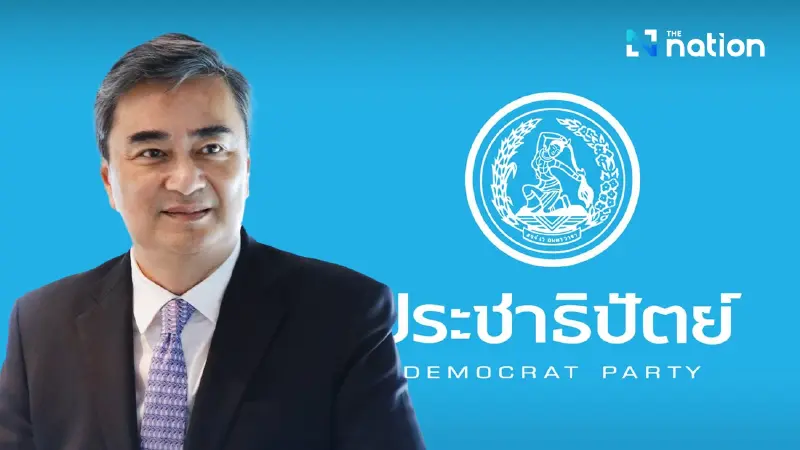


The Democrat Party is in turmoil following the resignation of leader Chalermchai Sri-on, with internal rifts widening. Former prime minister and ex-party leader Abhisit Vejjajiva has been floated as the man to rescue the party’s sinking fortunes — but the question remains: can he truly return?
The Democrat Party has been thrown into disarray following the resignation of party leader Chalermchai Sri-on, who stepped down less than two years after assuming the position.
In his resignation letter, Chalermchai cited health reasons, echoing what he had previously confided to party members and affiliated media, that he was prepared to retreat into a behind-the-scenes role in a “new political mode” if a suitable successor emerged.
At that time, speculation swirled that the transition might take place near the next general election, with the name of former party leader and prime minister Abhisit Vejjajiva already being floated.
However, political shifts triggered an election much earlier than expected, compounding the Democratic Party’s internal tensions.
Rifts among key figures have surfaced, particularly in the relationship between Chalermchai and party secretary-general Dech-it Khaothong.
Although Chalermchai has repeatedly insisted the two maintained reasoned discussions and never quarrelled, insiders suggest their rapport has soured to the point where they could “barely look each other in the eye.”
Meanwhile, reports have circulated of southern party heavyweights exploring deals with “capital-based parties,” while others were seen courting the “blue camp (Bhumjaithai).” This was reinforced by the visible presence of blue-camp leaders and influencers in key southern constituencies.
Amid the scramble to revive plummeting approval ratings, Abhisit’s name has resurfaced, with talk intensifying about his possible return to leadership.
Divisions have also emerged in the Democrats’ stance towards coalition politics. Chalermchai leaned on the party executive’s resolution granting him sole authority. He explained that the joint press conference with Pheu Thai was held in his capacity as part of the outgoing government, though it was interpreted by some as an olive branch extended to the blue camp.
By contrast, Dech-it declared unwavering support for Pheu Thai, vowing that he would “lose all credibility as a man” if the Democrats aligned with a party tainted by scandals such as the Khao Kradong land case and Senate election collusion scandal.

Adding to the drama, deputy leader Chaichana Dechdecho posted a photo alongside former Democrat stalwart Korn Chatikavanij with the hashtag #thefutureisalwaysbright, on the very same day Chalermchai tendered his resignation.
These overlapping signals of dissent, defections, and factionalism appear to have compounded the pressure on Chalermchai, with analysts pointing to them as the “final straw” that ultimately forced his decision to step down.
With the Democrat Party’s popularity in steep decline, many eyes have turned once again to Abhisit, the embodiment of the party’s “DNA” and a former leader during its more successful years. His name is the first to be floated as a possible figure to restore the party’s ratings.
Looking back at election results under his leadership offers a mixed record. In 2011, the Democrats secured 159 seats in the House. By 2019, after years of political stagnation, that number plunged to 53. Yet even then, the party still held enough bargaining power to claim the second-largest role in Gen Prayut Chan-o-cha’s coalition government.
This time, however, the balance of power within the party is far more fragmented. The choice of a new leader will ultimately rest with three groups of “voters” inside the party:
- Group one: current MPs, who hold 40% of the vote at the party congress. With 25 MPs in total, 22 from constituencies and three from the party list, the strongest bases remain in Nakhon Si Thammarat and Songkhla, each with six MPs.
- Group two: members of the executive board, controlling 20% of the vote.
- Group three: other party figures, including former leaders, ex-secretaries-general, sitting and former ministers, party branch chiefs and provincial representatives, making up the remaining 40%.
In total, the decisive weight lies with the first two groups, which command 60% of the votes, still dominated by the party’s traditional power blocs: Chalermchai’s camp, Dech-it’s camp, and Chaichana’s camp. Where these factions throw their support will shape the outcome.

For now, speculation is divided. One faction is pushing hard for Abhisit’s return, encouraged by strong momentum and cheerleading from the grassroots. Another, however, questions how he would fit into today’s political equation. With Dech-it already pledging 100% loyalty to Pheu Thai, critics ask where Abhisit would stand, and whether his stance would clash with the party’s current trajectory, like oil and water.
Another scenario now circulating within the Democrat Party is that the new leader may still come from the “old power” bloc, with speculation pointing squarely at party secretary-general Dech-it .
This aligns with the view of Sirichok Sopha, a former Songkhla MP and close ally of Abhisit, who argued that under the party’s existing structure and ideology, he remains unconvinced Abhisit will return as leader.
Most recently, Dech-it held a constituency branch meeting in Songkhla, where light-hearted remarks were made suggesting the next leader might well be “a son of Songkhla.”
Adding fuel to the speculation was a message posted by Dech-it in the Democrats’ MPs’ Line group on September 13, shortly after Chalermchai's resignation. He wrote:
“Dear Democrat brothers and sisters, our leader has resigned, whatever the reasons. This is a delicate matter for our party, and I urge you to remain calm. Let us treat this as a family matter. Do not be shaken or alarmed; there is always a way forward. I reaffirm that I will remain a pillar for us all. Next week we will meet to discuss the initial problems together and find a shared solution.”
The message was widely interpreted as a signal that Dech-it intends to keep the balance of power firmly in his hands.
All of this reflects the “deep game” unfolding inside the party. The key question is whether Abhisit will ultimately emerge as the party’s true leader once again or merely a placeholder in a larger power play. In the end, it will be the party’s voters who decide which faction closes the deal and seizes control.
