
People’s Party proposes 3 PM candidates to avoid legal risks
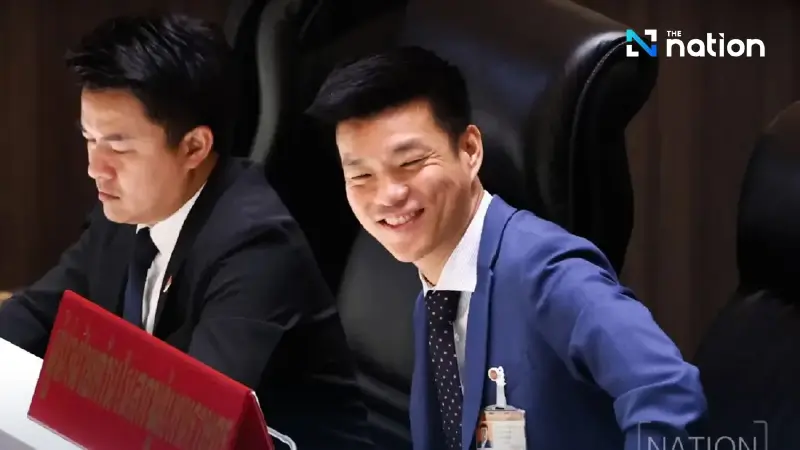


The People’s Party unveils a new strategy for the next election to avoid the impacts of "legal warfare" that led to the dissolution of the party twice. A key tactic is proposing three prime ministerial candidates to mitigate risks if the main candidate faces political disqualification.
The "Orange Camp" (People's Party) is facing heavy criticism following its decision to vote in support of the Bhumjaithai Party, which has led to its leader, Anutin Charnvirakul, being nominated as the 32nd Prime Minister.
This decision has caused considerable shock both internally and externally.
Critics from the “far-left” faction within the “Orange Camp” argue that supporting the “Blue Camp” (Bhumjaithai Party) to take power was ultimately “not worth the cost.” They believe that the “Red (Pheu Thai Party)-Blue ” conflict is untrustworthy, and that the political crisis unfolding is the direct result of the ongoing struggle between the two, with no involvement from the "Orange" faction.
Therefore, they argue that the “Orange” group should remain neutral and focus solely on the principle of “dissolving the House of Representatives.”
Meanwhile, the “Centre-left Orange Faction” supports the decision, viewing it as a necessary move to “break the deadlock” and prevent the possibility of an “outsider” prime minister from entering the parliamentary system.
Most importantly, this decision is seen as a step towards pushing for constitutional reform, a key goal for the “Orange Camp” since the founding of the Future Forward Party. This marks the first step in unlocking the political system, with other issues to be addressed in the next election.
There have been some rumours suggesting that the primary reason the “Orange Camp” decided to support the “Blue Camp” this time was due to a “secret deal” between top figures from both factions.
This supposed agreement would involve “delaying” certain cases currently under investigation by independent organisations, allowing the Orange Camp to still participate in the next election once the new constitutional amendments are completed. However, the "Orange Camp" executives quickly and repeatedly denied these rumours.
Interestingly, Natthaphong Ruengpanyawut, leader of the People’s Party, gave an interview on September 16 about their strategy for the next election. He mentioned that the public’s feedback indicated a preference for ministers with expertise in various fields, who are outside the political sphere.
He confirmed that his party is ready to introduce the next cabinet if entrusted with the responsibility of running the country, assuring that each minister will be respected in their respective field.
He also emphasised that the cabinet will include both political insiders and outsiders. Furthermore, he expressed confidence that his party would be able to move forward as a governing party in the next election, depending on the trust of the people.
“I am ready to be the best cabinet to run the country. However, since the election has not yet fully commenced, I cannot announce names yet. As for the prime ministerial candidate, it’s likely to be me. I confirm that we will have more than one prime ministerial candidate, but I am not revealing who they are just yet,” Natthaphong stated.
This suggests that the “Orange Camp” is well aware of the strategic games of the “2017 Constitution,” as they’ve already faced "legal warfare" leading to their party’s dissolution twice in just 7 years.
Sending only one prime ministerial candidate, as in the past (Future Forward Party’s Thanathorn Juangroongruangkit in 2019 and Move Forward Party’s Pita Limjaroenrat in 2023), may not be politically advantageous if unexpected situations like the current one arise.
It is undeniable that one of the key reasons the "Orange Camp" has had to endure legal battles and had its party dissolved twice is because they were seen as a “threat” by the conservative factions, which still hold power in this country.
This is largely due to their policies on “institutional reforms” and their push to amend Section 112 (Lèse-majesté law) of the Penal Code.
However, after the Constitutional Court’s ruling to dissolve the Move Forward Party, based on their campaign promise to amend Section 112, which was deemed as a threat to the government and a call for an overthrow, the situation for the “Orange Camp” seemed to “calm down” almost immediately.
They removed the policy to amend Section 112 from their website, and this issue has rarely been brought up in parliament again, aside from occasional mentions by individual MPs on a personal level or discussions about granting amnesty for those facing charges under Section 112.
Recently, Natthaphong gave an interview with TIME, a major global media outlet, where he reiterated his stance, saying that while some aspects of this law still have issues, any amendments would have to be made within the framework of the Constitutional Court’s ruling. As for whether the party will face political upheaval, particularly regarding legal warfare, he could not predict it, as it is a factor beyond their control.
This reflects that the “DNA” of the Future Forward Party still flows within the People’s Party, even though they must “hold back” on the issue of Section 112 for now. Their strategy is to wait until they win a landslide victory in the next election, thus creating a “societal consensus” to amend Section 112 without worrying about complaints or party dissolution.
However, if they decide not to pursue this issue, they will have to explain it to their "Orange Camp" supporters, as it is difficult to deny that the majority of their base strongly supports this policy.
Therefore, in the upcoming election scenario for the "Orange Camp," there are two key aspects to watch:
Will the policy regarding Section 112 be used in their campaign or advocacy in any form? If it is, how will they "navigate" to avoid violating the Constitutional Court's ruling?
The new prime ministerial candidates from the party are expected to be three individuals to prevent a "political vacuum" like the current situation. The top three potential candidates include Natthaphong, followed by Sirikanya Tansakun, Deputy Leader of the Party, and Weerayuth Kanchanachuchat, Deputy Leader of the Party and a close friend of Thanathorn Juangroongruangkit.
However, Natthaphong and Sirikanya are among the 44 MPs from the Move Forward Party under investigation by the National Anti-Corruption Commission (NACC) for allegedly violating ethical standards related to their involvement in proposing an amendment to Section 112.
Currently, 25 of these 44 MPs are still in parliament. This case will be a critical “make or break” point for the “Orange Camp” in determining its political future. This also applies to several of the “second-tier” leaders who are facing similar challenges.
Given this, the interview with Natthaphong about the new cabinet's composition, should they win the election, reflects a somewhat cautious stance. The political outcome is uncertain, and if the results are “unfavourable,” they might have to rely on "outsiders" to join the "Orange Cabinet" temporarily, possibly left-leaning academics or businessmen with connections to Thanathorn.
However, if a “secret deal” indeed exists, as some rumours suggest regarding the “44 MPs case,” it might be delayed until after the next election. The alliance between the "Orange" and "Blue" Camps could potentially occur again to strengthen their power against the "Red Camp."
