
ฺBhumjaithai submits constitutional amendment, barring changes to Chapters 1 and 2
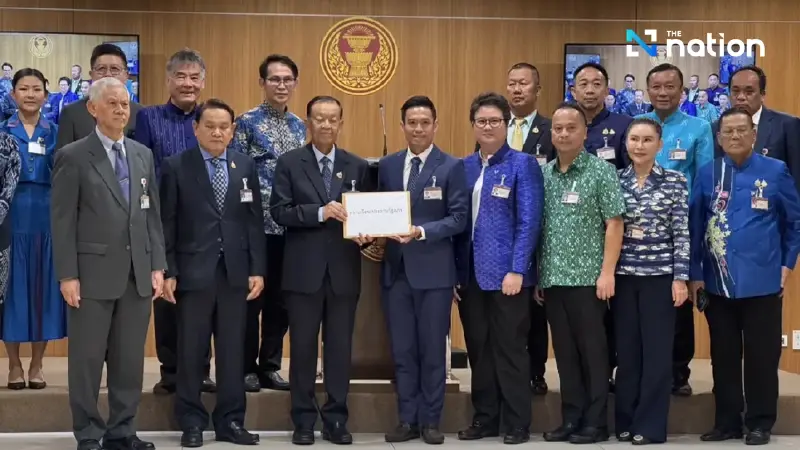


Bhumjaithai MP leads coalition parties to submit constitutional amendment; Wan Noor calls for whip meeting to discuss joint parliament session"
Angthong MP Korrawee Prissananantakul, along with several other MPs from the Bhumjaithai Party, submitted a proposed amendment to Section 256 of the Constitution to House Speaker Wan Muhamad Noor Matha, in his capacity as President of the National Assembly.
Nan Boonthida Somchai, an MP from Ubon Ratchathani, announced that 100 MPs from the Bhumjaithai Party and government coalition parties had signed and jointly submitted the draft amendment.
The next step is to await the inclusion of the agenda for consideration.
After receiving the documents, Wan Muhamad Noor stated that the documents would be submitted to officials for verification according to the proper legal procedures.
A meeting of the joint whip will be scheduled for 2pm on September 25, to discuss the government’s policy debate and the consideration of the constitutional amendment draft.
The meeting will determine the date for the debate and decide which political party's draft will serve as the main proposal.
The key content of the proposed amendment to Section 256 aims to adjust the proportion of votes required from Senators to approve the constitutional amendment in the first and third readings. The requirement would be reduced from at least one-third of the total number of Senators to one-fifth.
Currently, with 200 Senators, this would reduce the required number of votes for supporting the constitutional amendment from 67 votes to just 50 votes.
Additionally, a new chapter 15/1 is added to establish a Constitutional Drafting Assembly (CDA) consisting of 99 members. Parliament will select candidates in two groups:
- 77 members from various provinces, with one representative from each province.
- 22 experts or those with experience in public law (7), political science or public administration (7), and constitutional drafting or public administration (8), as determined by the Parliament President.
To qualify for the CDA, candidates from provinces must be Thai citizens by birth, at least 25 years old, have a degree at least at the bachelor’s level, and meet certain residence and education requirements in the province where they are applying. They must have lived in the province for at least one year or have worked or studied there for at least one year.
The disqualification criteria for candidates running for CDA are based on qualifications outlined in the Constitution for candidates running for the House of Representatives (MPs). Notably, the amendment prohibits current MPs, Senators, or political officials from running for the CDA. It also bars individuals temporarily suspended from the right to run for election or those who have had their electoral rights revoked.
According to reports, the coalition's proposed constitutional amendment specifies that the CDA must be selected within 90 days of the need to draft a new constitution. The Election Commission (EC) will be responsible for accepting applications from qualified candidates, with no limit on the number of applicants.
The list will then be submitted to the President of the National Assembly, who will schedule a vote within 20 days of receiving the complete list.
As for the voting criteria, MPs are required to select one candidate from each province, with the highest vote-getter from each province being chosen. Additionally, a reserve list will be created from the next three highest vote-getters in each province.
For the selection of experts, Parliament will choose the specified number of experts: 7 public law experts, 7 political science or public administration experts, and 8 individuals with experience in politics, public administration, or constitutional drafting, as determined by the President of the National Assembly.
Candidates will be selected based on the highest vote counts until the required number is met, and a reserve list of three candidates per category will be maintained.
The coalition's proposed amendment for the drafting of a new Constitution stipulates that the CDA will establish a 45-member constitutional drafting committee. Thirty of these members will be elected by the CDA itself, while the remaining 15 will be appointed by individuals who are not part of the CDA but must possess the necessary expertise and qualifications.
The amendment specifies that the drafting of the new Constitution must be completed within 360 days.
Additionally, the draft establishes content limitations for the new Constitution, prohibiting any changes to the democratic form of government with the King as the head of state, as well as any changes to the structure of the state. It also bars amendments to Chapter 1 (General Provisions) and Chapter 2 (The King) of the 2017 Constitution.
Once the new Constitution is drafted, it will be presented to Parliament for approval, which will be done in three readings. The approval process will include a requirement for at least one-fifth of the Senate and 20% of opposition MPs to support the draft.
If Parliament approves the draft, a referendum must be held within 7 days.
Furthermore, the amendment grants Parliament the power to reject the new Constitution if it contains content that alters the form of government or changes Chapters 1 and 2 of the 2017 Constitution.
If the draft Constitution is rejected, the Cabinet, or at least one-third of the MPs or MPs and Senators, may propose a motion to Parliament to initiate the drafting of a new Constitution for a second time.
