
Nepalese army moves to restore order after protest
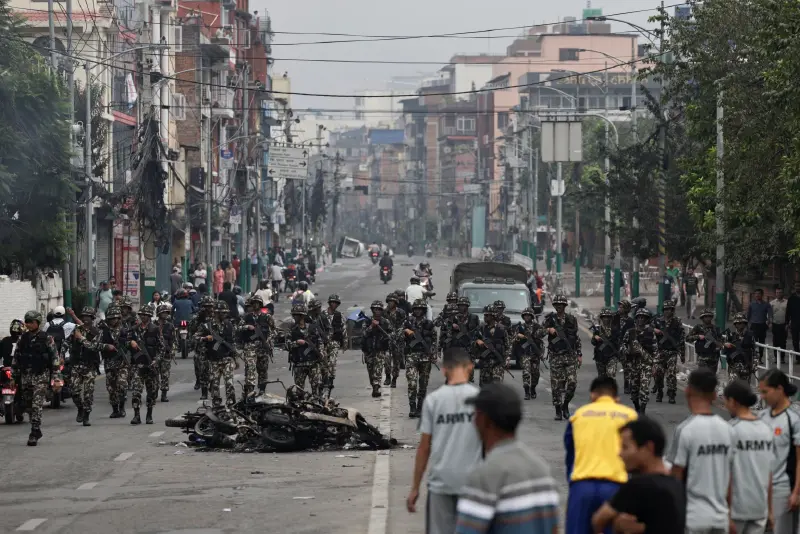


Armed soldiers guarded Nepal’s parliament while the streets of Kathmandu remained eerily quiet on Wednesday (September 10), after an indefinite curfew was imposed. This came in response to two days of violent anti-corruption protests that forced Prime Minister K.P. Sharma Oli to step down.
The unrest, the worst the country has seen in decades, began following a social media ban announced last week, which was reversed after 19 protesters were killed on Monday. Police had used tear gas and rubber bullets to disperse crowds.
In the aftermath, the area surrounding parliament was left in ruins, with burnt vehicles and twisted metal scattered across the streets. The main hall of parliament was still smouldering, as army firefighters worked to extinguish flames started by angry demonstrators. The exterior of the building was charred after protesters set it on fire on Tuesday.

"We are focusing on normalising the situation first," said Army spokesman Raja Ram Basnet. "We are committed to protecting the life and property of the people."
Military Presence and Continued Curfew
Armoured vehicles patrolled the empty streets, where only a few pedestrians could be seen. Shops and markets were closed.
Several government buildings, including the Supreme Court, ministers’ residences, and even Oli’s private home, were also set ablaze in Tuesday’s protests. The unrest only began to subside after the Prime Minister’s resignation.
The Tribhuvan International Airport in Kathmandu was shut down until 6 p.m., disrupting flights, according to an airport spokesperson.
Efforts to Resolve the Crisis
The army announced on X (formerly Twitter) that prohibitory orders would remain in place until Thursday morning. The army also stated that authorities and protesters were coordinating efforts to resolve the situation.
Media reports indicated that preparations were being made for potential talks between the government and protest leaders, though details were scarce. Reuters could not independently confirm this.

Former Supreme Court judge Balaram K.C. urged the protesters to form a negotiation team, with the army helping maintain law and order. He also called for fresh elections and the formation of a new caretaker government.
"Parliament should be dissolved, and new elections should be held," K.C. told Reuters. "They should discuss forming the next caretaker government."
A Nation in Crisis
The protests were primarily driven by young people frustrated with the government’s failure to tackle corruption and provide economic opportunities.
For years, Nepal has faced high unemployment, forcing millions to seek work abroad, particularly in Malaysia, the Middle East, and South Korea, where many are employed in construction jobs to send money home.
Nestled between India and China, Nepal has long struggled with political instability and economic challenges, particularly after protests led to the abolition of its monarchy in 2008.
In response to the growing crisis, India’s security cabinet met late on Tuesday to discuss Nepal’s situation.
"Nepal’s stability, peace, and prosperity are of utmost importance," said Indian Prime Minister Narendra Modi in a post on X. "I humbly appeal to all my brothers and sisters in Nepal to maintain peace and order."
Reuters
