
From Solar Power to Sustainable Livelihoods, How Clean Energy is Bringing Families Back Home in Udon Thani
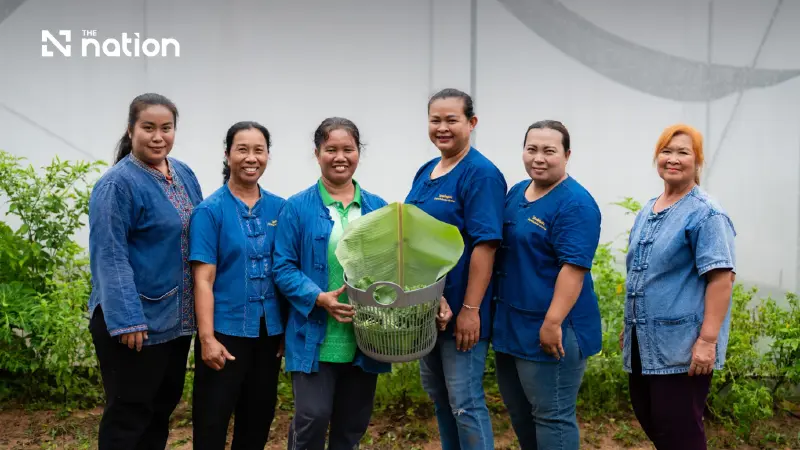


What do people want most in life? For many residents of Ban Khok Lam and Ban Saeng Aram in Kud Mak Fai Subdistrict, Nong Wua So District, Udon Thani Province, the answer is not wealth or material possessions.
Rather, it is the opportunity to live alongside their loved ones, in the place they call home, while earning a secure and sustainable livelihood.
Today, that aspiration is becoming a reality.
From Drought-Stricken Land to Sustainable Agriculture
For decades, life in Ban Khok Lam and Ban Saeng Aram was defined by water scarcity. After each rice-growing season, many villagers had little choice but to leave their hometowns in search of work elsewhere in Thailand or overseas, sending money back to support their families. Mr. Sawet Janhom, former village headman of Ban Saeng Aram, recalls the challenges vividly.
"Our communities faced chronic drought for many years. Water was insufficient not only for household consumption but also for farming. Villagers therefore submitted a petition through the Office of the Royal Development Projects Board. The late king, His Majesty King Bhumibol Adulyadej graciously accepted the issue as a royal initiative project, leading to the construction of Huai Khlai Reservoir to address water shortages in the area."

While the reservoir was a crucial first step, the absence of an effective water distribution system meant that local farmers could not fully benefit from the available water. As a result, seasonal migration continued, with working-age residents leaving their families behind to seek income elsewhere.
A turning point came when the Pid Thong Lang Phra Foundation, together with relevant agencies, introduced a systematic approach to water resource management. Beyond developing the reservoir, the initiative focused on empowering the community through water user groups, shared management rules, and collective stewardship of local resources.
At the same time, the Foundation applied the principles of the King's Philosophy, promoting a transition from monoculture farming toward integrated and organic agriculture. Farmers were encouraged to cultivate high-value crops in protected greenhouses, gradually transforming the community into a successful agricultural enterprise known for producing safe, high-quality vegetables supplied to local markets and modern retail chains.

GULF Expands Opportunities Through Solar-Powered Agriculture
Building on this success, Gulf Development Public Company Limited (GULF) has stepped in to further strengthen community development efforts.
GULF supported the construction of 10 safe-vegetable greenhouses, along with a comprehensive solar-powered irrigation system consisting of solar water pumps, elevated water storage tanks, transmission pipelines, and water distribution networks serving agricultural plots and surrounding community areas.
The initiative enables residents to cultivate vegetables, fruit trees, and economic crops while advancing toward the concept of “Three Forests, Four Benefits” for long-term environmental and economic sustainability. The project helps reduce household expenses while creating stable employment and income opportunities for local families.
According to Mr. Sawet, the impact extends far beyond infrastructure.
"GULF's support is not only about technology or water systems. It has genuinely improved the quality of life of people in our community. Elderly farmers no longer need to carry water manually as they once did. More importantly, the project has created jobs, occupations, and income opportunities right here at home."
Each greenhouse production cycle takes approximately 45 days and generates an average income of THB 4,000-5,000 per cycle. With up to eight production cycles per year, participating farmers can earn more than THB 32,000 annually per greenhouse in additional income.
"Many families have started returning home to live together once again," he added.

The Joy of Staying Close to Family
For Ms. Yupa Kaewkoed, joining the project marked a significant turning point in her life.
Before participating, she worked as a daily wage laborer, taking on sugarcane harvesting, cassava digging, and rice farming jobs that paid around THB 300 per day.
When she learned about GULF's greenhouse initiative, she immediately applied.
"The solar-powered water system has changed everything," she said. "I no longer spend hours carrying water. The system is convenient, efficient, and saves time. After watering vegetables in the morning, I can take my children to school and continue with other work. In the evening, I return to care for the greenhouse."
Beyond improved productivity, greenhouse-grown vegetables are fresher, safer, and command higher market prices due to their quality and chemical-free cultivation methods.
"The most important thing is that I can stay home with my family. I can take care of my parents, watch my children grow up, and earn additional income without relying on debt. My quality of life has improved tremendously, and I am happier every day."

A similar story is shared by Ms. Pornthip Panisut, who spent more than five years working in a bottled water factory in Bangkok before returning home following her father's passing.
Initially, she relied on irregular agricultural labor, earning between THB 300 and 450 per day.
"Being selected as one of the greenhouse farmers supported by GULF became a life-changing opportunity," she said.
"After several months, the results have been remarkable. The irrigation system makes farming easier, the vegetables are healthier, and the quality of produce has improved significantly. But more valuable than the income is the chance to spend every day with my family. Every morning, I wake up and see my mother and my child. That feeling is priceless."
Likewise, Mr. Boonhom Phanphrom, who spent more than a decade working abroad before returning to his hometown, says the project has helped transform his family's future.
"GULF's support for solar-powered pumps, elevated water tanks, and irrigation networks has reduced labor burdens while increasing family income. Within just a few months, I was generating several thousand baht in additional income each month while still having time to care for my family and manage other farming activities."
"Today, I can earn, save, and spend more comfortably. Most importantly, I have more time with my family and greater happiness in my daily life."

Clean Energy Powering a Better Future
The story of Ban Khok Lam and Ban Saeng Aram demonstrates how clean energy can do far more than power machinery. What was once drought-stricken land has become a landscape of opportunity. Communities that once watched their workforce leave for distant cities are now witnessing families reunite and thrive together at home.
Through the simple transformation of sunlight into water for agriculture, solar energy is creating something even more meaningful: hope. It is helping generate stable incomes, strengthen local livelihoods, bring loved ones back together, and steadily improve the quality of life for generations to come.
