
CKPower weaves new possibilities through Hinghoi Studio
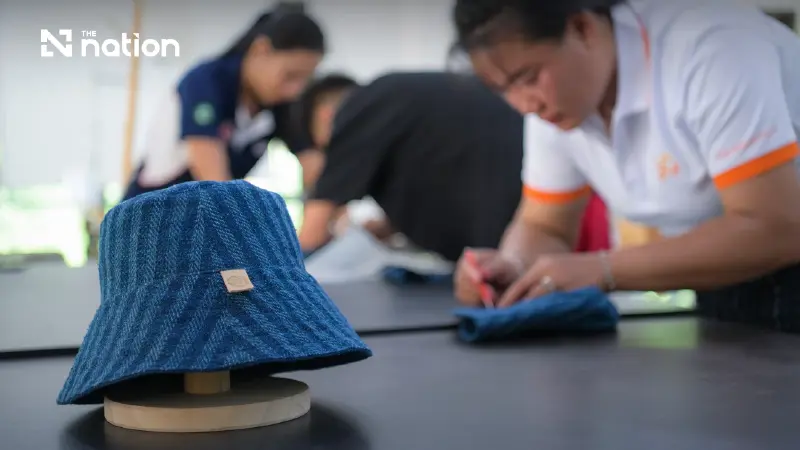


In Luang Prabang, a community craft studio brings local craft knowledge and contemporary design together to develop skills, preserve local knowledge and create opportunities for future livelihoods.
The future of Luang Prabang’s craft traditions lies in the hands of the people who keep using them. At Hinghoi Studio, CKPower and Luang Prabang Power Company Limited (LPCL) are helping local communities develop the skills to carry that knowledge forward, bringing handwoven textiles and contemporary design together to open up possibilities for work, income and creative expression.
Opened in November 2025, the studio is a learning and creative space for communities around the Luang Prabang Hydroelectric Power Project in Laos. Its purpose connects an everyday activity, learning to make something well, with a longer-term ambition: enabling people to build livelihoods from the knowledge and cultural resources within their own communities.
LPCL, an associate company of CK Power Public Company Limited, or CKPower, and the company responsible for the hydropower project, developed the studio as part of that commitment. For residents, children and young people, it offers a place to explore how the fabrics and skills associated with Luang Prabang can find new uses in contemporary life.

A place to learn by making
Craft skills take shape through practice. Since opening, Hinghoi Studio has continued to organise activities that let local residents and young people work with materials, use equipment and create pieces. Training covers sewing-machine operation, sewing techniques and product construction, with a focus on applying those skills to distinctive local textiles.
The studio works with Luang Prabang Vocational Technical College to connect craft and design instruction with practical experience. Workshops guide participants through using sewing machines and assembling pieces, helping them develop skills that can be taken into further learning and future work.
Participants also receive certificates to support their continuing vocational development. The aim is to provide a foundation from which learners can develop their own capabilities and explore possible career paths in craft.
For children and young people, this creates an opportunity to encounter local heritage through making. A piece of woven cloth becomes something they can work with, adapt and use as the starting point for a creative product. The connection between inherited knowledge and newly acquired skills is at the heart of the studio’s learning approach.

Local identity in products for everyday life
The starting point for Hinghoi Studio’s products is the local craft knowledge of Luang Prabang’s communities. This heritage carries a distinctive identity that the project aims to retain as they are contemporary craft products.
Through cutting, sewing and design, the studio explores ways to turn traditional fabrics into products suited to everyday use and the needs of today’s consumers. Attention to function sits alongside the craftsmanship, detail and cultural character that make the materials distinctive.
This approach gives product development a cultural purpose. As local textiles are used in new designs, the knowledge behind them continues to be practised and shared. Community members can build on familiar materials while considering how those materials might meet different needs.
The same process creates a connection between generations. Young people have opportunities to learn from local craft knowledge and develop the skills to give it their own practical expression. Preserving heritage becomes part of making and learning, with traditional techniques and contemporary creativity informing one another.

Partners who bring the learning space to life
Hinghoi Studio brings together the resources of business, public agencies, education and the community. Each partner contributes to a different part of the learning environment, from the building itself to the knowledge shared inside it.
Luang Prabang’s provincial industry and commerce department supports and endorses the centre’s operations. Luang Prabang Vocational Technical College contributes craft and design expertise, helping connect training with skills relevant to practical work and future occupations.
CH. Karnchang (Lao) Co., Ltd. supported the development of the site and its infrastructure, including construction of the studio building. The facility was built to meet structural standards and designed to sit comfortably within the architectural character of the World Heritage city of Luang Prabang.
The building’s design reflects the project’s attention to local context. A space created for contemporary learning also respects the cultural setting in which that learning takes place.
For CKPower and LPCL, these partnerships are an essential part of the studio’s purpose. Cooperation gives community development access to facilities and educational expertise, while keeping local people and their knowledge at the centre of the activities.

Community opportunity within a wider programme
Hinghoi Studio forms part of CKPower’s CSR Strategy Framework 2022–2026, under the programme “Hinghoi: Co-creating innovations to enhance opportunities for communities” and its One Power Plant One Product (OPOP) approach.
The framework brings together knowledge, innovation and partner organisations to develop community capabilities. Its long-term objective is to help communities strengthen their ability to support themselves, with skills and product development contributing to income-generating opportunities.
The broader programme provides context for that ambition. CKPower reports that, cumulatively between 2022 and 2025, it developed six community products and generated 2,818,567 baht in community income. The results cover the wider programme during that period and are not figures for Hinghoi Studio alone.

Three contemporary products developed by redesigning woven textiles accounted for 2,402,850 baht. School cooperative activities generated 1,880 baht, processed fermented fish products (pla som) generated 30,297 baht, and support for community vocational training in Luang Prabang generated 383,540 baht.
The figures bring together several kinds of community activity, with local knowledge and resources providing the basis for product development and income opportunities. Hinghoi Studio carries that approach into a dedicated space for learning and craft.

Keeping knowledge in the hands of the next generation
For CKPower and LPCL, the studio connects community development with the long-term presence of the Luang Prabang Hydroelectric Power Project. The underlying commitment is to support people’s capabilities alongside the project’s long-term development, with cultural heritage and local economic opportunity considered together.
That ambition begins with skills people can use. Sewing, design and product construction offer ways for residents to develop their craft and for younger learners to consider how local knowledge might become part of their future work.
Hinghoi Studio also gives cultural continuity a practical setting. When people use traditional textiles, pass on techniques and develop new products, they help keep the knowledge within those materials in circulation. The community remains part of how its heritage is interpreted and carried forward.
Through this combination of learning, partnerships and contemporary craft, CKPower and LPCL aim to create lasting opportunities rooted in Luang Prabang’s own identity. At Hinghoi Studio, the work begins with a piece of cloth and a skill to be learned, with the possibility that both can become part of a future livelihood.
