
BOT's rep office in Beijing officially opened
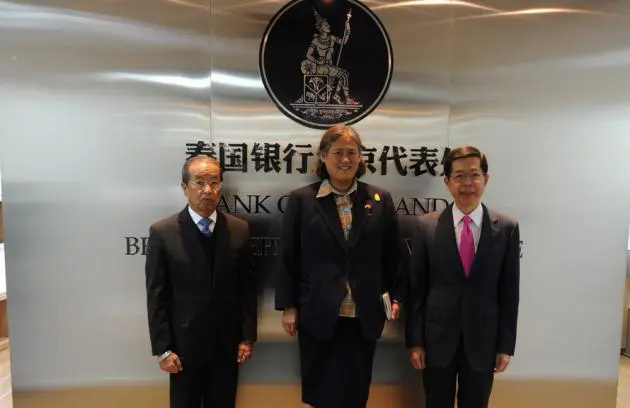


Bank of Thailand has officially opened its representative office in Beijing, China, to gain first-hand knowledge of economic and financial developments in the world's second largest economy.
The representative office, the third after the ones in New York and London which were opened in 1990 and 1993, respectively, also aims to strengthen cooperation and financial ties between Thailand and China over the long term.
The official opening ceremony on April 6 was presided over by HRH Princess Maha Chakri Sirindhorn.
"The increasingly important role of China to the Thai economy and financial system has brought about the need for broader and deeper understanding of the Chinese economy and a more proactive response from public agencies, including the Bank of Thailand, to seek a presence in China," said BOT Governor Prasarn Trairatvorakul in his speech to Thai and Chinese guests attending a luncheon on the day.
Prasarn said that the event paid tribute to history of the friendship between China and Thailand that has spanned over 700 glorious years since the Tang Dynasty and the Sukhothai Era. To him, the long-standing relations provide a solid foundation that shaped the modern economic and financial relationships. China is now Thailand's largest export destination and the second largest trading partner.
For more than 30 years, Thai businessmen have invested in China and now China is the fourth largest foreign investor in Thailand. While Bangkok Bank, Kasikornbank, and Krung Thai Bank are now operating in China; Bank of China and ICBC, the two largest Chinese banks, are already operating in Thailand. The relationship is strengthened through the Asean+3 framework, which paved way for the Chiang Mai Initiative Multilateralisation which pools resources within the region to safeguard against risks and volatilities, and the setting up of the ASEAN+3 Macroeconomic and Research Office or AMRO to act as a surveillance unit for the region. The other achievement is the Executives' Meeting of East Asia-Pacific Central Banks or EMEAP, which have helped develop the capital market in the region through the establishment of the Asian Bond Fund and many other initiatives.
While saying that the representative office is the first of an Asean nation in China, Prasarn noted that the office has fulfilled its objectives to further promote closer ties between the Bank of Thailand and the People’s Bank of China, as well as other Chinese government agencies.
This is illustrated by the deepening financial cooperation between China and Thailand, following the conclusion of the bilateral local currency swap arrangements between both central banks during the visit of Vice President Xi Jinping to Thailand, he said.
The agreement provides for the exchange of respective local currency upto 70 billion yuan or Bt320 billion, to facilitate bilateral trade and investment.
"I believe this is a crucial role that the public sector can provide to give assurance to the private sector on the availability of their access to the yuan and the baht for their trade and investment needs," he said.
In addition, the Bank of Thailand received approval from the People’s Bank of China and China Securities Regulatory Commission to participate in the interbank bond market and securities market here in China.
"Our investment would allow our asset allocation and diversification to better reflect the increasingly important role of the yuan in international monetary system," Prasarn noted.
