
Government urged to restore Thailand’s 100bn-baht shrimp sector
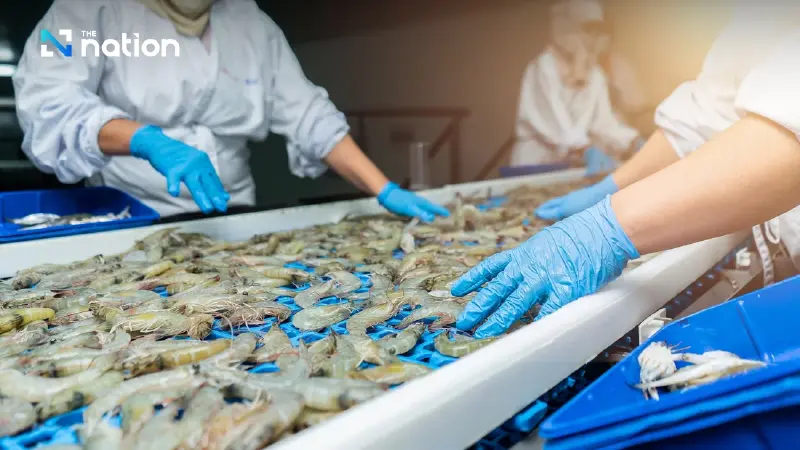


Thai Shrimp Association urges action on disease, export markets and Malaysia’s import ban to revive an industry losing billions in export revenue.
- The Thai Shrimp Association is urging the government to address widespread diseases that have increased production costs, making Thai shrimp uncompetitive against cheaper products from Ecuador and India.
- The government is being asked to regain lost market share by accelerating free trade agreement (FTA) negotiations with the European Union and resolving the closure of export routes to Malaysia.
- The association has proposed an 11-point, 5.5 billion baht reform plan to address structural problems, improve disease prevention, and boost production efficiency.
- Calls for action include promoting Thai shrimp in new Chinese markets and stimulating domestic consumption to support farmers amid slowing exports to the US and Japan.
The Thai Shrimp Association has urged the government to revive Thailand’s shrimp industry in a bid to restore export earnings that once exceeded 100 billion baht a year, calling for urgent action on shrimp disease and wider export access to China and the European Union.
The association has also asked the government to resolve the closure of shrimp export routes to neighbouring Malaysia and stimulate domestic consumption through measures such as the “Thais Help Thais Plus” programme.
Ekapoj Yodpinit, president of the Thai Shrimp Association, warned that Thai shrimp exports to key markets such as the United States and Japan began to slow in the first half of the year.
This comes despite Thai shrimp’s strong reputation for quality, firm texture, distinctive taste and safety, with products described as 100% free from residues and every pond inspected before harvest.
However, price has become a major obstacle, leaving Thai shrimp at a disadvantage in the global market, he noted.
Disease costs weaken Thailand’s competitiveness
Ekapoj explained that Thailand had lost competitiveness in the US market because Thai shrimp is now around US$1 per pound more expensive than major competitors such as Ecuador and India.
He stressed that the problem was not caused only by currency volatility, but also by hidden costs from shrimp diseases that have long burdened Thai farmers. Ecuador, by contrast, has continued to improve production efficiency and has suffered less damage from disease.
Thai farmers remain trapped by four major diseases: white spot syndrome, white faeces syndrome, early mortality syndrome (EMS) and yellow head disease. These diseases directly affect survival rates and production efficiency, pushing Thailand’s unit costs so high that producers can no longer compete on price in the global market.
As a result, major buyers that had purchased Thai shrimp for more than 30 years have begun shifting to suppliers in Ecuador, India and Vietnam.
The association had earlier pushed for an 11-point shrimp industry reform package to be made a national agenda. The proposal was drawn up after consultations with all relevant sectors and is intended to address structural problems across the entire shrimp industry.
Ekapoj noted that the restructuring plan would require a budget of just 5.5 billion baht to support the whole supply chain, from upstream to downstream. The plan covers the development of quality broodstock and larvae, improved production efficiency in ponds, stricter disease-prevention systems and better management of energy costs.
He argued that the 5.5-billion-baht investment should not be viewed as money thrown away, but as an investment to restore export revenue that once exceeded 100 billion baht a year.
More than 60 billion baht in annual export revenue has already disappeared, Ekapoj said, warning that accumulated losses would continue to grow if the government fails to act.
Over the past 12 to 13 years, Thailand’s shrimp industry has lost more than 700 billion baht in revenue, he added.
Reviving the shrimp industry would not only help shrimp farmers in more than 30 provinces, but also distribute income to other sectors, including crop farmers whose produce is used as key raw material in animal feed. The industry helps turn lower-priced agricultural products into high-value shrimp for export.

China and EU offer hope in the second half
Ekapoj pointed to China and the European Union as markets that still offer opportunities in the second half of the year, even as the outlook for the US market remains bleak.
China is the only major market still growing against the broader trend. Thai shrimp is in strong demand there because it is seen as “large, tasty, attractive in colour and safe”. Ekapoj noted that China still has significant untapped potential, particularly in inland and central provinces where shrimp consumption has not yet fully expanded.
If the Commerce Ministry and private sector work together to promote Thai shrimp through major international seafood trade fairs and penetrate new Chinese provincial markets, China could become a key market capable of replacing revenue lost from the US and Japan, he argued.
The European Union also offers hope through the Thailand-EU free trade agreement negotiations, which are moving closer to conclusion. The EU was once a long-established and major market for Thai shrimp, with Thailand previously exporting as much as 60,000 tonnes a year to the bloc.
However, after Thailand lost its Generalised System of Preferences (GSP) privileges and faced tariffs of 14-21%, the country lost almost the entire market to Vietnam, which gained an advantage through its own FTA.
Ekapoj stressed that the industry’s main hope now is for Thailand to accelerate FTA negotiations and conclude them within this year. If successful, Thai shrimp would immediately regain competitiveness in the EU market.
He also called for the government to resolve the closure of export routes to neighbouring Malaysia, which has severely affected farmers in the lower South, particularly in Pattani, Narathiwat, Satun and Nakhon Si Thammarat.
The problem has caused an oversupply of shrimp and pushed prices down because products cannot be moved out of the market. The industry is awaiting the outcome of talks on June 8, which could help revive export prospects in the second half of the year.
Malaysian authorities have announced a suspension of shrimp imports from Thailand covering five species: brown tiger prawn, banana prawn, whiteleg shrimp, giant tiger prawn and blue shrimp.
The measure took effect on June 1, 2026, after Thailand tightened staged inspections on imported sea bass from Malaysia following findings by Thai authorities that chemical and antibiotic residues had been detected in Malaysian sea bass.
The association is also placing hope in government efforts to stimulate domestic consumption, including the “Thais Help Thais Plus” programme, which previously helped make the domestic shrimp market noticeably more active.
Encouraging Thais to consume more shrimp would help ease pressure from shrinking foreign orders and support farmers through the economic slowdown and the impact of global conflicts, which have driven production costs higher, Ekapoj added.
