
Private involvement urged as a way to prevent graft in Bt2-trillion plan
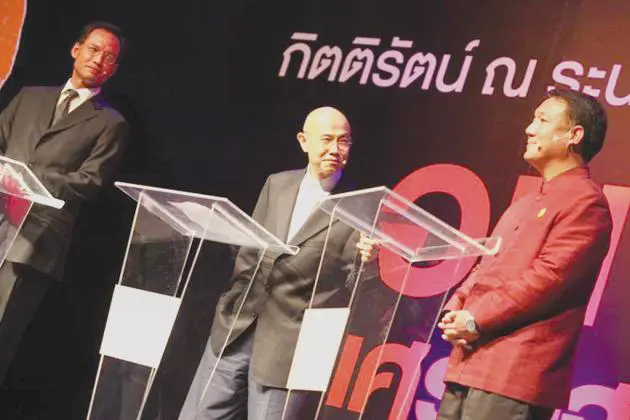


Finance Minister Kittiratt Na-Ranong has been urged to strengthen collaboration with the private sector to prevent corruption in the government's Bt2-trillion infrastructure investment programme.
Duanden Nikhomborirak, a researcher at the Thailand Develop-ment Research Institute, said that to boost transparency, the government should embrace an integrity pact (IP).
“Indonesia, Malaysia and Pakistan have adopted this concept, to have a third-party observer for the investment. If Thailand follows suit, this will change the overall picture,” she said during a recent debate hosted by Nation Group.
The Anti-Corruption Organisation of Thailand (ACT) has been vehement on the need to bolster private-sector involvement to prevent graft. It has so far succeeded in winning commitment from the Transport Ministry on adopting an IP. Developed by Transparency International, the IP is now being modified to fit the Thai environment. The Transport Ministry, which will oversee more than half of the Bt2-trillion investment budget, is the first government unit to have vowed to sign the pact.
At the debate, former finance minister Korn Chatikavanij said he was not quite content with the government’s anti-corruption process.
“The ACT should be involved with the screening of all projects. It should be written into the borrowing bill that there will be no loan for any project that does not contain sufficient information for the screening,” he said. “There’s still time to do this, as the bill has not yet become law.”
According to Kittiratt, who is also a deputy prime minister, a working committee is being set up to ensure transparency of investment and it will include Pramon Sutivong, chairman of the ACT. The committee will work out the median prices of all construction projects, mutually agreed by the government, the private sector and the National Anti-Corruption Commission.
He also promised information on all projects would be posted on the website of the Comptroller-General’s Office.
“We promise transparency, or it may affect other investment projects,” he said.
Thailand is ranked 88th in Transparency International’s Corruption Perceptions Index 2012, among 176 countries, with a score of 37 out of 100.
IP was developed by Transparency International (TI) in the mid-1990s as a guideline for countries worldwide in preventing corruption in state procurement – which constitutes a substantial amount.
The pact contains rights and obligations to the effect that neither side will pay, offer, demand or accept bribes of any sort, or collude with competitors to obtain a contract, or while carrying it out. Also, bidders will disclose all commissions and similar expenses paid by them to anybody in connection with the contract, and sanctions will apply when violations occur. These sanctions range from loss or denial of contract, forfeiture of the bid or performance bond and liability for damages, to being barred from future contracts on the side of the bidders, and criminal or disciplinary action against employees of the government.
Transparency International Indonesia was set up in 2000 as a non-profit organisation. Since then, it has introduced the first-ever district Integrity Pact in Sumatra’s Solok district, as well in Aceh, Banten, part of East Java, part of South Kalimantan, and part of South Sulawesi.
In Solok, an Independent Monitoring Board was set up by local non-government groups, together with TI Indonesia, called Aliansi Pendorong Pakta Integritas or APPI (the Alliance of Integrity Pact Independent Monitors). APPI is now working to monitor every development project funded by state or local authorities. APPI holds public hearings with the local government and legislature to make recommendations for transparent public procurement as well as community-based participatory monitoring.
Last year, APPI was in charge of monitoring nine of the largest procurement projects in Solok district. Three of the nine projects were scrutinised and finally declared as “troubled” (a convention-hall project in Alahan Panjang, a water-channelling project in Muaro Paneh and the Kapalo Banda Bridge). These cases have now been investigated by legal authorities and are waiting to be dealt with by the local court.
In Aceh, TI Indonesia is developing “citizen report cards”. Citizens are encouraged to take part in the monitoring of the reconstruction process. Then, local NGO partners will start investigating where reports indicate corruption. The results of these investigations will be used to lobby for changes in public policy by holding public hearings at the subdistrict level. There are plans to invite all stakeholders to join these public hearings, the aim of which is to make authorities aware of concrete complaints by directly listening to citizens’ voices.
