
No concern over rising private sector debt, says central bank


THE BANK of Thailand sees no need to worry about corporate debt despite the recent jump in the level of indebtedness.
Tongurai Limpiti, a deputy governor, said in an interview that there was no cause for concern given that debt built up in the most recent years was for “productive” investments.
“We are not concerned,” she said. “Our monitoring shows that big companies like Thai Union, PTT and Charoen Pokphand are making a big wave of expansion overseas. Much of the borrowing is to finance good investments overseas.”
She added that the situation was different from the past, when Thai companies borrowed excessively to finance “unproductive” investments, such as property projects.
Across the world, while several governments experienced an increase in the ratio of liabilities to gross domestic product, the Thai private sector’s debt-to-GDP ratio has also moved up.
Aside from Bt2.57 trillion in corporate bonds in the first half, corporate loans from Thai banks as of May stood at Bt10.8 trillion or 79.2 per cent of GDP. Including funds from other sources, the debt burden in May would have been Bt15.68 billion or 114.8 per cent of GDP, according to Kasikorn Research Centre. This had risen from 74.4 per cent of GDP or about Bt8 trillion in the second quarter of 2012.
The trend continued, as reflected by the 5.3-per-cent growth in lending by commercial banks in the first nine months of 2015. The growth rate was slightly higher than that in 2014, due to growth in corporate loans, the central bank said in its “Financial Stability Report 2015”.
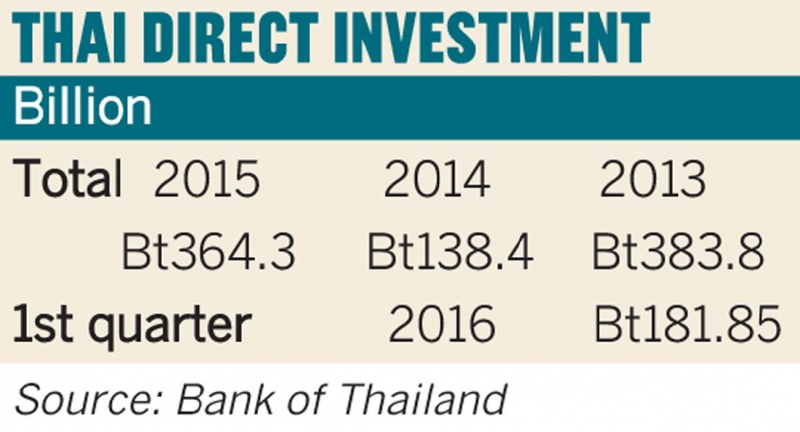
According to Tongurai, much of the corporate debt was driven by direct investment overseas by large Thai corporations. In the past three years, Thai conglomerates have made significant acquisitions abroad. The total investment reached Bt364.3 billion in 2015, rising from Bt138.4 billion in 2014 and Bt383.8 billion in 2013.
In the first quarter, the direct investment totalled Bt181.85 billion, with nearly half going to other Asean nations.
Thailand is not alone in this regard. Companies in emerging markets have cashed in on foreign inflows from developed economies since the 2008 financial crisis. This is expected to continue.
Global corporate borrowing demand is expected to reach a record US$62 trillion by 2020, fuelled by expansive monetary policy, S&P Global Ratings said in a recent report.
The report also suggests that total outstanding corporate debt – including new issuance and refinancing – will expand to $75 trillion over the next five years. China’s share of global corporate debt will rise to 43 per cent in 2020 from 35 per cent in 2015.
Analysts forecast a slight dip in US debt, to 22 per cent from 24 per cent, while Europe’s (euro zone and the UK) share will ease to 16 per cent from 20 per cent.
“Brazil has had the fastest growth in leverage [as cash flow declined] and we categorise its average funds-from-operations to debt ratio as aggressive,” said Diego Ocampo, a co-author of the report. The next fastest are Singapore, Australia, China, Mexico, and Hong Kong, which are generally trade-dependent, commodity-reliant, or China-related countries,” said David Tesher, a co-author of the report.
Throughout the Asia-Pacific region, the debt-to-GDP ratio is expected to stay around 80 per cent. The report showed concerns that up to 5 per cent of some 14,400 borrowers in its global radar are stretched and may not survive a meaningful stress scenario without defaulting on their debt.
