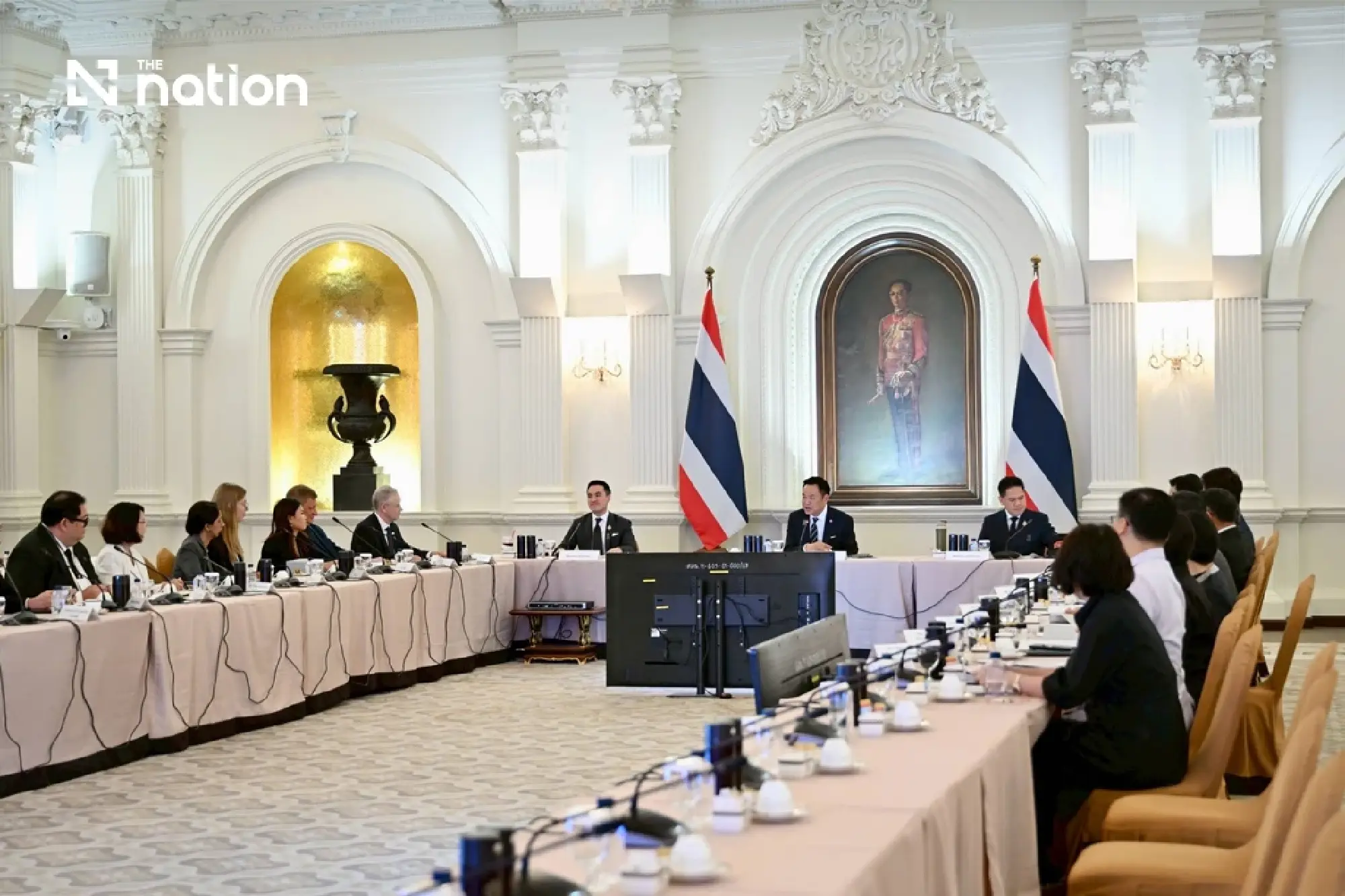
Thailand pitches faster infrastructure development, the Thailand–EU FTA and OECD membership to executives from more than 40 leading European companies.
Prime Minister Anutin Charnvirakul is promoting a three-pronged strategy to attract EU investment by developing infrastructure (digital, energy, transport), streamlining regulations, and seeking OECD membership.
A key element of the plan is to conclude negotiations on the Thailand–EU Free Trade Agreement (FTA) as quickly as possible to improve market access for Thai products.
These initiatives aim to establish Thailand as a major regional hub for manufacturing and innovation in sectors like semiconductors, clean energy, digital technology, and AI.
In a meeting with the Prime Minister, representatives from over 40 leading European companies reaffirmed their confidence in Thailand and supported the government's infrastructure and FTA efforts.
Prime Minister and Interior Minister Anutin Charnvirakul welcomed executives and members of the EU–ASEAN Business Council (EU-ABC) and the European Association for Business and Commerce (EABC) to Government House in Bangkok for talks on expanding economic cooperation.
The delegation comprised representatives from more than 40 leading European companies across key sectors, including pharmaceuticals, medical supplies and healthcare; finance, banking and insurance; automotive and industrial manufacturing; energy; agriculture and food; technology and digital services; hospitality and tourism; and consumer goods.
Companies represented included Bayer, Boehringer Ingelheim, Sanofi, Siemens Healthineers, Prudential, Standard Chartered, Robert Bosch, Michelin, Siemens Energy, Danone, SAP and Kenvue.
Government spokesperson Rachada Dhnadirek explained on Thursday (July 16) that the meeting provided a forum for exchanging views on economic, trade and investment issues and exploring ways to deepen cooperation between Thailand and the European Union.
Three-pronged plan to boost competitiveness
According to Rachada’s briefing, Anutin described Europe as one of Thailand’s most important economic partners. He noted that continued investment by leading European companies reflected confidence in the country’s potential.
The government is therefore working to strengthen Thailand’s competitiveness, attract new investment, create jobs and raise incomes. Its strategy centres on three priorities:
Future-ready infrastructure: Developing digital and AI infrastructure, clean-energy systems and broader energy infrastructure to support emerging industries.
Transport and logistics: Upgrading roads, railways, ports and airports, along with the Eastern Economic Corridor and Southern Economic Corridor, to improve connectivity, reduce costs and attract further investment.
Investment-friendly regulation: Streamlining rules through the Thailand FastPass scheme and advancing Thailand’s bid to join the Organisation for Economic Co-operation and Development (OECD), with the aim of raising public-sector standards, improving transparency and strengthening global investor confidence.
Anutin also outlined Thailand’s ambition to become a major regional base for manufacturing and innovation, particularly in semiconductors, clean energy, digital technology, AI, life sciences, modern agriculture and the food industry.
The government will also seek to conclude negotiations on the Thailand–EU Free Trade Agreement as quickly as possible. The agreement is expected to give Thai products greater access to European markets and create new opportunities for Thai businesses.
European businesses reaffirm confidence in Thailand
European business representatives reaffirmed Thailand’s position as a key destination for European investment, citing its strategic location, established manufacturing base and skilled workforce.
They welcomed the government’s efforts to develop high-value industries, expand the digital economy, promote clean energy and pursue sustainable development. The delegation also backed the Thailand–EU FTA negotiations and Thailand’s bid for OECD membership.
The representatives proposed deeper cooperation in five priority areas: manufacturing and supply chains; healthcare and life sciences; food and consumer goods; finance and investment; and the digital economy and AI.
The delegation noted that these industries could create jobs, develop the skills of Thai workers and strengthen the country’s competitiveness.
More than 7,000 laws targeted for reform
The government is seeking economic growth that goes hand in hand with sustainability by increasing the share of renewable energy in the country’s energy mix.
It is also pressing ahead with legal reform under the Regulatory Guillotine initiative, which is intended to reduce administrative procedures and remove obstacles to doing business.
More than 7,000 unnecessary or outdated laws and regulations have been earmarked for review and modernisation to create a more investment-friendly environment.
“A better investment environment will help Thailand attract foreign capital, technology and innovation. It will generate jobs, raise Thai workers’ incomes, strengthen local entrepreneurs and deliver economic growth that produces tangible benefits for the public,” Anutin stressed.
With Thailand–EU relations approaching their 65th anniversary, the prime minister expressed confidence that ties would continue to deepen and generate new economic opportunities for both sides.