
Thailand Pledges to Arm Exporters for a Fractured World Trade Order
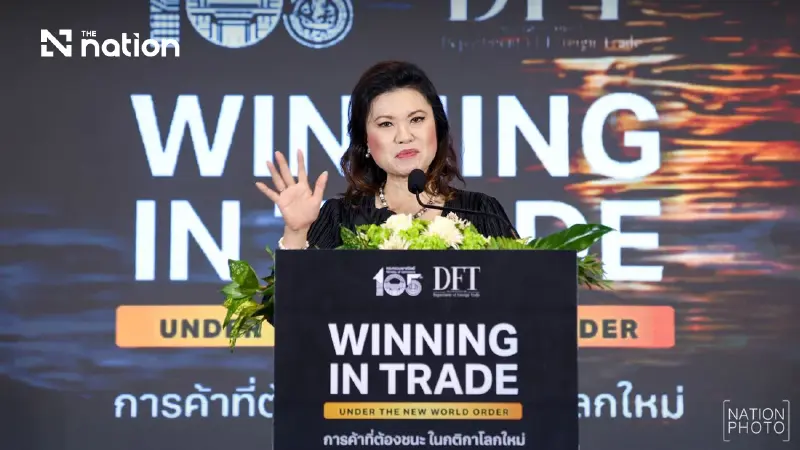


The Commerce Ministry vows to open new market doors for Thai businesses through fresh trade agreements and digital tools as global trading rules are rapidly rewritten
- Thailand's Commerce Ministry is pursuing new free trade agreements (FTAs) to help exporters diversify markets and counter challenges like potential US tariffs.
- The ministry is deploying digital tools and AI to streamline trade processes, such as licensing and certification, making it easier for businesses to export.
- Thailand is leveraging its strategic neutrality to maintain trade and investment relationships with competing global blocs like the US, China, and the EU.
- The government is encouraging exporters to shift from competing on price to adding value and building trust with partners to gain an advantage in the new trade order.
The Commerce Ministry vows to open new market doors for Thai businesses through fresh trade agreements and digital tools as global trading rules are rapidly rewritten.
Thailand's Commerce Ministry has committed to acting as a "strong rear guard" for the country's private sector as businesses grapple with a rapidly fragmenting global trade landscape, a senior official said on Thursday.
Speaking at a seminar hosted by the Department of Foreign Trade (DFT), titled Winning in Trade: Under the New World Order, Vice Minister for Commerce Dr Kirida Bhaopichitr outlined four major shifts reshaping global commerce and set out what the ministry is doing to help Thai entrepreneurs seize the opportunities they present.
"The world is changing fast, and the rules are no longer the same," Dr Kirida said. "What we know for certain is that global trade rules will never be what they were — and they will change quickly. If we understand this, we can adapt in time and gain an advantage over competitors who do not."
She identified four defining trends: the fracturing of globalisation into rival trading blocs; the formation of new trade groupings and bilateral agreements; the rising importance of economic security — covering energy, food and critical minerals; and the growing premium placed on trust between trading partners.

Dr Kirida placed Thailand in a fourth, neutral bloc alongside Indonesia, Singapore and India – countries that have not aligned firmly with any of the three dominant powers – the United States, China, or the loose coalition of traditional US allies such as the European Union, Japan, South Korea, Australia and New Zealand.
This neutrality, she argued, is a strategic asset. "Because we are not seen as taking sides, countries from all three blocs are willing to invest and trade with us," she said.
On the threat posed by rising US tariffs, Dr Kirida confirmed that Thailand faces a minimum 12.5 per cent import duty under Section 301 of US trade law following the first of two investigations into Thai trade practices — the first concerning imports made using forced labour, and the second relating to alleged excess production capacity.
A final determination on the first case is expected within weeks, she said, while the second case will add a further levy on top.

"We expect the rate to be higher than 12.5 per cent," she acknowledged, adding that a submission contesting the measures would be filed with US authorities by 7 July.
The ministry's priority, she stressed, is to ensure Thailand's tariff rate remains competitive within South-East Asia, even if exact parity with neighbours cannot be guaranteed.
"What matters is not just what rate we face, but whether we can compete with other countries in our region," she said.

In response to that pressure, the ministry is pushing Thai businesses to diversify away from dependence on the US market, which currently accounts for roughly 20 per cent of Thai exports.
Thailand already has 14 free trade agreements in force, covering 18 countries. Two more are set to take effect in January next year — one with the four-nation European Free Trade Association (comprising Switzerland, Liechtenstein, Norway and Iceland) and one with Bhutan. A Thai–Sri Lanka agreement is also working through parliamentary ratification.
Negotiations are continuing on several additional agreements, including a long-running Thailand–EU FTA, for which a tenth round of talks was under way in Brussels on Thursday.

Dr Kirida expressed hope that a deal could be concluded before the end of this year. ASEAN-wide negotiations with Canada and South Korea are also in progress.
Thailand has additionally received an invitation to join a new grouping known as the Facilitate Investment Partnership (FIP), initiated by Singapore and New Zealand to bring together like-minded economies on investment facilitation.
Beyond market access, the ministry said it is deploying digital technology and artificial intelligence to streamline licensing and certification processes, cutting paperwork and allowing businesses to apply for trade documents online.

A Smart Licensing initiative and a digital certificate-of-origin system were among the tools highlighted. Afternoon workshops at the seminar were designed to walk exporters through the new platforms.
Dr Kirida closed with a call for Thai businesses to invest in knowledge, add value to their goods and services, and above all maintain the trust of their trading partners.
"We can no longer compete purely on price — especially not against China," she said. "We need to find new ways to add value. And a trusted partner can often command a premium, even when its products cost more."
She framed the ministry's role as that of a lighthouse rather than a helmsman: "We will try to shine a light so you can see the direction. But you are the ones steering the ship."

