
Japan and Thailand Join Forces to Unlock RCEP's Trade Potential
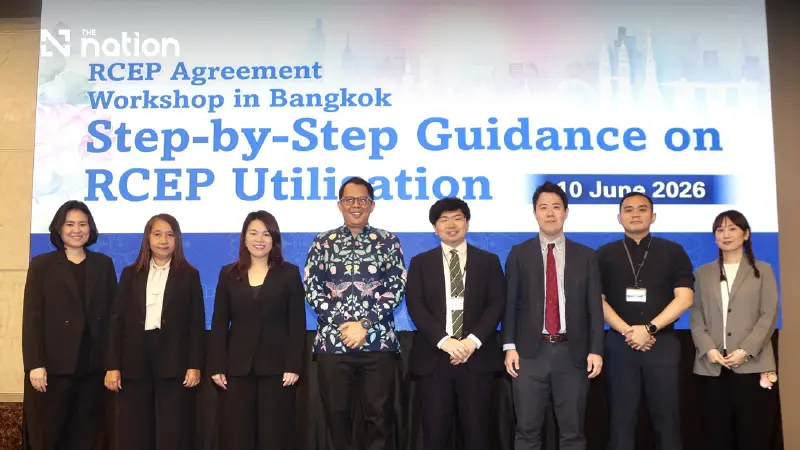


Japanese and Thai officials deliver step-by-step guidance on how businesses can slash export costs and boost profit margins through RCEP’s powerful trade tools
- Japanese (METI, JETRO) and Thai (DFT) government agencies collaborated on a workshop to provide practical guidance for Thai businesses on how to utilize the RCEP trade agreement.
- The joint initiative focused on educating entrepreneurs about RCEP's key features, such as the "Single Rule of Origin," which simplifies qualifying for reduced tariffs by allowing materials from all 15 member states to count towards a product's origin.
- The partnership promoted the use of Thailand's digital platforms, like ROVERs Plus and SMART C/O, to help companies, particularly SMEs, streamline certification and turn the trade agreement into a competitive advantage.
Japanese and Thai officials deliver step-by-step guidance on how businesses can slash export costs and boost profit margins through RCEP’s powerful trade tools.
Thai entrepreneurs stand to gain substantially from the world's largest free trade agreement, but only if they know how to use it. That was the central message at a specialist workshop held in Bangkok on Wednesday (June 10th), as Japan's Ministry of Economy, Trade and Industry (METI), the Japan External Trade Organization (JETRO), and Thailand's Department of Foreign Trade (DFT) joined forces to help local businesses turn the Regional Comprehensive Economic Partnership (RCEP) from a legal framework on paper into a genuine competitive advantage.
Held at the Sofitel Bangkok and online and attended by nearly 200 industry representatives, the event — titled "Step-by-Step Guidance on RCEP Utilisation" — reflected a deliberate effort by Tokyo to move beyond trade diplomacy and into practical business support.
"From this seminar, they could learn how to use RCEP," said Makoto Sudo of METI, who framed the event as a "great kick-off" for Thai firms ready to start making the most of the agreement. METI and JETRO, he confirmed, remain committed to providing ongoing support as businesses navigate the evolving regional trade landscape.

What is RCEP and Why Does it Matter?
RCEP brings together 15 member states — including Japan, China, South Korea, Australia, New Zealand, and the ten ASEAN nations — representing roughly 30 per cent of global GDP.
For Thai exporters, its headline advantage is the elimination or reduction of tariffs across this enormous bloc. But the agreement's more transformative feature lies in how it determines whether a product actually qualifies for those preferential rates.

Kyohei Yabu of JETRO Bangkok illustrated the stakes with a striking example from the automotive sector: a tariff reduction translating to a saving of just $820 (USD) per vehicle could shift a manufacturer's profit margin from 16.5 per cent to 23.3 per cent.
"That is a gain that internal cost-cutting measures rarely match," he noted. For an industry where margins are thin and competition fierce, the implications are significant.

The Single Rule of Origin: A Game Changer for Supply Chains
At the heart of RCEP's appeal is what experts call the "Single Rule of Origin" — a unified framework replacing the patchwork of rules that previously governed separate bilateral agreements between ASEAN members and dialogue partners such as Japan and China.
Under the old system, a Thai manufacturer sourcing materials from Japan, China, and Korea would need to navigate three separate sets of origin rules to export to any of those markets. Under RCEP, one set of rules covers the entire 15-nation bloc.
Crucially, the agreement includes a "Cumulation Rule", which allows raw materials or components sourced from any of the 15 member states to count towards a product's regional origin.
To qualify for preferential tariffs, goods typically need to meet a 40 per cent Regional Value Content (RVC) threshold — and under RCEP, inputs from across the entire bloc contribute to that figure.
Piyachat Sorthip of the DFT captured the broader significance of this shift: the ability to use the same origin rules for every market in the bloc is a benefit that "sometimes cannot be calculated" in purely financial terms.
She noted that Thai producers who previously struggled to source sufficient local content for bilateral FTAs may now find RCEP's cumulation provisions offer a straightforward path to qualification.

Digital Tools Making Compliance Simpler
A recurring theme at the workshop was that RCEP's benefits are most accessible to businesses that make use of Thailand's digital trade infrastructure — two platforms in particular.
The first is ROVERs Plus, an online system that allows exporters to verify whether their products qualify for RCEP origin status before formally applying for certification. Businesses input their cost structure — covering originating materials, non-originating materials, production costs, and profit — and the system calculates whether the RVC threshold is met.
Once approved, a verification result remains valid for two years, meaning companies need not repeat the process for every shipment of the same product line. Applications are processed within three working days.
The second is SMART C/O, the DFT's online platform for applying for Certificates of Origin around the clock. The system supports e-payments through Krungthai Bank and allows businesses to print certificates directly, removing the need to visit government offices.
For high-volume exporters, the Approved Exporter programme goes a step further, enabling eligible companies to self-certify on commercial invoices – streamlining the process to the point where a Certificate of Origin is no longer required for every individual shipment.
Both systems are accessible through the DFT's digital portal, and officials urged businesses yet to register to do so promptly.

SMEs Urged to Act
Perhaps the most pointed message of the day was directed at smaller businesses. In his closing remarks, Taufiq Arfi Wargadalam of the RCEP Support Unit acknowledged the complexity that many firms face: "For many businesses, especially SMEs, understanding procedures, documentation, and compliance requirements can be complex. However, as we have seen today, with the right tools and knowledge, these challenges can be addressed."
He emphasised that SMEs form the "backbone" of regional economies, and that their increased participation in cross-border trade is essential for inclusive and sustainable growth.
Reflecting on the workshop's broader purpose, he noted that initiatives of this kind go beyond mere awareness-raising — they build genuine capacity, helping businesses translate trade agreements into tangible commercial outcomes.
He also acknowledged the collaborative spirit that made the event possible, extending thanks to METI, the RCEP Support Unit, JETRO Bangkok, and the DFT for their joint efforts.
Closing on behalf of the Thai government, Piyachat Sorthip of the DFT's Trade Preference Division echoed that sentiment, attributing the day's success to the close cooperation between all organising parties.
She expressed confidence that the Rules of Origin guidance delivered throughout the workshop would give participants a practical framework for production planning and a sharper competitive edge in overseas markets.
Her closing charge to attendees was clear and memorable: she urged every business in the room — SMEs in particular — to convert what they had learnt into what she called an "Origin Opportunity."
The goal, she said, is not simply to understand the rules, but to transform them into sustainable business growth. For any further questions, she reminded participants that the DFT's 1385 Hotline remains available at all times.

What Businesses Should Do Now
With RCEP's first major review scheduled for 2027, the window to establish operational familiarity with the agreement is now. As preparations for the review also move forward, it is essential to deepen the effective utilisation of RCEP, thereby generating mutually reinforcing benefits for participating countries.
The practical steps are clear: register with the DFT's digital platforms, use ROVERs Plus to verify origin eligibility, and explore whether your business qualifies for Approved Exporter status. For technical queries, the DFT's 1385 Hotline offers direct support.
METI and JETRO have signalled that Wednesday's Bangkok workshop marks the beginning of a sustained engagement programme, not a one-off event. For Thai businesses willing to invest modest effort in understanding the agreement's mechanics, the rewards — in lower costs, wider market access, and stronger supply chain flexibility — are well within reach.
