
Thailand braces for US trade ruling over labour, capacity claims
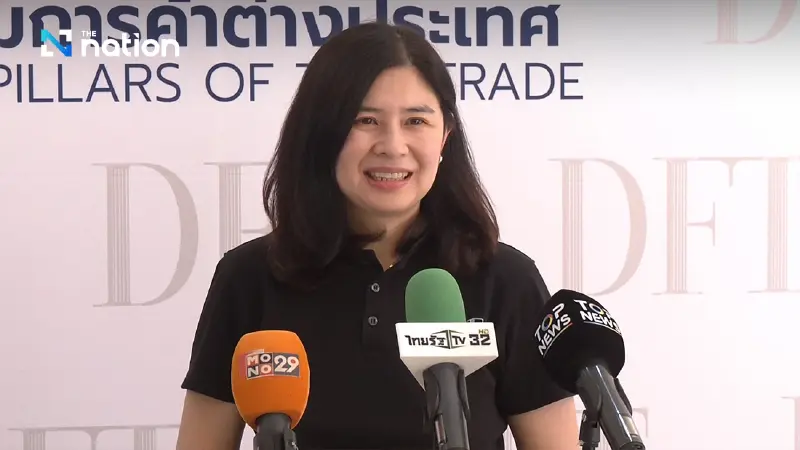


Thailand will meet USTR on May 13-14 to defend exporters against Section 301 claims on forced labour and overcapacity.
Thailand will send senior officials to a technical meeting with the Office of the United States Trade Representative (USTR) on May 13-14 to defend the country against Section 301 trade allegations, as forced-labour scrutiny emerges as one of the biggest risks for Thai exporters.
Arada Fuangtong, director-general of the Department of Foreign Trade under the Commerce Ministry, said the department had been assigned as the lead agency to gather information from government agencies and the private sector for Thailand’s written comment to the USTR.
The submission was completed on April 15, ahead of the next stage of talks with US officials.
Thai delegation to meet USTR
Arada said the Department of Foreign Trade would lead a Thai government delegation to the technical meeting with the USTR to provide further clarification on the documents already submitted and answer detailed questions following the US hearing process.
The delegation will include the Customs Department under the Finance Ministry, the Department of American and South Pacific Affairs under the Ministry of Foreign Affairs, the Board of Investment (BOI), and the Labour Ministry.
She said Thailand would use the face-to-face talks to explain that the country does not fall under the US allegations.
The two main issues Thailand must clarify are allegations involving forced labour and structural excess capacity.
Why Section 301 matters
The current dispute stems from two major US Section 301 actions launched in March 2026. The USTR opened investigations into structural excess capacity and production in manufacturing sectors covering 16 economies, including Thailand, and separately launched forced-labour-related investigations covering 60 economies.
Section 301 of the Trade Act of 1974 allows the USTR to examine whether foreign government practices are unreasonable or discriminatory and burden or restrict US commerce, potentially leading to tariff or non-tariff action.
For Thailand, the case is economically sensitive because the US can consider measures by country and by industrial sector after the consultation process. Arada said the outcome was expected between mid and late June, and no later than July 24, 2026.
Three Thai sectors under scrutiny
Arada said Thailand had been placed in three main target industry groups: automotive and auto parts, machinery and electrical appliances, and rubber and rubber products.
Thailand has already submitted information to the US confirming that it does not have structural overcapacity problems in those industries, she said.
She added that the current tariff rate of 10% applies equally to all countries and all products, but Section 301 still gives the US the power to decide whether to apply measures selectively by country and by sector.
After the consultation process, the US is expected to provide more details on which countries and industries could be affected.
Forced-labour issue seen as bigger concern
Arada said the more worrying issue was US import measures linked to forced labour, as Washington was expected to apply such criteria strictly and could enforce them selectively against some countries.
Several parties still had questions over how the US would prove whether forced labour had been used at the original production source, she said.
The Labour Ministry is pushing a draft Human Rights Due Diligence (HRDD) law to raise business standards, particularly among large operators. The bill aims to strengthen traceability across supply chains, from raw materials and production sources to manufacturing processes, to confirm that forced labour has not been used.
The move is intended to build long-term confidence among international trading partners.
Thailand to seek product exclusions if tariffs are imposed
Arada said that regardless of the outcome, the US was still likely to use trade measures, either under Section 301 or through an extension of Section 122.
If the US announces measures affecting Thailand, the Department of Foreign Trade will continue its work beyond this round of clarification by seeking product-by-product exclusions to ease the impact on Thai exporters.
She said global trade would continue to face pressure from protectionist measures, including anti-dumping (AD) and countervailing duty (CVD) actions.
“The Department of Foreign Trade confirms that it will serve as a key mechanism in supervising and supporting Thai exporters so they can compete and grow sustainably in the global trade arena,” Arada said.
She added that the department was adjusting its role to become an “integrator”, connecting data networks across sectors while using digital technology to improve service efficiency and strengthen businesses’ ability to cope with volatility in global trade.
