
Thailand Charts Course for Victory Amid Shifting Global Trade Order
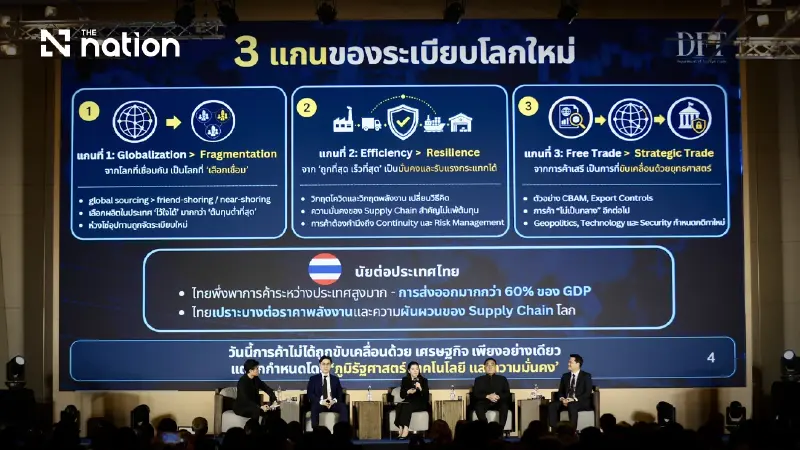


Industry leaders and officials urge Thai businesses to embrace resilience, AI, and ESG standards as geopolitical tensions redraw the rules of global commerce
- In response to a new global trade order driven by geopolitics rather than economic efficiency, Thailand is shifting its focus to building business resilience.
- Key strategies include embracing artificial intelligence (AI), particularly in data center infrastructure, and adhering to strict Environmental, Social, and Governance (ESG) standards to attract investment.
- The government plans to act as a "Trade Integrator," using digital tools and early-warning systems to help businesses navigate the changing landscape.
- Officials stress that overcoming internal challenges like corruption and reforming the education sector are crucial for competing with regional rivals and attracting foreign investment.
Industry leaders and officials urge Thai businesses to embrace resilience, AI, and ESG standards as geopolitical tensions redraw the rules of global commerce.
Senior officials, business leaders, and economists have sounded the alarm over a fundamental transformation in the rules governing international trade, urging Thai entrepreneurs to act swiftly or risk being left behind in a world where political alliances increasingly trump economic efficiency.
The warnings came during the first major seminar of the 2026 fiscal year, titled "Winning in Trade: Under the New World Order," held in Bangkok on Thursday and attended by prominent figures from the public, private, and academic sectors.

From Efficiency to Resilience
Arada Fuangtong, director general of the Department of Foreign Trade (DFT), set the tone by declaring that the era of globalisation — built on open markets and cost-driven logic — is over. In its place, she said, has emerged a more volatile world order defined by geopolitical rivalry and economic fragmentation, where trade flows are dictated as much by political alignment as by commercial advantage.
"We are moving from a focus on efficiency to resilience," Arada said. "The ability to fall and get up quickly is now more vital than being the lowest-cost producer."
She outlined plans to transform the DFT from a regulatory body into a "Trade Integrator," deploying digital tools such as smart certificates of origin and early-warning systems for trade barriers, with the private sector incorporated into all future trade strategies.

Geo-economics and the Corruption Problem
Poj Aramwattananont, chairman of the Thai Chamber of Commerce, warned that geopolitics had evolved into what he termed "geo-economics," disrupting global supply and demand chains in ways that are proving deeply damaging to export-reliant economies such as Thailand's.
He singled out corruption as a persistent obstacle to the country's international standing and its ability to attract foreign investment, cautioning that rival economies in the region are closing the gap.
"If our corruption rankings do not improve, we will struggle," Poj said, noting that Vietnam and Indonesia are rapidly eroding Thailand's traditional competitive advantages.
He called for a comprehensive overhaul of the agricultural sector and more targeted support for the country's approximately three million small and medium-sized enterprises (SMEs), many of which he described as effectively operating as "zombie companies."
AI and the Infrastructure Opportunity
Burin Adulwattana, managing director and chief economist of Kasikorn Research Centre (KResearch), identified artificial intelligence as the single most important variable reshaping modern trade.
He described the AI ecosystem as a "five-layer cake" comprising energy, chips, infrastructure, AI models, and applications.
While conceding that Thailand is unlikely to compete in semiconductor manufacturing, Burin highlighted a tangible opening in data centre infrastructure and clean energy.

However, he cautioned that the country must position itself as more than merely a landlord for foreign technology companies, stressing the need to ensure that inbound investment generates high-skilled employment and integrates with local supply chains.
Educational reform, he argued, is equally urgent, given what he described as a chronic shortage of internationally competitive higher-education institutions capable of retaining domestic talent.

Investment Waves and the ESG Imperative
Satha Vanalabhpatana, chief strategy officer of Amata Corporation, presented data indicating a significant shift in global investment flows towards South-East Asia, with Thailand currently attracting approximately $20 billion (about 670 billion baht) of the regional total.
He forecast an exceptional wave of industrial growth running through to 2030, driven by higher-complexity sectors including semiconductors and advanced manufacturing.
Satha stressed that competing successfully in this environment requires strict adherence to environmental, social, and governance (ESG) standards and greenhouse gas regulations, which he described as non-negotiable prerequisites in the eyes of international buyers.
"Businesses must use data-driven planning to prepare for these new global mandates," he said. "Verified environmental credentials are now a condition of trade, not an afterthought."

A High-Income Goal by 2037
In closing remarks, panellists urged Thai entrepreneurs to conduct an honest audit of their own strengths and weaknesses before attempting to scale globally. Arada reaffirmed the government's commitment to the Trade Integrator vision and pledged that the private sector would be a full partner in shaping the country's future trade strategy.
The overarching ambition, she said, remains Thailand's elevation to high-income nation status by 2037 — a goal that the panellists agreed can only be achieved through strategic alignment, the embrace of new technologies, and the willingness to adapt to a global landscape where the rules are no longer fixed.
