
US sets 12.5% tariff on Thai goods over forced labour
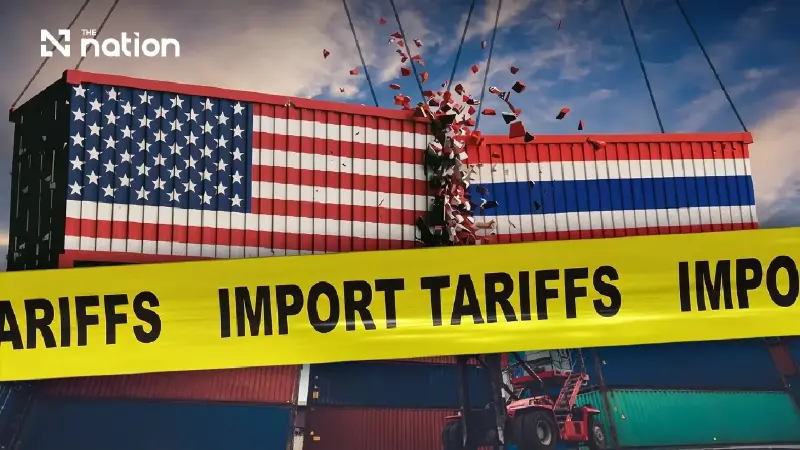


The new US duties cover almost all imports from 60 trading partners, replacing a temporary global tariff that expires on Friday
- The United States is imposing a 12.5% tariff on goods from Thailand, citing the country's inadequate enforcement against forced labour.
- Thailand is one of 38 trading partners assigned the higher 12.5% rate because its restrictions on forced labour were considered insufficient by Washington.
- The tariff is part of a new, broader system of duties targeting 60 trading partners, with a lower 10% rate applied to countries judged to have adequate laws prohibiting forced labour.
The United States will impose a 12.5% tariff on goods from Thailand from Friday as part of a new system of duties targeting 60 trading partners over what Washington describes as inadequate enforcement against forced labour.
The tariffs, set at either 10% or 12.5%, will take effect at 12.01am US Eastern time on July 24, or 11.01am in Thailand. They will replace a temporary 10% global levy that expires at the same time.
The new duties will cover 99.4% of US imports, although oil and gas, fertiliser, certain food products and several other categories will be exempt. Goods already covered by Section 232 national-security tariffs, including automobiles, steel, aluminium and copper, will also be excluded.
Imports already in transit will remain exempt until 12.01am US Eastern time on July 28.

Thailand placed in higher tariff group
Thailand, China and Vietnam are among 38 trading partners assigned the higher 12.5% rate under the final determination issued by the Office of the United States Trade Representative.
Seventeen countries will face the lower 10% duty: Argentina, Bangladesh, Britain, Cambodia, Canada, Ecuador, El Salvador, Guatemala, Honduras, India, Indonesia, Jordan, Malaysia, Mexico, Pakistan, Sri Lanka and Trinidad and Tobago.
The European Union, Taiwan, Japan, South Korea and Switzerland will face additional duties that bring their combined tariff rates, including existing most-favoured-nation tariffs, to either 10% or 12.5%.
Washington said the lower rate would apply to countries judged to have adequate laws prohibiting forced labour, while the higher rate would cover those whose restrictions were considered insufficient.
US Trade Representative Jamieson Greer said the United States had enforced a ban on imports made with forced labour for nearly a century and that its trading partners should adopt similarly rigorous measures.
The administration argues that countries failing to enforce such bans gain an unfair trade advantage over the United States, where imports suspected of being produced through forced labour face tighter restrictions.
New duties follow Supreme Court setback
The tariffs were imposed under Section 301 of the Trade Act of 1974, which allows the United States to respond to practices it considers unfair or discriminatory after conducting an investigation.
The Trump administration turned to Section 301 after the US Supreme Court ruled in February that the president had exceeded his authority when imposing reciprocal tariffs of between 10% and 50% under emergency economic powers.
President Donald Trump subsequently introduced a temporary 10% tariff under Section 122, which allows measures addressing balance-of-payments problems but limits them to 150 days. That levy expires as the new tariffs begin.
A senior administration official rejected suggestions that the forced-labour duties were simply a replacement for the expiring tariff, despite their similar rates, timing and broad coverage. The official said the action resulted from an investigation into whether trading partners’ labour policies placed US businesses at a disadvantage.
The final decision largely follows rates proposed on June 1. India was moved into the lower-rate group after taking legislative and other action on forced labour.
Following public hearings, Washington also expanded the exemptions to include pig iron, certain sugar, animal and seed products, and some chemicals.
Goods complying with the United States-Mexico-Canada Agreement will generally be exempt because of the integrated North American supply chain and the high proportion of US content in those products.
The US government is conducting several other Section 301 investigations. One has already resulted in a 25% tariff on Brazil, while another is examining whether 16 countries have contributed to unfair excess manufacturing capacity.
