
Thailand on alert as US Section 301 probe raises tariff risk up to 25%
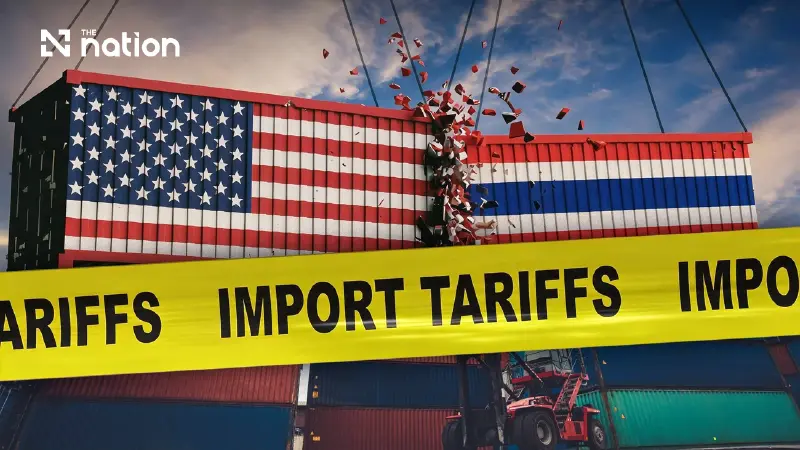


Thailand faces rising pressure from US Section 301 investigations into forced labour controls and excess industrial capacity, with experts warning tariffs could climb as high as 25% if both cases proceed.
- The United States is investigating Thailand under Section 301 of the Trade Act, creating a risk of new tariffs on Thai exports of up to 25%.
- The investigation focuses on two main issues: inadequate controls against goods produced with forced labour and structural excess production capacity.
- U.S. authorities are concerned that Thailand is being used for "circumvention," where goods from other countries like China are minimally processed and re-exported as Thai products.
- Each of the two issues carries a potential 12.5% tariff, and unlike temporary measures, tariffs imposed under Section 301 have no clear expiration date.
Thailand’s trade relationship with the United States is entering a critical new phase as Washington prepares to use Section 301 of the US Trade Act of 1974 to examine countries accused of unfair trade practices.
The move has put Thai exporters on alert, with experts warning that Thailand could face additional tariffs of up to 25% if the United States proceeds with action on two issues: forced labour controls and structural excess production capacity.
Section 301 is being closely watched because it could replace temporary measures under Section 122, which allows the US president to impose temporary import tariffs of up to 15%, currently applied at 10%, for 150 days. That measure is due to expire on July 24, 2026.
Unlike Section 122, Section 301 allows the US to impose trade countermeasures without a clear tariff ceiling or fixed expiry date if it concludes that a partner country’s policies damage US trade or investment interests.
Thailand under scrutiny on two fronts
Associate Professor Dr Aat Pisanwanich, an independent academic and expert on international and ASEAN economics, told Thansettakij that Thailand is currently on the US Trade Representative’s investigation list in two areas: forced labour and excess production capacity.

On forced labour, the USTR has already issued a preliminary assessment covering 60 trading partners, including Thailand. It concluded that these countries do not yet have sufficient measures to regulate imports of goods produced with forced labour from abroad, and proposed a 12.5% tariff measure. However, the implementation date has not yet been officially announced as the hearing process continues.
Dr Aat said Thailand’s risk does not lie only in domestic labour practices, but also in imported raw materials that may be linked to forced labour abroad, especially materials from China’s Xinjiang region. These include cotton, yarn, polysilicon, graphite, magnets and raw materials used in solar panels and batteries.
Thai industries that could face closer scrutiny include fisheries and some seafood products, such as shrimp, squid, blue crab and soft-shell crab, due to their reliance on migrant labour.
US questions Thai exports and Chinese supply chains
The second issue is structural excess capacity. The USTR is also investigating Thailand and 15 other countries over whether they produce or export more than domestic demand would justify.
The US has raised questions over why Thai exports to the US have remained high even as Thailand’s industrial capacity utilisation has fallen over the past decade to below 50%. This has led to concern that goods or raw materials from other countries may be entering Thailand for limited processing before being exported as Thai products — a practice known as circumvention.
Dr Aat said the US is watching Thailand more closely because the kingdom is deeply linked with China through machinery, components, raw materials, technology and Chinese investment. More Chinese companies are also setting up production bases in Thailand, increasing US attention on rules of origin, traceability and local content.
High-risk product groups include mobile phones, communications equipment, integrated circuits, computers, steel products, rubber, automotive parts and transformers. These top 10 risk categories account for about 31% of Thailand’s imports from China. Other products under watch include wires, cables, electronics, plastics, electrical appliance parts and display panels.
Exports to US worth B2.37 trillion
The stakes are high for Thailand. In 2025, Thai exports to the United States were worth 2.37 trillion baht, out of total bilateral trade of 3.06 trillion baht. Thailand recorded a trade surplus with the US of 1.68 trillion baht that year.
In the first five months of 2026, Thai exports to the US had already reached 1.19 trillion baht, with a trade surplus of 842 billion baht.
Dr Aat warned that if Thailand is hit under both Section 301 issues, the total additional tariff could reach 25% — 12.5% from the forced labour case and another 12.5% from the excess capacity case.
He said such tariffs could have no clear end date, making them a serious risk for Thailand’s export sector.
Thailand urged to prove supply chains are clean
Dr Aat said Thailand must urgently strengthen supply-chain governance to meet international standards.
This includes improving traceability systems, verifying the origin of raw materials, increasing local content and introducing concrete import-control measures for goods linked to forced labour.
He also recommended that the government position Thailand as a trusted and traceable industrial supply-chain hub, while deepening investment cooperation with the US in sectors where Thailand has potential, such as health food, pet food, jewellery, furniture and products for the elderly.
These sectors could help Thailand become an alternative ASEAN production base aligned with US priorities.
Commerce Ministry pushes talks with Washington
Dr Kirida Bhaopichitr, Vice Minister for Commerce, said negotiations on Agreement on Reciprocal Trade, or ART, between Thailand and the US are continuing.
Thailand has already integrated proposals from relevant agencies and submitted them to the US side. It is now waiting for Washington’s response on whether the proposals will be accepted or whether further adjustments will be requested.
Thai negotiators have travelled to the US for two rounds of talks and have received positive signals on bilateral relations. However, Kirida said the key challenge is that the USTR is handling both ART negotiations and Section 301 investigations involving several countries at the same time.
Thailand is therefore trying to persuade the USTR to prioritise consideration of its case.
For the forced labour issue, Kirida said there is a strong possibility that tariffs on Thai goods could rise from 10% to 12.5% after the US closed its public comment period on July 15 and began summarising information for the US president’s decision.
All eyes are now on July 24, when Washington is expected to indicate whether it will immediately apply Section 301 measures or allow a grace period before enforcement.
The Thai negotiating team is continuing talks in a bid to protect trade interests and reduce the impact on exporters.
Source: Thansettakij
