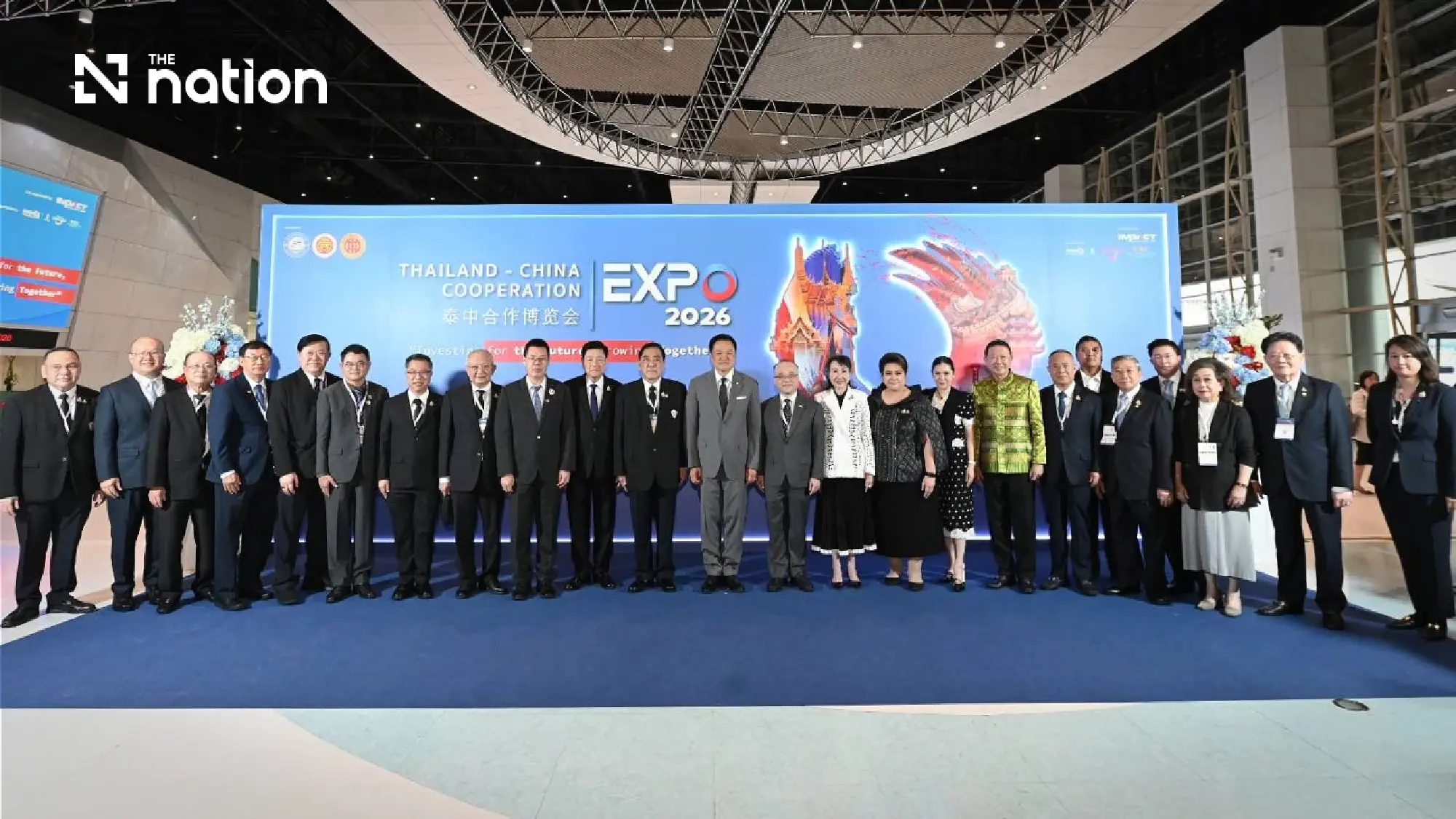
Anutin Pledges Full Backing for Chinese Investment as Thailand-China Expo Opens in Bangkok
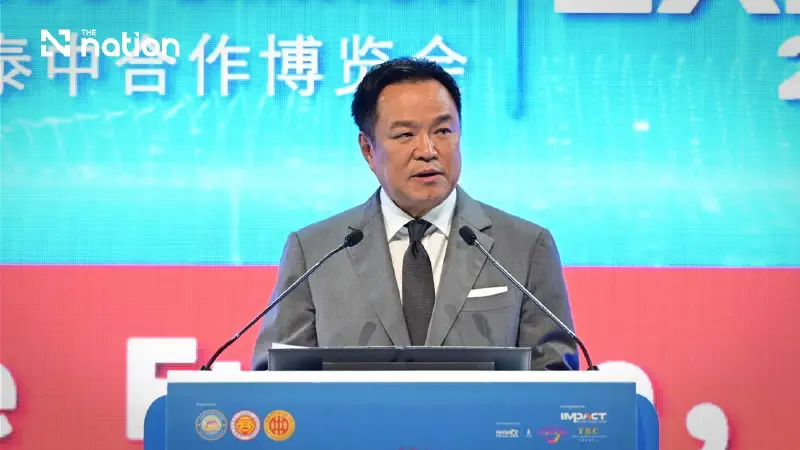


PM tells business leaders Thailand will stake its "own head" on investor safety, as China's chargé d'affaires calls for a friendship as sweet as an old Chinese love song
- Thai Prime Minister Anutin Charnvirakul pledged to streamline bureaucracy for Chinese investors, promising to fast-track approvals and warning officials against causing delays.
- Anutin offered a personal guarantee for the safety of Chinese investors, instructing police and local officials to ensure they are protected from exploitation.
- He defended Thailand's record on technology transfer, arguing it happens organically through sustained collaboration and urging Thai firms to build trust with Chinese partners.
- The Prime Minister emphasized deep historical and cultural ties, framing the closer economic relationship with China as a natural extension of a shared heritage.
The PM tells business leaders Thailand will stake its "own head" on investor safety, as China's chargé d'affaires calls for a friendship as sweet as an old Chinese love song.
Prime Minister Anutin Charnvirakul used the opening of the Thailand-China Cooperation Expo 2026 on Wednesday to deliver an unusually forceful endorsement of Chinese investment, promising bureaucratic shake-ups, personal guarantees of investor security, and warning officials who slow down approvals that they would face consequences.
Speaking at Challenger Hall, IMPACT Muang Thong Thani, where the four-day expo opened its second edition under the theme "Investing for the Future, Growing Together", Anutin told an audience of Thai and Chinese business leaders that closer economic ties with China were not merely desirable but unavoidable for Thailand's future.

"No need for classrooms": PM defends technology transfer record
Addressing academic criticism that Chinese capital flows into Thailand without meaningful technology transfer, Anutin rejected the premise directly. Technology transfer, he argued, does not require formal training programmes or dedicated schools — it happens organically through joint planning, strategy sessions and sustained collaboration between Thai and Chinese firms.
He acknowledged that Chinese equipment and technology would likely dominate in the early stages of any partnership but insisted that sustained cooperation would eventually allow Thai firms to capture greater value.

He urged Thai entrepreneurs to move beyond a "copying" mindset and instead build the trust needed to attract genuine technology transfer, while pushing companies to raise local content and research and development spending.
He cited unnamed Chinese firms that reinvest around a quarter of turnover into R&D as an example that Thai businesses should study and adapt.
Fast-track approvals and a warning to civil servants
Anutin used the platform to publicly warn against bureaucratic obstruction, telling officials that the old culture of civil servants acting as overlords must give way to one of service and facilitation.
He pointed to fast-track mechanisms now available through the Board of Investment (BOI) and the Eastern Economic Corridor (EEC) office, designed to spare investors the need to navigate multiple ministries separately, and said he would not tolerate officials who created unnecessary friction for investors.
He was blunt about the stakes for government itself, telling the audience that without private investment, tax revenue and, by extension, civil servants' salaries would dry up within a year – a dependence he said justified treating the private sector, not the state, as the true engine sustaining public administration.

Security guarantee and deep historical ties
Turning to security, Anutin sought to reassure investors that Thailand faced no meaningful external threat, telling the room he would personally guarantee investor safety and instructing police and local administrative officials to ensure foreign business people were not exploited.
He said Thailand had communicated clearly to neighbouring countries that it sought peaceful coexistence but would respond firmly to any provocation.

He also leaned heavily into cultural affinity, noting that many in the room, himself included, carried Chinese surnames passed down through generations, and argued that a relationship spanning what he described as a millennium made closer cooperation with China a natural extension of shared heritage rather than a purely transactional arrangement.
He recalled a recent official visit to China — his first as prime minister — where he met President Xi Jinping and Premier Li Qiang, attended the World AI Conference, and presided over the opening of a new BOI office in Chengdu, framing the trip as evidence of momentum in both AI cooperation and regional investment ties.

Chinese envoy: "golden fifty years, new chapter"
Wu Zhiwu, China's chargé d'affaires ad interim in Thailand, told the gathering that this year marked the beginning of what he called a "new chapter of a golden fifty years" in China-Thailand relations, describing Thailand as a reliable and dependable strategic partner within China's regional diplomacy.
He set out three expectations for the expo: that it serve as an effective communication platform between government and business; that it deepen industrial cooperation through local procurement, joint research and development, and workforce training, particularly with Thai small and medium enterprises; and that it strengthen people-to-people ties between the two nations.
According to earlier reporting on the visit, Wu also expressed hope that the warmth between the two countries would echo the sentiment of Tian Mi Mi, the classic Chinese love song Anutin performed during a reception in China — a nod to the prime minister's now well-known impromptu rendition and a symbolic wish for a relationship as sweet as the song itself.

Business chamber: building on last year's momentum
Dr Poj Aramwattananont, chairman of the Thai Chamber of Commerce and Board of Trade, speaking on behalf of the joint coordinating mechanism for sustainable Thailand-China business promotion, said this year's expo builds directly on the success of its inaugural edition, held around the 50th anniversary of diplomatic relations.
He said the goal was to elevate economic and social cooperation, strengthen confidence among businesses in both countries, and connect business networks from upstream to downstream.

270 companies, 670 booths, and a robotics showcase
This year's expo has drawn more than 270 Thai and Chinese companies exhibiting across some 670 booths. A newly launched Consultation Zone brings together officials from nine government agencies, including the BOI, the EEC office, the Department of Foreign Trade and the Customs Department, to advise investors on incentives, trade regulations and foreign labour rules.
The event also features a Job Fair offering roughly 3,000 positions from 47 leading Thai-Chinese firms, and an Education Fair with more than 2,000 scholarships from over 20 Chinese universities.
Among the highlights drawing crowds on opening day were a robotics showcase from UBTECH, AGIBOT and DOBOT, featuring humanoid robots, logistics robots and AI-controlled robotic dogs performing walking, dancing and object-handling demonstrations — a display organisers positioned as a glimpse of Thailand's industrial future.
The Thailand-China Cooperation Expo 2026 runs from 22 to 25 July at IMPACT Muang Thong Thani.