
VOYAH Brings Dongfeng's Premium Electric Ambitions to Thailand's Luxury Market
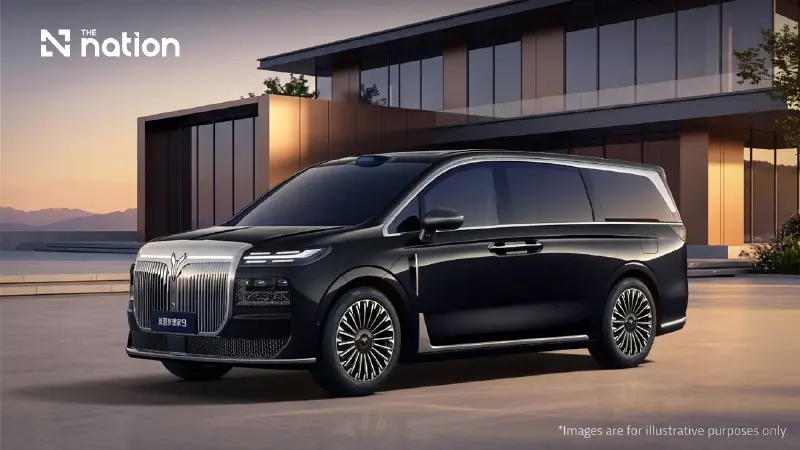


AI Mobility, the AAS Group unit, will launch Dongfeng's premium marque in November, backed by an eight-year battery warranty and a nationwide rollout plan
- Dongfeng's premium electric vehicle brand, VOYAH, is entering Thailand's luxury market through its sole distributor, AI Mobility, a subsidiary of the AAS Group.
- The brand will launch with its flagship model, the VOYAH Dream, a full-size luxury electric MPV, with sales starting on December 1st from two Bangkok showrooms.
- VOYAH aims to compete on luxury and quality rather than price, targeting the high-end MPV segment currently dominated by established Japanese brands.
- The launch is supported by a significant marketing budget, a nationwide showroom expansion plan, and a strong aftersales service commitment, including an eight-year battery warranty.
AI Mobility, the AAS Group unit, will launch Dongfeng's premium marque in November, backed by an eight-year battery warranty and a nationwide rollout plan.
Chinese carmakers have spent the past few years winning Thai buyers with price. VOYAH, the premium electrified brand of state-owned Dongfeng Motor Corporation, is attempting something harder: persuading them to pay for luxury.
At a media briefing recently, AI Mobility Co., Ltd., a subsidiary of AAS Group and the sole distributor of VOYAH in Thailand, set out how the brand will enter the market.
Sales begin on 1 December at two Bangkok showrooms, with the flagship VOYAH Dream, a full-size luxury multi-purpose vehicle (MPV), leading the line-up.
A segment ruled by familiar names
The timing and choice of vehicle are telling. Thailand's MPV and executive transport segment is estimated at 29,000 to 30,000 units a year, and its upper end has long been dominated by established Japanese luxury models, often bought as chauffeur-driven cars or family vehicles.
AI Mobility is targeting a price zone of roughly 2.59 million to 3 million baht, according to briefing materials. Official pricing is due at the brand's formal launch on 20 November, followed by a public showing at the Thailand International Motor Expo.
A bespoke four-seat version is also under evaluation, potentially with interiors finished by Thai craftspeople, although no decision has been announced.
Initial Thai deliveries will focus on the fully electric (BEV) MPV, with a full lineup expected to follow as infrastructure and tax policy settle.
To build awareness ahead of the first deliveries, AI Mobility has committed 50 million to 60 million baht to marketing the brand through the rest of this year.
The spending is planned around four main brand-building activations, with the aim of introducing VOYAH to Thai buyers before the showrooms open and establishing it as a luxury choice rather than a price-led newcomer.
What the Dream brings
At the vehicle's core is ESSA, short for Electric Smart Secure Architecture, a proprietary platform designed to support battery-electric, extended-range and plug-in hybrid powertrains. VOYAH says it allows one engineering base to underpin sedans, SUVs and MPVs. The Dream's 800-volt electrical system allows rapid charging.
The company says up to 450 kilometres of range can be recovered in ten minutes under optimal conditions, a figure that will need testing against Thailand's real-world chargers.
Safety, Silence, Stability, and First-class comfort are the other pillars.
The body structure uses high-strength and ultra-high-strength steel, with multi-layer battery protection. The cabin is reportedly built to withstand a roof load of 12 tonnes, a notable figure for a vehicle weighing about three tonnes.
An active air-suspension system and intelligent damping are intended to reduce vibration and body movement, which matters in a vehicle whose passengers often sit in the rear. There is some evidence of market acceptance elsewhere.

The company reports more than 30,000 pre-orders for the Dream in China within 48 hours of its launch there.
In a November 2025 survey by the Chinese research firm Land Roads, the model scored 78.5 on net promoter score, the highest among new-energy MPVs ranked, ahead of Buick's GL8 plug-in hybrid at 74.2.
Owner satisfaction is not the same as sales success, but it is a useful early indicator.
Behind the badge
VOYAH is a young brand. It was founded in April 2019 and listed on the Hong Kong Stock Exchange in March 2026. It sits within a much older industrial group: Dongfeng, founded in 1969, says it has produced more than 62 million vehicles and sells in over 100 countries.
Investment has risen quickly. VOYAH's research and development spending climbed from about 1.12 billion yuan in 2023 to 3.9 billion yuan in 2025, a cumulative total of roughly 7 billion yuan, or about 35 billion baht.
The 2025 figure represented 11.2 per cent of revenue. VOYAH delivered 150,169 vehicles last year, up 87 per cent. The company operates 579 outlets in 233 cities worldwide, having entered Norway in 2022 before expanding across Europe and the Middle East. Its vehicles have also cleared regulatory hurdles abroad.
VOYAH says models including the Dream have received European Union Whole Vehicle Type Approval, and that its models have earned five-star ratings from China's national new-car assessment programme.
Answering the aftersales question
For Chinese brands in Thailand, the sharpest criticism has rarely concerned the cars. It has concerned what happens after purchase: how quickly parts arrive and whether technicians understand high-voltage systems. AI Mobility has structured much of its plan around that concern.
Parts will be supplied from the AAS Kalapaphruek Service Hub warehouse, while a dedicated AAS Body & Paint Centre will handle collision repair. Lead electric-vehicle technicians are to be trained and certified at Dongfeng's headquarters in Wuhan. Owners will have roadside assistance and a call centre.
The warranty terms are generous by market standards: five years or 150,000 kilometres for the vehicle, and eight years or 200,000 kilometres for the battery. After-sales operations in Bangkok are scheduled to begin on 25 December, three weeks after the first sales.
The distributor's credentials matter here. AAS Group has spent four decades serving luxury car buyers in Thailand, and the partnership is intended to give VOYAH an established customer-care culture that a new entrant could not build quickly alone.
Expansion from Bangkok outwards
The Ekkamai-Ramintra and Bangna showrooms open first, on 1 December. Emsphere follows in the first quarter of 2027, with Vibhavadi and Kalapaphruek in the second.
Regional showrooms are planned in Chiang Mai in the first quarter, and in Khon Kaen, Korat, Chonburi, Phuket and Hat Yai in the second, operated through selected local partners.
Risks and open questions
The path will not be smooth. Thailand's electric-vehicle incentives are being reviewed, and tax changes could alter the economics of imported cars.
For that reason, local assembly options are being studied alongside the import plan. VOYAH's executives have indicated that Thailand is a priority market, but any production commitment remains to be confirmed.
Brand perception is the larger challenge. Buyers in this price range often favour long-established names, and a new entrant must prove itself through reliability, resale values and service rather than specifications.
Competition from other Chinese luxury electric vehicles is also growing.
AI Mobility's stated approach is to prioritise brand standing and customer experience before chasing volume, which suggests a deliberately measured start. Whether Thai buyers accept that proposition will become clear when the first cars reach customers this December.
