
Isuzu seeks urgent tax incentives to support Thailand’s pickup market


Full-year pickup sales are forecast at 140,000 in a 700,000-vehicle market, while the FTI promotes local content under Reinvent Thailand.
- Isuzu is urging the Thai government to introduce urgent tax incentives to support the country's sharply contracting pickup truck market.
- The company argues that the slowdown harms the wider economy because pickups are produced domestically with over 90% local parts content.
- Specific measures proposed include trade-in schemes or a tax deduction plan allowing buyers to claim a portion of the purchase price against their taxes.
- The market's decline is attributed to consumer financial pressures, including high household debt, tight lending conditions, and rising energy prices.
Pickups were long Thailand’s largest vehicle segment, at times accounting for around half the market, before contracting sharply in recent years.
For the latest eight-month period, Tri Petch Isuzu Sales said the overall vehicle market grew by 18%, driven mainly by passenger cars and SUVs, while pickup sales were close to the level recorded in the same period last year.
The full-year vehicle market is forecast at 700,000 units, including 140,000 pickups, a figure similar to last year and representing a market share of just 20%.
Hiroyasu Sato, managing director of Tri Petch Isuzu Sales Co., Ltd., said the contraction in the pickup market had knock-on effects on businesses and the economy because pickups are produced domestically and have the highest local parts content, at more than 90%.
The market’s sharp contraction is partly due to the difficulties consumers face in buying vehicles, including household debt, tight lending conditions and rising energy prices.
Without support, the situation could deteriorate further.
The government has already introduced support measures, including those channelled through the Thai Credit Guarantee Corporation (TCG).
These were seen as positive steps for which the government deserved thanks.

However, further measures were now considered necessary, such as trade-in schemes or an approach similar to Chim Shop Chai, including allowing pickup buyers to claim tax deductions.
“Urgent measures are needed to give people a real, practical opportunity to buy vehicles. These could follow a concept similar to Chim Shop Chai, for example by allowing spending on a pickup, say THB0.1 million, to be claimed as a tax deduction. This would directly support people who need a pickup and are within the tax system.”
Sato said Isuzu sold 52,800 vehicles over the past nine months, down 1.3%. Full-year sales across pickups, PPVs and trucks are forecast at 70,400 units, down 4%.
Despite major changes in the market and the impact of other vehicle categories, including EVs, core customers such as farmers, traders and factory workers still need pickups.
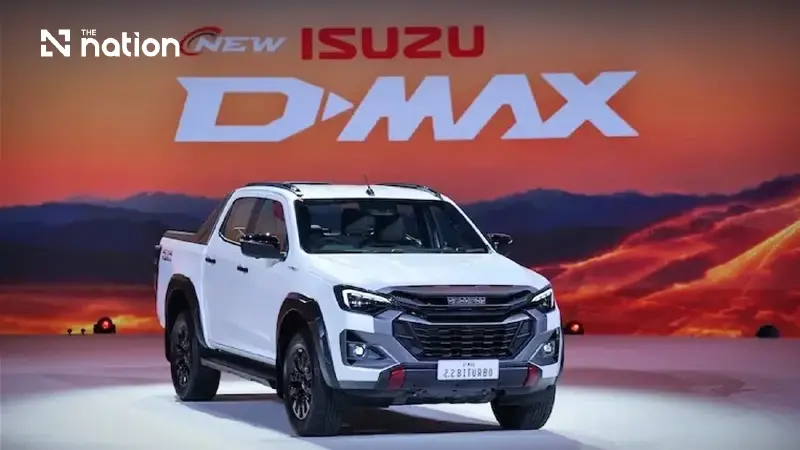
Isuzu has recently moved to attract customers by introducing the new 2.2 Ddi MAXFORCE Biturbo engine in selected pickup and PPV models.
The single-turbo 2.2-litre engine remains available, as does the 3.0-litre unit.
However, the range of 3.0-litre variants has been reduced to those intended for uses requiring pulling power, such as:
- V-Cross Z two-door
- Spacecab S
- Spark 4x4 S
- Spark 4x2 S
- Spark 4x2
A new Cab-Chassis variant with a 3.0-litre engine has also been added to target the commercial vehicle market.
The new engine adds a high-pressure turbocharger to work alongside the variable-geometry turbocharger (VGS).
The number of injector holes has increased from eight to 10, while the cooling and lubrication systems have been modified to accommodate the engine’s higher performance.
The new unit will be the most powerful engine Isuzu has ever produced for this market, delivering maximum power of 204 horsepower and peak torque of 500 newton metres.

The Federation of Thai Industries (FTI) held a meeting with the automotive industry group, led by FTI chair Pimjai Leeissaranukul, vice-chairman Suwat Supakarndechakul and Suphot Sukphisarn, secretary of the FTI’s Promotion and Support for Industry Division.
Representatives of more than 10 leading car and motorcycle manufacturers also attended, including Toyota, Mitsubishi, Isuzu, Nissan, Mazda, Hino, Honda, Mercedes-Benz, BMW, BYD, Changan, GWM, Hyundai and Yamaha.
The meeting aimed to build a shared understanding and exchange views on investment direction and promoting local content, while supporting the new excise tax.
The automotive industry is one of seven future economic sectors that will drive Reinvent Thailand, with the aim of strengthening capabilities, attracting new investment and helping Thai small and medium-sized enterprises (SMEs) grow alongside the industry.
Pimjai said the priority was to turn Local Content Contribution into practical results, creating opportunities for Thai SMEs, increasing value generated within the domestic economy and maintaining the long-term competitiveness of Thailand’s automotive industry.
The FTI is ready to work with the private sector and relevant government agencies to advance policy proposals and develop a transparent, verifiable and workable framework for certifying local content.
This would go hand in hand with improving regulations and reducing obstacles to doing business to encourage investment and upgrade Thailand’s automotive industry for strong, sustainable growth under the Reinvent Thailand strategy.
The automotive and parts sector currently accounts for around 10% of Thailand’s GDP.
Growth in the sector will help create opportunities and support the expansion of businesses across the supply chain.
The FTI will submit the plans arising from the meeting to Ekniti Nitithanprapas, deputy prime minister and finance minister, for consideration.
The plans will then be submitted to the Joint Public and Private Sector Committee for Economic Problem Solving (JPPCC).
Source: Bangkokbiznews, posttoday
