
Pool Capital, Govern at Arm's Length: How Pensions Can Power Growth
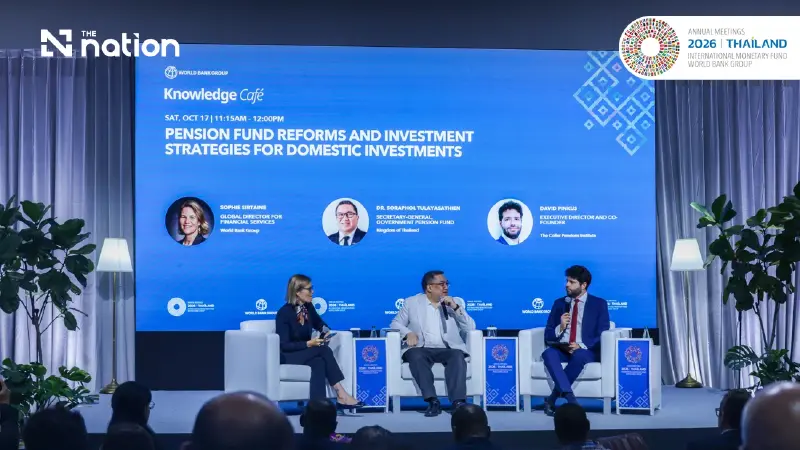


Panellists in Bangkok urged larger, independently run funds, shared investment platforms and incentives designed for women and informal workers
- To effectively finance domestic growth, pension funds should build scale by creating larger funds or by having smaller funds pool their capital through shared investment platforms.
- Funds must be governed independently and at arm's length, with the primary focus on securing financial returns for retirees; broader economic development should be a secondary benefit, not the main goal.
- Expanding the capital pool for investment requires designing pension systems with targeted incentives to include underrepresented groups, particularly women and informal workers.
Panellists in Bangkok urged larger, independently run funds, shared investment platforms and incentives designed for women and informal workers.
Pension funds can help finance domestic growth if they are large enough, independently governed and clear that retirees come first. That was the common ground between two panellists at the IMF-World Bank Annual Meetings in Bangkok on Saturday (October 17), who also called for shared investment platforms, stronger technical support and incentives aimed at women and informal workers.
The session, "Knowledge Café: Pension Fund Reforms and Investment Strategies for Domestic Investments", was hosted by the World Bank's Financial Services Sector and moderated by Sophie Sirtaine, the Bank's global director for financial services.
The speakers were Dr Soraphol Tulayasathien, secretary-general of Thailand's Government Pension Fund (GPF), and David Pinkus, executive director and co-founder of the Coller Pensions Institute.

Four recommendations Across the hour, the panellists converged on a handful of practical steps:
Build scale. Larger funds, Pinkus said, earn better returns, diversify more widely and are likelier to build in-house teams for assets such as infrastructure. Dr Soraphol agreed: "Size matters."
Ring-fence governance. Boards and investment processes should operate at arm's length, with savers' interests at the centre. Pinkus said wider economic benefits should be seen as "positive side effects", not a substitute for public investment.
Share the load. Smaller funds can pool resources through co-investment platforms, guarantees and technical advisory hubs. Dr Soraphol said regional and global funds increasingly collaborate, mainly by exchanging expertise, while investing deal by deal.
Design for those left out. Tax incentives rarely work for informal workers, Pinkus said, and targeted incentives can narrow the gender gap.
A fund born of crisis
Dr Soraphol said the GPF was founded 29 years ago, in the wake of the 1997 Asian financial crisis. It serves about 1.3 million civil servants and manages roughly $45 billion, split broadly evenly between domestic and global assets.
It is a defined contribution fund that complements the civil service's long-standing defined benefit arrangements, and civil servants hired after 1997 must join.
The fund invests in real-economy assets such as infrastructure through real estate investment trusts and direct holdings.
After a tsunami hit southern Thailand, he said, the GPF bought a hotel in Phuket while tourism struggled. The investment later returned many times its cost to members.
"Our investment needs to have a return for the pensioners," he said, stressing that this remained the main priority.

Why governance and capacity matter
Dr Soraphol said the GPF's board includes officials from the finance ministry, the Bank of Thailand and the securities regulator, alongside representatives of its 14 member groups, among them teachers, police and military personnel.
An investment committee of industry experts and a strategic asset allocation framework set how much risk the fund can take. As Thailand's second-largest pension fund, he said, it sits in a "sweet spot": small by global standards but big enough to run a small internal team for alternative assets.
Pinkus said the tension between development goals and savers' interests is not confined to emerging markets, noting similar debates in Britain and the European Union.
Capacity, he added, is often the first obstacle funds cite, because many lack the assets or staff to explore domestic markets. Loosening investment limits alone does not always change allocations.
Examples of support include European Investment Bank hubs for infrastructure projects and Colombia's FDN.
Longevity and active ownership
Looking ahead, Dr Soraphol said he was exploring "longevity" as an investment theme, citing healthcare, hospitality, wellness, wealth management and post-retirement services. He added that investors should do more than allocate money.
The GPF visits companies it owns and presses them on climate, human rights due diligence and governance, sometimes alongside other investors or through mandates given to external managers.
Diversification and risk Responding to a board member of Thailand's National Savings Fund, who asked how to justify investing abroad when returns at home are limited, Dr Soraphol said every asset must earn its place in a portfolio, whether for return or diversification.
About a third of the GPF's assets form a reserve fund managed for the finance ministry, which the law currently requires to be invested domestically. Because domestic assets suffered badly in 1997, the fund is seeking to amend the law to allow global diversification, "not for the return but for the diversification when it rains".
Asked whether the 50-50 domestic-global split should change, he said bonds and equities now tend to move together, reducing the hedging benefit, so allocations must be rethought as conditions shift.

Women and the informal economy
Coverage drew the most pressing questions. Victoria Johnson of Women's World Banking said only about 35% of adults globally contribute to pensions, falling to 17.5% in lower-middle-income countries and 5% in low-income ones, with gender pension gaps of 30% to 40%.
Pinkus said the gap largely mirrors labour market inequalities: the gender pay gap, more part-time work and time out of employment for caring. As populations age and families shrink, he warned, women risk bearing a double care burden for children and elderly relatives.
Remedies exist, he said. Most European Union countries subsidise social security contributions while women are away from work caring for children. In Malaysia, a scheme for women from low-income households offers higher financial incentives to save for retirement.
Taking a gender lens to pension policy, he said, is "extremely important". On informal workers, he said evidence is thin. A review by his institute of programmes in 11 countries, including Thailand and Malaysia, found that schemes relying on tax incentives rarely work for them.
Designs must reflect informal workers' circumstances rather than copy formal-sector models. Only about 7% of workers in low-income countries contribute, he noted. Raising that to 20% would boost assets substantially, as 1.2 billion people reach working age in developing countries over the next 10 to 15 years.
Asked by an Indian participant about pensions for micro, small and medium-sized enterprises (MSMEs), where many women work, Pinkus said funds usually invest through dedicated vehicles, including venture capital and government-backed funds in Denmark, because single deals are often too small.
In Chile, he said, firms with more domestic pension fund ownership have obtained better bond market terms.
Asked for a final message, both stressed that solutions are country-specific. Dr Soraphol said he learns most from sharing ideas. Mr Pinkus said savers' interests must be the guiding principle and that, with populations ageing, now is the time to build pension systems and put their capital to work.
