
Krungthai and SET Build Carbon Credit Market as Grab, Thai Airways Eye Purchases
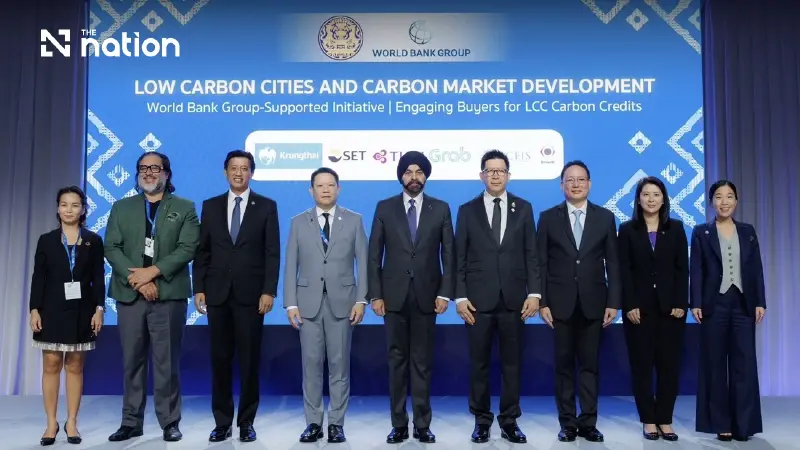


Krungthai will aggregate credits, SET will run auctions and four companies have signalled interest in buying, under the World Bank-backed LCC project
- Krungthai Bank will aggregate carbon credits while the Stock Exchange of Thailand (SET) will develop and run a transparent auction platform for their sale.
- The partnership is part of the World Bank-supported Low Carbon Cities and Carbon Market Development Project (LCC) to expand low-carbon investment in Thailand.
- Grab, Thai Airways, ACEIS Electric and Power Co., and DriverAI have all expressed interest in becoming buyers of the carbon credits.
- Thai Airways intends to explore using the credits to offset international flight emissions, while Grab sees it as part of its broader Green Programme.
Krungthai will aggregate credits, SET will run auctions, and four companies have signalled interest in buying under the World Bank-backed LCC project.
Krungthai Bank has joined The Stock Exchange of Thailand (SET) and private-sector partners to advance a carbon credit market under the World Bank-supported Low Carbon Cities and Carbon Market Development Project (LCC).
The move follows the I-SPARK industrial decarbonisation initiative that Krungthai announced with PTT and the Department of Climate Change and Environment (DCCE), and which may later connect to the LCC.
The partnership was announced during the session "Low Carbon Cities and Energy Security – Building Systems at Scale, Mobilising Private Capital, Creating Jobs" at the 2026 IMF–World Bank Group Annual Meetings.
It aims to link financial expertise, market infrastructure and private-sector demand to expand low-carbon investment across Thailand.
Who does what
Krungthai will support the aggregation of eligible carbon credits and connect them with prospective buyers. SET will develop a transparent auction and price-discovery mechanism to facilitate transactions and strengthen business confidence in the market.
Grab, ACEIS Electric and Power Co., Ltd., DriverAI and Thai Airways have expressed interest in becoming buyers of carbon credits in future, which would strengthen demand and create incentives for further investment.
The partners stressed that credits will be subject to the applicable validation and verification processes and must be issued under the relevant standards before any sale. Any future transactions will follow the applicable agreements and requirements of the parties involved.
Turning emissions cuts into income
Payong Srivanich, Chief Executive Officer of Krungthai, said the market offers a chance to turn emissions reductions into new sources of income and investment.
"A key success factor is connecting high-quality projects with genuine buyer demand through transparent market mechanisms," he said.
That lets developers realise economic value from their environmental efforts and encourages continued investment in clean energy. Krungthai is working with the DCCE, SET and private-sector partners to connect projects, data and market mechanisms.
With leading companies expressing interest as prospective buyers, it is also developing a national digital data platform to reduce transaction costs and improve market access for smaller projects.
"We aim to scale from individual projects to a carbon credit market that serves businesses nationwide and connects with international markets," Payong said.
He said this would be supported by the World Bank Group's implementation framework and credibility standards. The goal, he added, is for the market to channel private capital into the low-carbon economy while creating new growth opportunities.
Auctions and the climate law
Asadej Kongsiri, President of SET, said the collaboration brings together financial institutions, the private sector and the exchange to build capital market infrastructure. It would connect investment in greenhouse gas reduction with private-sector demand for credits.
SET stands ready to support the transition through its carbon credit auction platform, he said, which is "an important first step towards a voluntary carbon credit ecosystem".
The trading mechanism, he said, would be transparent, credible and open to domestic and international buyers. The first round of auctions is expected by the second quarter of 2027.
Asadej said the platform will also serve as a foundation for a future mandatory emissions trading platform under the draft Climate Change Act.
It is in line with SET's three-year strategic plan for 2026–2028, which aims to support carbon credit trading infrastructure and prepare all sectors before the law takes effect. He said this reaffirms SET's vision, "The Trusted Gateway to Inclusive Opportunities".
Buyers' perspectives
Chantsuda Thananitayaudom, Managing Director of Grab, said the company's Green Programme lets users fund carbon credit projects across Thailand and Southeast Asia through small, voluntary contributions on every ride or order.
Cutting emissions across its value chain remains the priority, she said. Grab nonetheless recognises the importance of a credible carbon market and intends to explore buying eligible credits generated under the LCC Project.
Cherdchome Therdsteerasukdi, Chief of Finance and Accounting at Thai Airways, said the airline is participating to support Thailand's transition to a low-carbon economy. It is also committed to exploring ways for credits from the project to qualify as CORSIA Eligible Emissions Units (CEEUs) under the International Civil Aviation Organization (ICAO).
That would allow them to be used in future to offset emissions from international flights.
About the LCC Project
The LCC Project is supported by a US$200 million loan from the World Bank's International Bank for Reconstruction and Development (IBRD). The loan is channelled through EXIM Bank and backed by a sovereign guarantee from the Thai government.
It aims to scale up renewable energy and energy-efficiency investment in public assets nationwide. Krungthai serves as the Coordinating and Managing Entity (CME). It supports small-project aggregation and carbon credit development and uses a digital Measurement, Reporting and Verification (dMRV) system to strengthen data integrity.
The LCC Program of Activities is already registered with Gold Standard. The project seeks to link carbon credit revenues with clean energy investment, encouraging greater private-sector participation and the growth of low-carbon cities.
A carbon market works only if businesses of every size can take part. In the third announcement of the series, Krungthai and the DCCE turned to how smaller firms can make the low-carbon shift.
