
Thai Solar Firm Urges State to Cut Six-Month Grid Permitting Delays
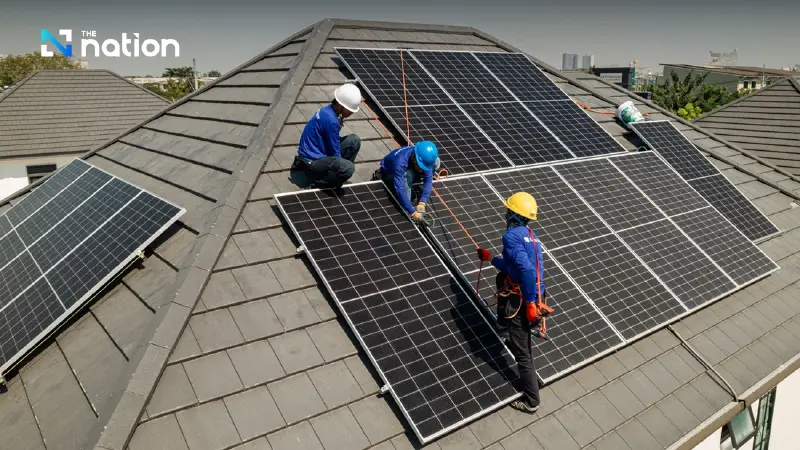


ION Energy calls for seven-day utility approvals, clearer incentives, and battery storage support to unlock Thailand’s one-million-rooftop solar goal
- A Thai solar company, ION Energy, is urging the government to reduce grid-connection permitting delays that can last up to six months, despite installations taking only two to three days.
- The firm is calling for a streamlined process to achieve a seven-day approval target, arguing the current bottlenecks create financial strain on installers and hinder Thailand's rooftop solar goals.
- These long delays tie up installers' working capital in equipment costs and security deposits, while also creating unfair competition from contractors who bypass the official permitting process.
- In addition to faster permits, the company also recommends clearer incentive rules, higher buyback rates for surplus solar power, and policy support for battery storage systems to accelerate adoption.
ION Energy calls for seven-day utility approvals, clearer incentives, and battery storage support to unlock Thailand’s one-million-rooftop solar goal.
Thailand’s push to install solar rooftops across one million households risks being slowed by utility permitting bottlenecks that take up to six months to clear, even though physical installation takes just two to three days, according to residential solar provider ION Energy Corporation.
Speaking on the outlook for Thailand’s residential clean energy market, ION Energy Chief Executive Officer Peerakan Manakit said rising electricity bills and environmental awareness have driven strong household demand under the government’s “People’s Solar” programme.

However, complex, document-heavy grid-connection approvals with state electricity authorities remain the sector’s primary operational obstacle.
“Installing solar panels at a customer’s home takes only two days, or three days at most, yet the permitting process sometimes requires waiting up to six months,” Peerakan said. “Even after the contractor has paid for equipment and completed the installation, we are left waiting for paperwork from agencies outside our control.”

Working-Capital Strain and Unfair Competition
The permitting backlog places direct financial pressure on compliant installers, particularly small and medium-sized enterprises (SMEs). Under the government’s residential solar support scheme, contractors must lodge a 50,000-baht security deposit per installation, which is refunded only once grid-connection approvals are finalised.
Carrying equipment and deposit costs for months while awaiting sign-off ties up working capital and squeezes liquidity for smaller firms competing against larger conglomerates.
At the same time, Peerakan noted that burdensome procedures have prompted some contractors to bypass permitting altogether. That creates price distortion in the market, leaving compliant operators that factor full regulatory and safety compliance into their pricing at a competitive disadvantage.
While acknowledging that utility inspections and permits are essential to protect technicians maintaining local power lines, ION Energy urged authorities to expand staffing and streamline workflows to deliver on the government’s stated target of completing grid-connection approvals within seven days.

Three Policy Proposals to Accelerate Adoption
Alongside faster permitting, Peerakan outlined three policy adjustments aimed at strengthening investor and household confidence:
Clearer Incentive Rules: Government agencies should communicate eligibility criteria consistently from the outset. Peerakan pointed to initial confusion surrounding the 200,000-baht personal income tax deduction and the separate 50,000-baht cash subsidy, which caused prospective buyers to delay purchases before officials clarified that the two incentives cannot be combined.
Higher Feed-in Tariff (FiT) Rates: The current buyback rate for surplus residential solar power stands at 2.20 baht per unit, compared with retail electricity tariffs of roughly 4 baht per unit. At existing buyback rates, households installing solar primarily to export power face a payback period of nearly a decade. Raising the FiT rate would improve project economics and speed up household investment.
Support for Battery Energy Storage Systems (BESS): Policy incentives should be extended to household battery storage to prepare for rapid market expansion over the next one to two years.

Shift Toward Solar-Plus-Storage Reaches 40 Per Cent
Market demand is already evolving beyond daytime bill reduction toward integrated solar-and-battery systems capable of supplying power at night, supported by falling battery prices.
At ION Energy, the proportion of customers pairing rooftop panels with battery storage rose from 1–2 per cent in 2025 to nearly 40 per cent in 2026.
Peerakan noted that solar-plus-storage is best suited for households with monthly electricity bills of 5,000 to 10,000 baht or higher, where investment budgets average around 350,000 baht—roughly 200,000 baht for solar panels and 150,000 baht for battery storage.
Homes occupied during the day can maximise direct solar self-consumption without batteries, whereas households empty during working hours require storage to achieve viable returns, often opting to install solar panels first and add batteries later.

Looking ahead, emerging stationary storage chemistries such as sodium-ion or saltwater batteries could further lower costs for residential and industrial applications. D
Despite permitting headwinds, ION Energy projects 2026 revenue to grow 25 per cent year-on-year to approximately 250 million baht, up from 200 million baht in 2025. Backed by the People’s Solar initiative, the company aims to reach 600 million baht in revenue in 2027 and plans to expand its workforce from 70 to 100 staff, adding capacity across installation and after-sales service teams.
