
Middle East war scenarios send Thailand GDP outlook tumbling
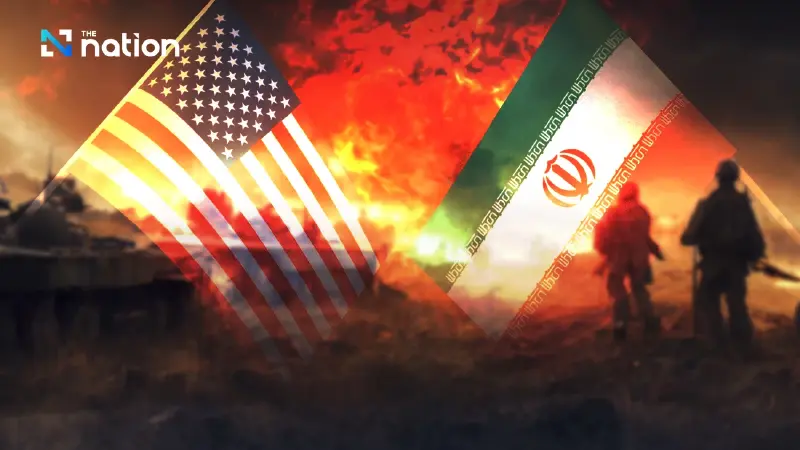


NESDC warns the Middle East war could slash Thailand’s 2026 GDP to 0.2%, fuel inflation and raise the risk of stagflation if the conflict drags on
Thailand’s economic outlook is facing mounting uncertainty as the ongoing conflict in the Middle East continues to weigh on global energy markets, prompting authorities to reassess growth projections and warn of rising stagflation risks.
The conflict, which began on February 28, 2026, has yet to reach a resolution despite attempts at ceasefire negotiations and efforts to reopen shipping routes through the Strait of Hormuz. The prolonged disruption has already begun to erode confidence in global energy markets and forced multiple agencies to revise their economic forecasts downward.
Danucha Pichayanan, Secretary-General of the National Economic and Social Development Council (NESDC), said the closure of key shipping routes and escalating tensions have become a major factor affecting global energy stability. While Iran has signalled a willingness to negotiate including calls for foreign military withdrawal from the region, there remains no clear indication of a breakthrough with the United States or Israel.
Oil markets have remained highly volatile, with prices swinging sharply in response to shifting developments. While occasional signs of de-escalation have triggered short-term price drops, authorities warn that without a lasting resolution, the broader economic impact will continue to unfold.
Four scenarios reshape Thailand’s 2026 outlook
The NESDC has outlined four possible scenarios to reassess Thailand’s economic trajectory in 2026. Prior to the conflict, the economy was expected to grow by around 2%, with oil prices averaging US$58–68 per barrel and inflation at 0.2%.
Scenario 1: Short conflict, contained impact (ends within two months)
If fighting spreads across parts of the region but concludes within two months, disruptions to oil transport through the Strait of Hormuz and the Red Sea would remain temporary, with no further damage to energy infrastructure.
Under this scenario, oil supply would gradually return, with prices averaging US$85–95 per barrel for the year. Financial markets would remain volatile, with investors shifting towards safer assets and the baht weakening. Thailand’s GDP growth would slow to 1.4%, with inflation rising to 2.7%.
Scenario 2: Escalation across the region (3–5 months)
If the conflict expands across multiple countries and lasts three to five months, oil production infrastructure could be damaged, leading to prolonged supply disruptions. Average oil prices would rise to US$105–115 per barrel.
This would significantly tighten global energy supply, drive up inflation, and disrupt industrial supply chains. Many economies, including Thailand, could enter a stagflationary phase marked by slowing growth and rising prices. Thailand’s GDP would fall to 0.9%, with inflation climbing to 4.4%.
Scenario 3: Prolonged war and global downturn (6–9 months)
A prolonged conflict lasting six to nine months, potentially extending to November 2026, would likely trigger a full-scale confrontation involving Iran and its allies against the US and Israel.
Energy supply from the Middle East would struggle to recover even after the conflict ends, pushing oil prices to US$135–145 per barrel. The global economy could slide into a severe downturn, with widespread supply chain disruptions, trade fragmentation and shortages of both energy and food.
In this case, Thailand’s economy would slow sharply, with GDP growth dropping to just 0.2% and inflation surging to 5.8%.
Scenario 4: Full-scale global conflict
The most severe scenario involves a broader war drawing in major powers such as Europe, China and Russia. This would lead to prolonged global recession, widespread shortages, and the risk of conflict spilling into other regions.
Under such conditions, authorities say it would be impossible to reliably forecast oil prices, inflation or economic growth.
Rising risk of stagflation
Danucha warned that the impact of the conflict extends beyond oil prices, feeding into higher costs for consumer goods and eroding purchasing power. As demand weakens while inflation rises, the risk of stagflation becomes increasingly pronounced.
Supply chain disruptions are also expected to intensify, particularly shortages of key raw materials such as plastic pellets, which could further strain production and industrial activity in the months ahead.
Policy focus shifts to cost-of-living support
In response, policymakers are urging a shift away from broad economic stimulus towards targeted cost-of-living relief measures. Danucha said traditional stimulus policies may be less effective under current conditions, and support should instead focus on sustaining household demand during the downturn.
He also stressed the importance of clear government communication to help the public prepare for prolonged economic pressure, noting that the conflict’s effects are likely to ripple across multiple sectors throughout the year.
Finance Ministry acknowledges risks
Lavaron Sangsnit, Permanent Secretary of the Finance Ministry, said the Fiscal Policy Office shares the NESDC’s assessment that Thailand faces a real risk of stagflation — where inflation rises even as economic growth slows.
However, he noted that Thailand’s relatively low inflation base in recent years provides some buffer compared to countries already facing high inflation.
Authorities are closely monitoring developments in the Middle East, particularly tensions between Iran and the United States, as any easing could quickly relieve pressure on global oil prices.
The Finance Ministry is preparing to submit targeted fiscal measures to the Cabinet on April 11, 2026, including seven support schemes aimed at assisting those most affected by the energy crisis. These measures will include clearer timelines for implementation and compensation payments.
Additional support for vulnerable groups, particularly state welfare card holders, is also under consideration, with the possibility of increased assistance depending on available budget resources.
Economists and industry warn of slowdown signals
Thanavath Phonvichai, President of the University of the Thai Chamber of Commerce, said earlier projections had assumed GDP growth of around 2%, but the outlook now depends heavily on how long the conflict persists.
He estimates that if the war lasts one month, growth could reach 1.6%, while a duration of one to three months would see growth fall to between 1.0% and 1.5%. If the conflict drags on for more than six months, the economy could stagnate or even contract.
Meanwhile, Kriengkrai Thiennukul, Chairman of the Federation of Thai Industries, said the Joint Standing Committee on Commerce, Industry and Banking (JSCCIB) has already revised GDP forecasts down to 1.2–1.6%.
He also highlighted a sharp drop in diesel consumption, from around 80 million litres per day to just 40–50 million litres since April 5, as a worrying indicator. While it may reflect cost-saving behaviour, it could also signal a significant slowdown in transport and logistics activity, a key driver of economic momentum.
Although Thailand has not yet entered stagflation, Kriengkrai warned that without effective management, prolonged instability could push the economy into that territory.
