
Anutin vows reforms to restore foreign investor confidence
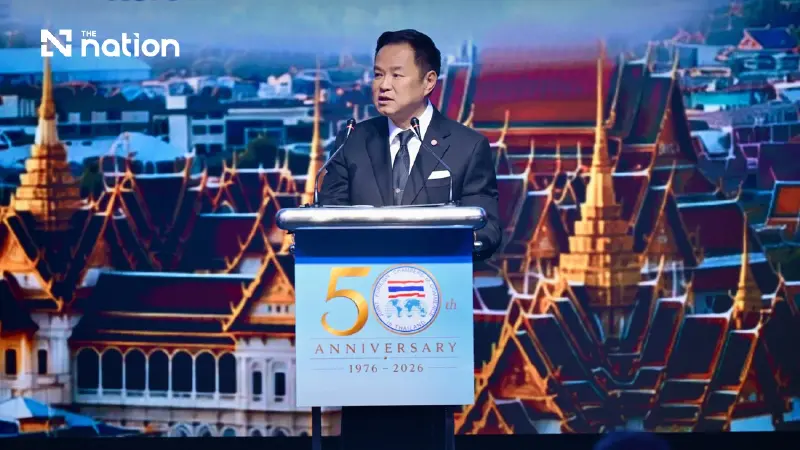


Anutin tells JFCCT 2026 that Thailand will use regulatory reform, future industries and OECD ambitions to restore investor confidence
Prime Minister Anutin Charnvirakul has sought to reassure foreign investors that Thailand is ready to compete on reliability, reform and resilience, telling a major business forum that the country aims to become a trusted long-term investment base in a world increasingly shaped by uncertainty.

Anutin delivered the message on Friday at the JFCCT Prime Minister’s Address Luncheon 2026, held at Crystal Hall Ballroom at The Athenee Hotel, Bangkok. The event, organised by the Joint Foreign Chambers of Commerce in Thailand, brought together Cabinet members, foreign chamber leaders, business representatives and ambassadors from JFCCT member countries, with around 400 participants in attendance.
The programme gave the business community and investors an opportunity to hear the government’s policy direction first-hand, under a theme focused on Thailand’s competitiveness, investment and future-ready economy. Before taking the stage, Anutin met informally with foreign chamber presidents, event sponsors and representatives from overseas chambers, before joining a group photograph. JFCCT president Vibeke Lyssand Leirvag then delivered the welcome remarks.

In his keynote address, Anutin congratulated JFCCT on its 50th anniversary and praised the organisation’s role in connecting Thailand with the international business community. He described those in the room as important partners and close friends of Thailand who had helped drive the country’s economic development over the past five decades.
The prime minister said that in recent months, one word had repeatedly surfaced in his meetings with global business leaders: uncertainty. He pointed to supply-chain restructuring, technological disruption and geopolitical tensions as forces now shaping investment decisions, while countries around the world compete more fiercely for capital, talent and innovation.
For today’s investors, Anutin said, cost alone is no longer the deciding factor. They are looking for confidence, predictability and strong partners able to adapt to rapid global change. Thailand, he said, intends to be one of those destinations, a country that is trusted, stable and resilient enough to support long-term investment.
He set out the government’s economic direction through four broad priorities, beginning with efforts to make Thailand more business-ready. These include improving ease of doing business, modernising regulations, expanding digital public services, reducing investment procedures and integrating work across state agencies to give the private sector greater speed, transparency and certainty.
Anutin highlighted Thailand FastPass as one mechanism designed to speed up investment approvals and licensing processes involving multiple agencies. He said 25 investment projects worth more than 223 billion baht had already benefited from the measure. The government is also moving ahead with legal and regulatory updates, including improvements to the Foreign Business Act, to reduce unnecessary restrictions, remove duplication and create a more investment-friendly environment.
The second priority focuses on future industries. Anutin said the government wants to strengthen Thailand’s economic ecosystem in high-potential sectors such as advanced electronics, semiconductors, artificial intelligence, digital services, automation, robotics, clean energy, electric vehicles and bio-based industries. The aim is to position Thailand as a regional hub for the industries that will shape ASEAN’s next phase of growth.
That push builds on earlier efforts to attract high-value investment under the government’s broader future-industry agenda, including EVs, semiconductors, clean energy, digital technology and AI. Thailand FastPass has also been presented as part of the state’s toolkit for accelerating approvals and supporting large-scale investment.
Human capital formed the third pillar of the prime minister’s message. Anutin said technology, including AI, would deliver its greatest value only when matched with people who have the right skills and the ability to adapt. The government is therefore accelerating cooperation between state agencies, educational institutions and the private sector to develop workers whose skills match the needs of future industries.
The fourth priority is Thailand’s connection to the global economy. Anutin said ASEAN remains one of the world’s most dynamic growth regions, with a population of more than 700 million and a steadily expanding middle class. Thailand’s location at the heart of the region, he said, gives the country a strategic advantage in linking trade, investment and supply chains at both regional and global levels.
The government will continue pushing high-standard trade agreements and deeper international economic partnerships, including Thai-EU free trade negotiations, while also promoting Thailand as an ASEAN logistics hub. Anutin said these efforts would expand economic opportunities, sharpen the country’s competitiveness and strengthen Thailand’s role as a trusted investment gateway connecting ASEAN with major economic regions around the world.
In the closing section of his speech, Anutin said Thailand could not remove all uncertainty from the global environment, but it could build confidence through effective administration, structural reform and close cooperation with the business sector. He linked this approach to Thailand’s ambition to join the Organisation for Economic Co-operation and Development, saying OECD accession would help raise the country’s governance, competitiveness and international standards.
That emphasis has been building in recent weeks. The Cabinet has established a national committee chaired by Anutin to steer Thailand’s OECD accession process, with the government targeting membership by 2028. Public and private-sector discussions have also placed legal certainty, regulatory reform and the rule of law at the centre of the country’s competitiveness agenda.
Anutin said Thailand’s future vision would depend on cooperation between the public sector, business community and society as a whole. Over the past two decades, he said, the country had faced many internal and external challenges, but those experiences had made Thailand stronger, more experienced and better prepared for the future.
After the address, the prime minister joined Cabinet members, foreign chamber representatives, event sponsors and ambassadors for a photograph on stage, before attending the luncheon and exchanging views with international business representatives. The meeting was intended to strengthen economic cooperation and support a more positive investment climate in Thailand.
